
Landscaping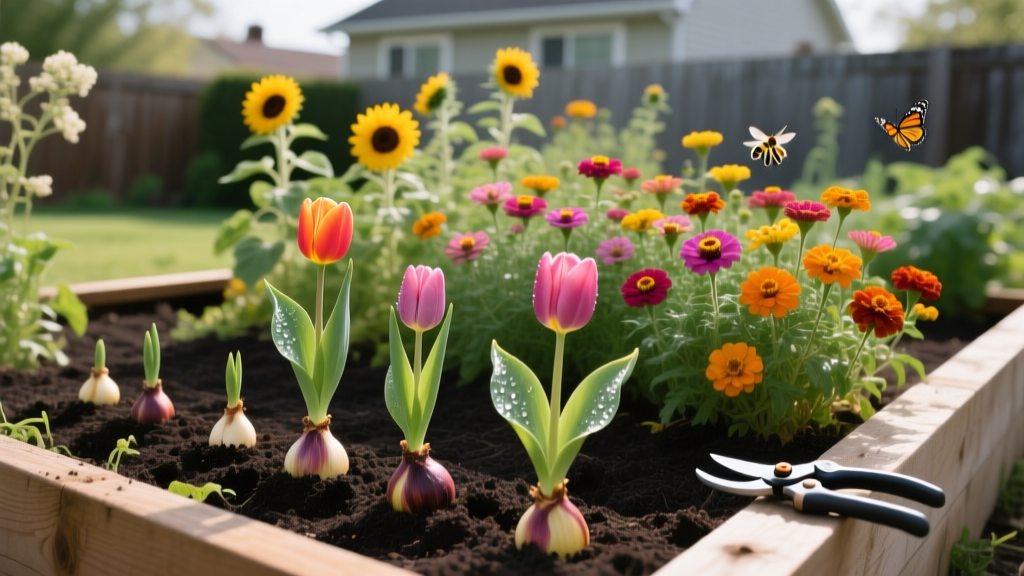
2026 Raised Bed Flower Rotation: Spring Bulbs To Summer Annuals
Sarah ChenPublished
The 2026 Approach to Raised Bed Ecosystems
In 2026, the most successful raised bed vegetable gardens are no longer monocultures of isolated crops. Modern regenerative gardening practices emphasize the integration of ornamental and edible plants to create resilient, high-yielding micro-ecosystems. One of the most effective strategies for maximizing space, boosting pollinator activity, and naturally deterring pests is the seasonal rotation of spring bulbs into summer annuals directly within and around your raised vegetable beds. This technique ensures that your garden remains visually stunning while providing critical ecological services to your vegetables from early spring through the first frost.
Raised beds offer distinct advantages for this rotation strategy. The superior drainage of a raised bed prevents spring bulbs from rotting in erratic early-season rains, while the loose, amended soil allows summer annual roots to establish quickly alongside warm-season vegetables. By mastering this transition, you can transform a standard vegetable plot into a continuous corridor of color and ecological benefits.
Why Integrate Flowers into Vegetable Raised Beds?
Integrating flowers into your vegetable beds is a cornerstone of companion planting. According to guidance from the Royal Horticultural Society, strategic floral pairings can confuse pests, attract predatory insects, and improve soil health. When you rotate from spring bulbs to summer annuals, you are effectively providing a continuous food source for beneficial insects. Early spring pollinators emerge when few resources are available, and your spring bulbs provide a critical lifeline. As summer arrives and your tomatoes, squash, and peppers require intense pollination, the transition to summer annuals ensures that native bee populations remain anchored to your garden.
Furthermore, this rotation maximizes the spatial efficiency of your raised beds. The perimeter and interstitial spaces of a 4x8 or 4x4 raised bed are often underutilized. By occupying these margins with rotating florals, you suppress weed growth, retain soil moisture, and create a physical barrier against crawling pests.
Phase 1: Spring Bulbs and Cool-Season Vegetables
The first phase of this rotation begins in the fall prior to the 2026 growing season, but its management peaks in early spring. As soon as the soil in your raised beds thaws and becomes workable, you will be planting cool-season vegetables like peas, radishes, spinach, and brassicas. At this time, your fall-planted spring bulbs are pushing through the soil.
Top Spring Bulb Picks for Raised Beds
- Allium 'Purple Sensation': Alliums are the ultimate companion for early brassicas. Their strong onion-like scent masks the aroma of cabbage and broccoli, deterring cabbage loopers and aphids. They require minimal footprint and grow vertically, avoiding shade competition with low-growing spring greens.
- Narcissus 'Tete-a-Tete': These dwarf daffodils are perfect for the corners of raised beds. They are deer and rodent resistant, protecting the vulnerable edges of your garden, and they bloom early enough to support the first emerging solitary bees.
- Tulipa 'Apeldoorn': Darwin hybrid tulips offer robust stems and vibrant colors that attract early-season pollinators. Plant them along the north-facing edge of your raised bed so they do not cast shadows on your sun-loving spring crops.
Planting and Spacing Rules: When interplanting bulbs with early spring veggies, maintain a minimum distance of 4 inches between the bulb shoots and your vegetable seedlings. This prevents root competition and ensures you do not accidentally slice into the bulbs when harvesting early radishes or thinning carrots.
Phase 2: The Transition Strategy
The most challenging aspect of the bulb-to-annual rotation is the transition period in late spring. After spring bulbs finish flowering, their foliage must be left intact to photosynthesize and store energy in the bulb for the following year. However, dying bulb foliage can look untidy and may harbor fungal spores in the humid microclimate of a dense raised bed.
To manage this in 2026, gardeners are utilizing the 'masking' technique. As the bulb foliage begins to yellow, you will direct-sow or transplant fast-growing summer annuals directly in front of and around the dying leaves. The new annual foliage will quickly obscure the senescing bulb leaves, maintaining the aesthetic appeal of the raised bed while allowing the bulbs to complete their natural life cycle undisturbed.
Phase 3: Summer Annuals for Warm-Season Crops
By late May or early June, your cool-season crops are being harvested, and warm-season transplants like tomatoes, peppers, and cucumbers are taking over the raised bed. This is the cue to introduce summer annuals. The Xerces Society for Invertebrate Conservation heavily advocates for planting diverse, nectar-rich annuals to support native pollinators and predatory wasps that keep pest populations in check.
Top Summer Annuals for Vegetable Companion Planting
- Zinnia 'Profusion' Series: The 2026 seed catalogs continue to highlight the Profusion series for its unmatched resistance to powdery mildew, a common issue in the humid canopy of raised bed tomatoes. Zinnias act as a magnet for predatory wasps and hoverflies, which decimate aphid populations on nearby peppers.
- French Marigold 'Taishan': Marigolds are famous for their root exudates, which produce alpha-terthienyl, a compound that suppresses root-knot nematodes in the soil. Planting these compact marigolds at the base of your indeterminate tomatoes provides both subterranean and aerial protection.
- Nasturtium 'Jewel' Mix: Nasturtiums serve as an excellent trap crop. Aphids and flea beetles often prefer the tender leaves of nasturtiums over your valuable cucumbers and squash. Allow them to trail over the wooden or metal edges of your raised beds to save interior space for vegetable roots.
Step-by-Step Implementation for a 4x8 Raised Bed
To successfully execute this rotation in a standard 4x8 raised bed, follow this spatial blueprint:
- The Perimeter (Bulb Zone): In the fall, plant a continuous border of Alliums and dwarf Daffodils 3 inches from the interior edge of the raised bed walls. This creates a defensive ring.
- The Interior (Veggie Zone): Reserve the central 3-foot width for your primary vegetable crops. Use trellises on the north side for peas (spring) and indeterminate tomatoes (summer).
- The Interstitial Gaps (Annual Zone): As spring veggies are harvested in early summer, amend the empty pockets with a handful of organic compost and transplant Zinnias and Marigolds. Space summer annuals 8 to 12 inches apart to ensure adequate airflow, which is critical for disease prevention in 2026's unpredictable summer humidity.
2026 Soil and Nutrient Management
Continuous planting in raised beds depletes soil nutrients rapidly. Transitioning from bulbs to annuals requires a shift in your fertilization strategy. Spring bulbs generally require a low-nitrogen, high-phosphorus environment to encourage root and bloom development. Conversely, summer annuals and heavy-feeding vegetables like tomatoes require a balanced, nitrogen-rich profile to support vigorous vegetative growth and sustained flowering.
In 2026, the standard practice for this transition is a mid-season top-dressing. Once the summer annuals are transplanted, apply a half-inch layer of premium vermicompost or a slow-release organic granular fertilizer (such as a 4-4-4 NPK blend) over the entire raised bed surface. Water deeply to activate the microbial life and draw the nutrients down to the active root zones of both the new annuals and the establishing vegetables.
Seasonal Rotation Data Comparison
| Feature | Spring Bulbs (March - May) | Summer Annuals (June - September) |
|---|---|---|
| Primary Function | Early pollinator forage, pest deterrence | Continuous nectar, trap cropping, weed suppression |
| Ideal Veggies | Peas, Radishes, Spinach, Brassicas | Tomatoes, Peppers, Zucchini, Cucumbers |
| Watering Needs | Moderate (rely heavily on spring rains) | High (requires deep, consistent raised bed irrigation) |
| Top 2026 Picks | Allium 'Purple Sensation', Narcissus 'Tete-a-Tete' | Zinnia 'Profusion', Marigold 'Taishan', Nasturtium |
| Soil Nutrition | Phosphorus-heavy (bone meal at fall planting) | Balanced NPK (top-dress with compost in June) |
Budgeting Your 2026 Floral Rotation
Integrating this rotation is highly cost-effective compared to purchasing mature nursery plants throughout the season. For a standard 4x8 raised bed, budget approximately $35 to $45 in the fall for 50 high-quality spring bulbs. In the spring, allocate $15 to $20 for premium, disease-resistant summer annual seed packets or a few starter plugs. According to the Old Farmer's Almanac, the investment in companion flowers pays for itself by reducing the need for organic pest control sprays and increasing the overall yield of your vegetable crops through superior pollination rates.
Conclusion
The transition from spring bulbs to summer annuals is a masterclass in spatial and ecological garden design. By viewing your raised bed vegetable garden not just as a food production site, but as a dynamic, rotating habitat, you align your 2026 gardening efforts with the best practices of regenerative landscaping. The result is a vibrant, highly productive raised bed that feeds your family while supporting the vital pollinator networks that sustain our broader environment.

