Lawn Care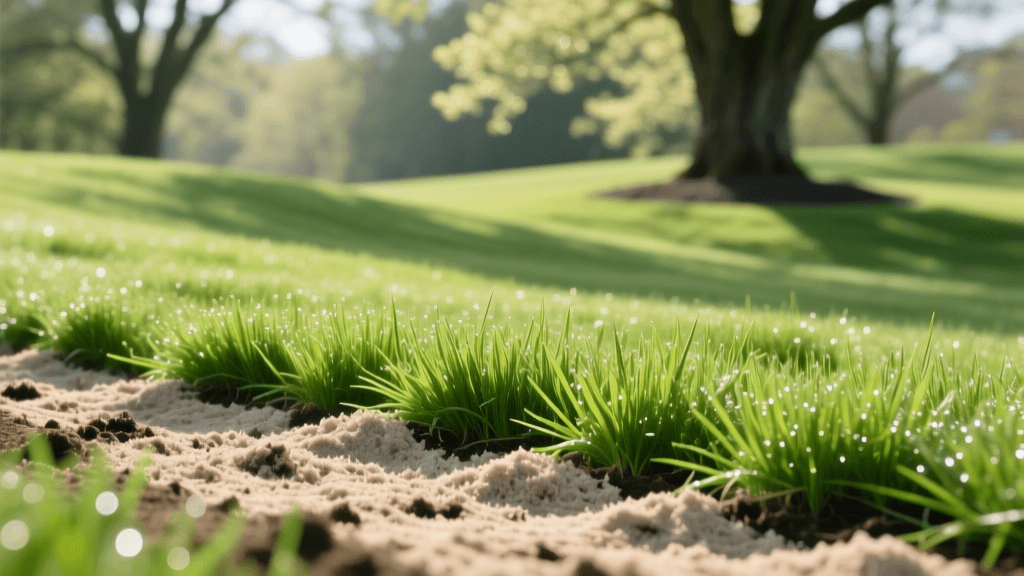
Scalped Lawn Recovery After Tree Planting: 2026 Guide
The Hidden Cost of Tree Installation: Scalped Turf and Compacted Soil
When homeowners and landscape architects select and plant a new tree, the primary focus is almost entirely on arboriculture. We carefully measure the root flare, dig the appropriate width, amend the backfill, and ensure proper staking. However, the surrounding turf often pays a heavy price during this process. Heavy machinery, skid steers, wheelbarrows, and relentless foot traffic during tree installation frequently leave the surrounding lawn severely scalped, stripped of its topsoil, and suffering from deep compaction. As we navigate the 2026 growing season, integrating turfgrass recovery with tree planting protocols is more critical than ever. A scalped lawn not only detracts from the aesthetic of your newly planted tree but also creates a hostile environment for surface roots and invites aggressive weed invasion.
Recovering a scalped lawn around a newly planted tree requires a delicate balance. You must rebuild the soil profile and establish new grass without suffocating the young tree's root system or burying its vital root flare. This comprehensive guide details the exact topdressing and reseeding methods required to restore your lawn while protecting your new tree investment, utilizing the latest 2026 turfgrass science and soil biology standards.
Step 1: Assessing Soil Compaction and the Tree Root Zone
Before dropping a single seed or spreading compost, you must evaluate the damage. Tree planting often involves digging a wide basin, which disrupts the natural soil horizons. The areas immediately surrounding the planting hole are usually compacted by boots and equipment, creating a hardpan layer that repels water and prevents grass roots from penetrating.
The Root Flare Rule
The most critical rule when recovering turf near a new tree is to never bury the root flare. The root flare is the area where the trunk expands at the base and transitions into the structural roots. According to the Arbor Day Foundation, burying the root flare with topsoil or topdressing material is a leading cause of tree decline and girdling roots. When preparing your scalped lawn for recovery, ensure that any topdressing material stops at least 3 to 6 inches away from the trunk of the tree, creating a mulch ring that protects the bark and allows the root flare to breathe.
Addressing Compaction Without Deep Aeration
In a standard lawn recovery, core aeration is the go-to solution for compaction. However, aggressively aerating the soil immediately surrounding a newly planted tree can sever the delicate, newly establishing feeder roots. Instead, rely on the topdressing method combined with liquid soil surfactants and humic acids, which are widely adopted in 2026 turf management to alleviate surface tension and improve water infiltration without mechanical disruption.
Step 2: Selecting the Ideal Topdressing Matrix for Tree Health
Topdressing is the process of applying a thin layer of material over the soil surface to level ruts, improve soil structure, and provide a protective bed for grass seed. When working around trees, the topdressing material must benefit both the turfgrass and the tree's shallow feeder roots. The Morton Arboretum emphasizes that tree roots thrive in well-aerated, biologically active soil, making your choice of topdressing paramount.
| Topdressing Material | Tree Root Impact | Lawn Recovery Benefit | Best Use Case |
|---|---|---|---|
| Fine Screened Compost | High (Adds microbes and essential nutrients) | Excellent (Superior moisture retention and seed-to-soil contact) | Most tree species and heavy clay soils |
| Topsoil/Compost Blend (70/30) | Moderate (Adds physical structure and organic matter) | Good (Levels deep equipment ruts and scalped depressions) | Severe scalping and heavy machinery damage |
| Mason Sand | Low (No nutrients, can compact and restrict oxygen) | Poor for trees (Drains too fast, lacks water-holding capacity) | Avoid near new tree root balls; use only on pure sports turf |
| Mycorrhizal-Inoculated Compost | Exceptional (Symbiotic fungi expand root absorption capacity) | Excellent (Accelerates seedling establishment and drought tolerance) | Premium 2026 standard for high-value tree installations |
For the vast majority of residential tree plantings, a fine-screened compost or a mycorrhizal-inoculated compost is the superior choice. It mimics the natural forest floor, providing a rich, biologically active medium that supports both the emerging grass seedlings and the expanding tree roots.
Step 3: 2026 Seed Selection for Emerging Canopies
When you plant a tree, you are fundamentally altering the microclimate of your lawn. Even if the tree is currently small, it will eventually cast significant shade. Therefore, your reseeding strategy must account for the future canopy. According to research highlighted by the University of Minnesota Turfgrass Science program, selecting shade-tolerant species is vital for long-term turf survival under tree canopies.
Top Shade-Tolerant Grass Types for 2026
- Fine Fescues (Creeping Red, Chewings, Hard Fescue): These are the undisputed champions of shade tolerance. They require less nitrogen and water than traditional bluegrasses, making them excellent companions for tree roots that compete for moisture.
- Shade-Tolerant Tall Fescue (TTTF) Cultivars: The 2026 seed market features advanced TTTF cultivars bred specifically for lower light conditions while maintaining deep, drought-resistant root systems that coexist well with mature trees.
- Supina Bluegrass (Poa supina): An emerging favorite for heavily shaded, high-traffic areas under dense canopies, offering superior spreading capabilities via stolons to recover from minor root-zone disturbances.
Avoid planting pure Kentucky Bluegrass or Perennial Ryegrass directly under the projected drip line of your new tree, as these species will thin out and die as the tree's canopy matures and blocks vital sunlight.
Step 4: The Reseeding and Topdressing Application Method
Executing the recovery requires precision to ensure seed germination while protecting the tree. Follow this step-by-step method for optimal results.
1. Prepare the Seedbed
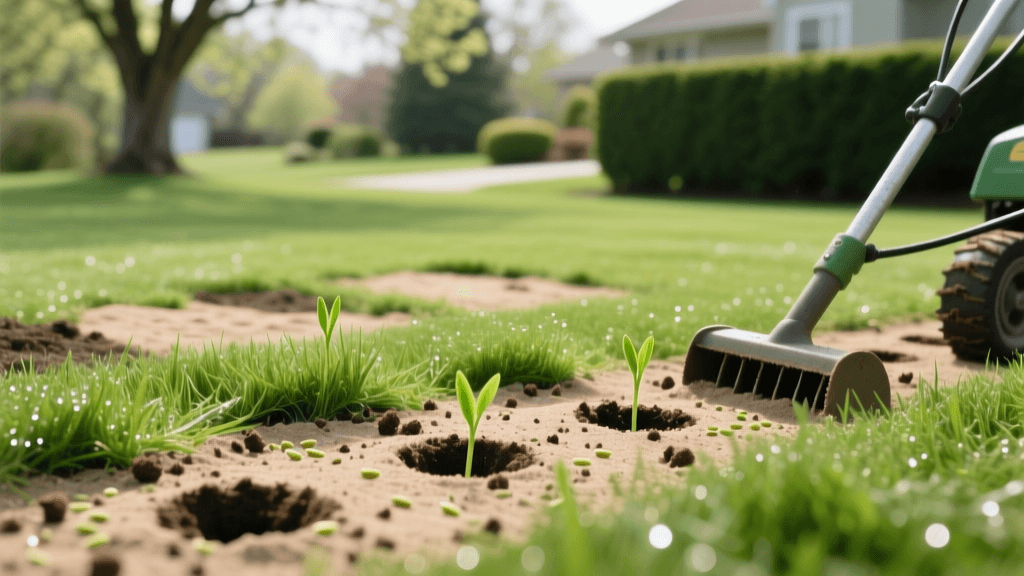
Using a stiff-tined landscaping rake, aggressively scarify the scalped, compacted soil. You are not trying to deeply till the soil (which risks tree roots), but rather scratching the top 1/4 inch to break the surface crust and create micro-furrows for the seed to settle into. Remove any large debris, rocks, or construction remnants left behind by the tree planting crew.
2. Apply the Seed
Using a broadcast or drop spreader, apply your chosen shade-tolerant grass seed at the recommended rate—typically 4 to 6 pounds per 1,000 square feet for fine fescues. For an extra layer of biological support, consider seeds pre-coated with 2026-standard bio-stimulants and kelp extracts, which drastically improve germination rates in stressed soils.
3. Apply the Topdressing
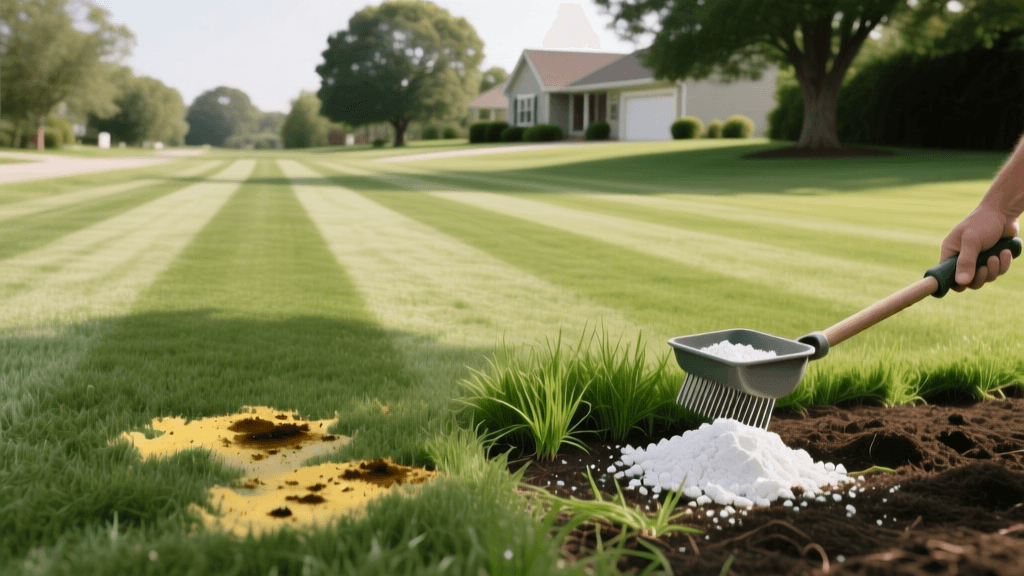
Shovel your fine-screened compost into a wheelbarrow and use a flat-backed landscaping rake or a specialized topdressing drag mat to spread a uniform layer over the seeded area. The goal is to apply exactly 1/4 to 1/2 inch of compost. This layer should be thick enough to cover the seed and retain moisture, but thin enough that the soil beneath is not entirely smothered. Crucial: Keep the compost at least 6 inches away from the tree trunk to preserve the root flare and prevent bark rot.
4. Ensure Seed-to-Soil Contact
Lightly water the area immediately after topdressing to settle the compost. If the area is relatively flat and free of fresh tree roots near the surface, you can use a lightweight lawn roller (filled only 1/4 with water) to gently press the topdressing into the scarified soil. This ensures intimate seed-to-soil contact, which is the primary driver of successful germination.
Step 5: Navigating the Irrigation Paradox
The most challenging aspect of recovering a lawn after tree planting is the conflicting irrigation needs of the two plants. Newly planted trees require deep, infrequent watering to encourage roots to grow downward into the native soil. Conversely, newly sown grass seed and thin topdressing require frequent, shallow watering to prevent the seed from drying out during germination.
The 2026 Hydro-Management Strategy
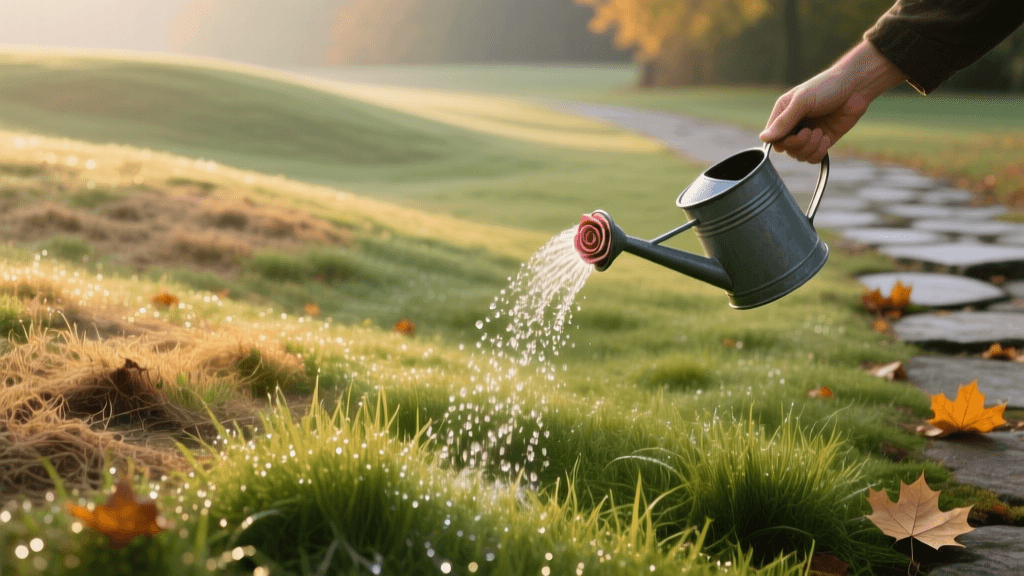
To solve this paradox, utilize a two-tiered watering approach. For the first 14 to 21 days, prioritize the grass seed. Water the topdressed area lightly 2 to 3 times a day for 5 to 10 minutes, just enough to keep the top 1/2 inch of compost consistently moist. To ensure the new tree receives the deep hydration it needs without waterlogging the surface seed, use a deep-root water injector or a slow-drip soaker hose placed exclusively within the tree's root ball zone, bypassing the surface topdressing entirely.
Once the grass seedlings reach 2 inches in height and have been mowed for the first time, transition the entire zone to a deep, infrequent watering schedule. This encourages the new turfgrass roots to dive deeper into the compost and native soil, establishing a resilient lawn that can coexist harmoniously with your newly planted tree for decades to come. By following this specialized topdressing and reseeding method, you ensure that your landscape investment—both the canopy above and the turf below—thrives in unison.