Lawn Care
Scotts GrubEx vs Bayer Advanced 2026 Mowing Tactics
The 2026 Grub Control Landscape and Mowing Synergy
As we navigate the 2026 lawn care season, erratic spring rainfall and shifting soil temperatures have complicated the traditional timelines for white grub management. Homeowners and turf professionals alike are facing a critical question: how do we integrate powerful chemical interventions with our weekly mowing routines? Grub control is rarely a standalone task; it is deeply intertwined with your mowing techniques, cutting heights, and turf patterns. When grubs sever the root system of your lawn, the grass loses its ability to uptake water and nutrients. If your mowing strategy is not adjusted to compensate for this subterranean stress, the canopy will collapse, turning a manageable pest issue into a catastrophic lawn failure.
In this comprehensive guide, we are breaking down the two titans of the grub control industry: Scotts GrubEx1 (the preventative standard) and Bayer Advanced 24-Hour Grub Killer (the curative rescue treatment). More importantly, we will explore exactly how your mower deck height, mowing patterns, and cutting schedules must adapt before, during, and after the application of these specific products in 2026.
Root Severing and Canopy Stress: The Biological Connection
To understand why mowing techniques matter when applying grub control, you must understand the biological relationship between the root zone and the leaf blade. White grubs feed aggressively on turfgrass roots just below the soil surface. As they consume the root mass, the grass plant loses its anchor and its vascular highway. According to turfgrass researchers at the University of Minnesota Turfgrass Science program, removing more than one-third of the grass blade in a single mowing forces the plant to expend massive amounts of stored energy to push new growth. If the root system is simultaneously being devoured by grubs, the plant simply lacks the resources to recover from the mowing shock.
This is why lawns infested with grubs often show the most severe browning immediately following a mowing session. The mechanical stress of the mower blades, combined with the suction lift of the mower deck, literally tears the weakened, rootless grass crowns from the soil. Adjusting your mowing tactics is not just about aesthetics; it is a vital survival mechanism for your turf while the grub control products take effect.
Product Showdown: Scotts GrubEx1 vs. Bayer Advanced 24-Hour
Before altering your mowing patterns, you must select the right chemical tool for the job. The 2026 formulations of both Scotts and Bayer products remain highly effective, but they operate on entirely different biological timelines and require distinct mowing and watering protocols.
| Feature | Scotts GrubEx1 (2026 Formula) | Bayer Advanced 24-Hour Grub Killer |
|---|---|---|
| Active Ingredient | Chlorantraniliprole (0.08%) | Trichlorfon / Dylox (6.2%) |
| Control Type | Preventative (Long-residual) | Curative (Quick-kill) |
| Target Grub Stage | Young larvae (1st and 2nd instar) | Mature larvae (3rd instar / active feeders) |
| Application Window | Spring to early Summer | Late Summer to early Fall |
| Watering Requirement | Water within 24 hours to activate | Water immediately after application |
| Mowing Restriction | Mow before application for soil contact | Mow before; avoid mowing wet turf post-watering |
Scotts GrubEx1 utilizes Chlorantraniliprole, a highly targeted anthranilic diamide that binds to the soil and provides months of residual protection. It must be applied before the eggs hatch. Bayer Advanced, conversely, relies on Trichlorfon (commonly known as Dylox), a fast-acting organophosphate that degrades quickly in the soil but delivers a lethal blow to mature, actively feeding grubs within 24 hours. Your mowing strategy will change depending on which of these two products you are deploying.
Utilizing Mowing Patterns for Granular Application Tracking
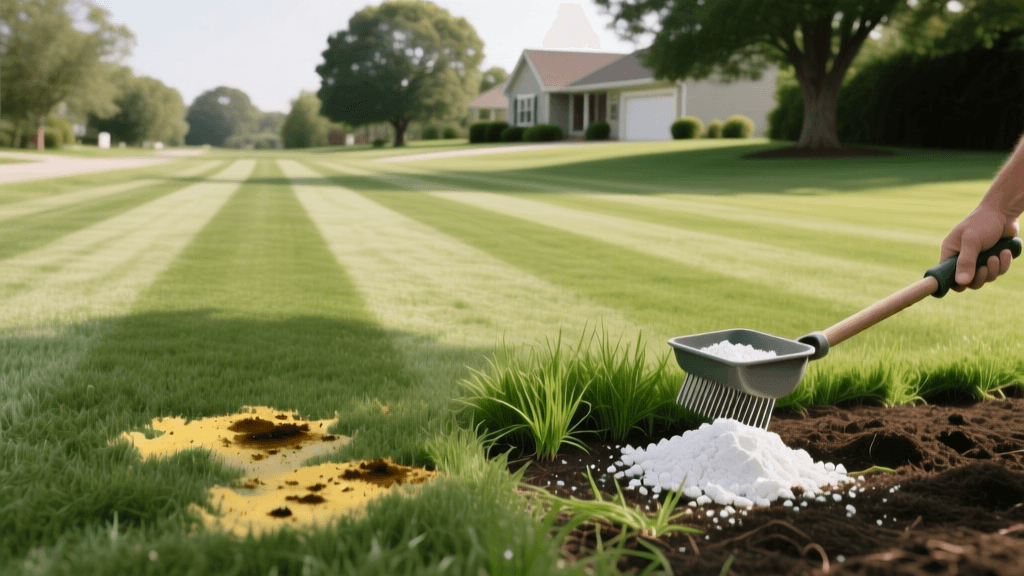
One of the most overlooked mowing techniques in lawn care is using your mowing patterns to guide your fertilizer and pesticide spreader. Uneven application of grub control leads to patchy survival zones where grubs can continue to breed and migrate. When applying either Scotts GrubEx or Bayer Advanced, you can use the visual lines left by your mower to guarantee perfect spreader overlap.
Here is a professional tactic for 2026: Two days before your planned grub control application, mow your lawn using a strict, alternating stripe pattern. Ensure your mower wheels are aligned perfectly on the return pass to create sharp, distinct visual lines in the turf canopy. When you walk with your broadcast spreader to apply the GrubEx or Bayer granules, use the center of your mower's wheel tracks as your guide line for the edge of your spreader's throw. This eliminates the guesswork of overlapping, ensuring that every square inch of soil receives the precise dosage required to break the grub life cycle. As noted by Michigan State University Extension, uniform distribution of granular insecticides is the single most important factor in achieving total lawn coverage and preventing localized grub outbreaks.
Timing Your Mow: Pre-Application and Post-Watering Protocols
The sequence in which you mow, apply, and water is critical for the efficacy of both Scotts and Bayer products. Granular grub killers must reach the soil surface; if they are trapped in a thick canopy of tall grass, they will degrade in the sunlight or be washed away into storm drains before they can penetrate the thatch layer.
Scenario A: Applying Scotts GrubEx1 (Preventative)
- Step 1: Mow your lawn 24 to 48 hours before application. Bag the clippings if your thatch layer is thicker than half an inch to expose the soil.
- Step 2: Apply Scotts GrubEx1 using the mower-track overlapping technique mentioned above.
- Step 3: Water the lawn deeply (about half an inch). Because Chlorantraniliprole is slow-acting, you can resume your normal mowing schedule once the grass is dry, typically the next day.
Scenario B: Applying Bayer Advanced 24-Hour (Curative)
- Step 1: Mow the lawn immediately before application. Because Bayer is a rescue treatment used in late summer when cool-season grasses are stressed, set your mower deck to its highest setting to preserve as much leaf tissue as possible.
- Step 2: Apply the Bayer Advanced granules to a dry lawn.
- Step 3: Water immediately and heavily. Trichlorfon requires immediate moisture to move into the soil profile before it hydrolyzes (breaks down) in the sun.
- Step 4: Crucial Mowing Restriction: Do not mow for at least 3 to 4 days after watering. The soil will be soft, and the grass roots are currently compromised by active grub feeding. Mowing too soon will cause severe turf tearing and soil compaction.
Navigating "Spongy" Turf: Mower Deck and Wheel Adjustments
When a lawn is heavily infested with mature grubs, the root system is entirely severed. If you walk on the lawn, it will feel spongy, and the turf can be rolled back like a loose carpet. Driving a heavy zero-turn mower or a gas-powered push mower over this spongy turf in 2026's compacted soil conditions can cause irreversible mechanical damage.
If you must mow a lawn that is awaiting the curative effects of Bayer Advanced 24-Hour Grub Killer, you must alter your mower's physical setup and your driving patterns. First, reduce the tire pressure on your mower wheels slightly to widen the footprint and reduce ground pressure (PSI). Second, abandon your traditional circular or striping mowing patterns. Instead, mow in long, straight, alternating passes, avoiding tight turns. Tight zero-turns on spongy, grub-eaten turf will act like a scalpel, twisting and tearing the rootless grass crowns right out of the topsoil. By keeping the mower moving in straight lines, you minimize the lateral shearing force on the weakened turf.
Recovery Mowing Techniques Post-Infestation
Once the Bayer Advanced has eliminated the active grub population, or your Scotts GrubEx has successfully prevented them, the lawn must enter a recovery phase. According to turf experts at Penn State Extension, promoting deep root regrowth is the primary goal of post-infestation turf management. Your mowing technique is the primary lever you can pull to achieve this.
For the remainder of the 2026 season, raise your mower deck to the maximum allowable height for your specific grass type (typically 3.5 to 4 inches for Kentucky Bluegrass and Tall Fescue). A taller canopy provides two massive benefits: it shades the soil to retain the moisture necessary for new root generation, and it maximizes the photosynthetic surface area, allowing the plant to manufacture the carbohydrates required to push new roots into the grub-voided soil. Furthermore, leave the clippings on the lawn during recovery mowing. The decaying organic matter will help rebuild the soil microbiome that may have been disrupted by the heavy watering required to activate the grub control chemicals.
Conclusion
Winning the war against white grubs in 2026 requires more than just buying the right bag of chemicals. Whether you are deploying the long-lasting preventative shield of Scotts GrubEx1 or the rapid-strike curative power of Bayer Advanced 24-Hour Grub Killer, your mowing techniques dictate the success of the application. By utilizing mower tracks for precise spreader overlap, adjusting your deck height to mitigate canopy stress, and altering your turning patterns to protect spongy, rootless turf, you transform your mower from a simple cutting machine into a vital instrument of turf recovery and pest management.