Lawn Care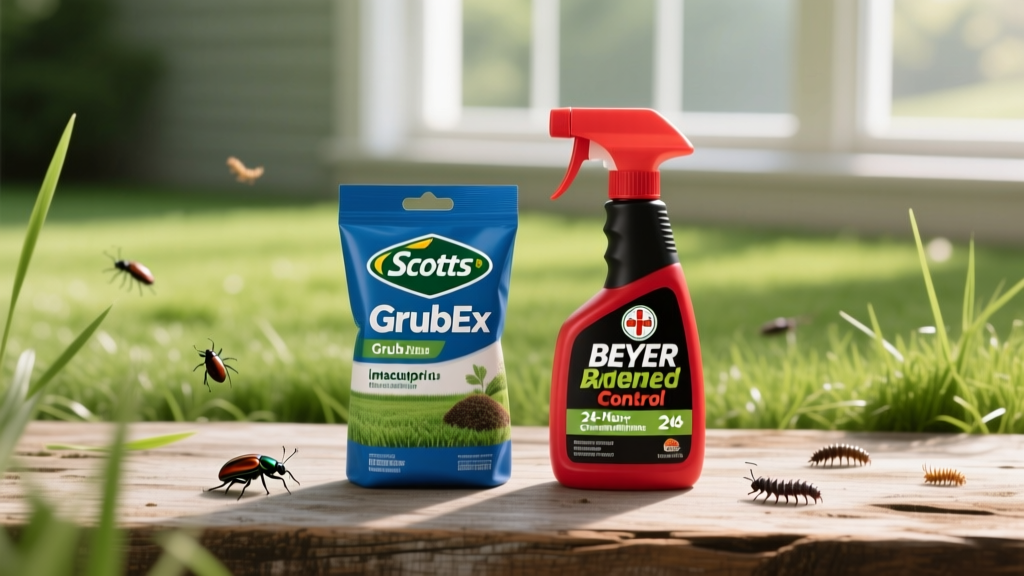
Scotts GrubEx vs Bayer Advanced 24-Hour Grub Control 2026
Anna KowalskiPublished
The Canopy and the Turf: A Webworm Specialist’s Take on Grub Control
As a specialist who spends the majority of the year managing canopy pests—specifically fall and spring tree webworms—I am often asked how my approach translates to the soil level. When you are dealing with tree webworms, the golden rule of Integrated Pest Management (IPM) is timing. You do not spray a massive web nest with Bacillus thuringiensis (Bt) after the caterpillars have already pupated; you target them when the webs are small and the larvae are actively feeding. This exact same meticulous, timing-obsessed philosophy must be applied to soil-dwelling turfgrass pests.
As we navigate the 2026 lawn care season, the debate between preventative and curative grub control remains at the forefront of turf management. Specifically, homeowners constantly ask me to compare the two industry heavyweights: Scotts GrubEx and Bayer Advanced 24-Hour Grub Killer. While one is a slow-release preventative shield and the other is a rapid-response curative strike, choosing the wrong product at the wrong time is as useless as spraying dormant tree branches for webworms.
In this comprehensive guide, we will break down the active ingredients, application windows, and ecological impacts of both products, viewing them through the lens of a strict, calendar-driven IPM strategy.
Understanding the Enemy: White Grubs vs. Webworms
Before we compare products, we must understand the target. Tree webworms (like the fall webworm, Hyphantria cunea) defoliate branches, creating unsightly but rarely fatal silk tents in the canopy. White grubs, the larval stage of beetles like the Japanese beetle, June bug, and European chafer, operate in stealth. They sever the roots of your turfgrass just below the soil surface.
According to the University of Minnesota Extension, a healthy lawn can tolerate up to 10 grubs per square foot. However, once populations exceed this threshold, or when secondary predators like skunks and raccoons tear up your lawn to feast on the grubs, intervention is mandatory. Just as we monitor tree perimeters for early webworm egg masses, turf managers must monitor soil moisture and beetle flight patterns in early summer to predict grub hatches.
Scotts GrubEx: The Preventative Shield
Active Ingredient and Mode of Action
Scotts GrubEx relies on Chlorantraniliprole, a highly targeted anthranilic diamide insecticide. In the context of our 2026 IPM protocols, Chlorantraniliprole is celebrated for its low toxicity to mammals and beneficial pollinators, making it a favorite for environmentally conscious lawn care routines. It works by disrupting the muscle function of the grub, but it requires the insect to ingest the treated roots. Because it moves slowly through the soil profile and breaks down gradually, it provides a long-lasting residual barrier.
The 2026 Application Window
Timing is everything. You must apply Scotts GrubEx between early May and mid-July, depending on your hardiness zone. The goal is to have the active ingredient in the root zone exactly when the new generation of grubs hatches and begins its first feeding cycle in late July and August. If you apply GrubEx in September to kill existing large grubs, you will fail. It is not a curative product.
Pros and Cons
- Pros: Long-lasting residual control (up to 4 months); highly safe for earthworms and pollinators; single annual application.
- Cons: Useless against mature grubs; requires precise spring timing; slow to move into the soil profile.
Bayer Advanced 24-Hour Grub Killer: The Curative Strike
Active Ingredient and Mode of Action
Bayer Advanced 24-Hour utilizes Trichlorfon (often known by its trade name, Dylox). This is an organophosphate insecticide that acts on the nervous system of the grub. Unlike Chlorantraniliprole, Trichlorfon is a contact and stomach poison that degrades rapidly in the soil—often within a few days to a week, especially in alkaline soils. It is designed for one thing: immediate eradication of actively feeding grubs.
The 2026 Application Window
If you missed the spring preventative window, or if you are seeing severe turf damage and active grubs near the surface in late August through October, Bayer Advanced is your emergency response. According to turf entomologists at Michigan State University Extension, curative treatments like Trichlorfon are only effective when grubs are young and feeding near the surface. Once grubs migrate deep into the soil for winter dormancy (usually by late October in northern zones), surface-applied curatives will not reach them.
Pros and Cons
- Pros: Rapid knockdown (kills within 24 hours); saves lawns from imminent destruction; effective on larger grub instars.
- Cons: Very short residual life (will not protect against future hatches); higher toxicity profile; requires heavy watering to activate.
Head-to-Head Comparison Chart
| Feature | Scotts GrubEx (Preventative) | Bayer Advanced 24-Hour (Curative) |
|---|---|---|
| Active Ingredient | Chlorantraniliprole (0.08%) | Trichlorfon (6.2%) |
| Primary Use | Preventative (Season-long shield) | Curative (Emergency eradication) |
| Ideal Application Time | May to Mid-July | August to Early October |
| Speed of Kill | Slow (Days to weeks) | Fast (24 to 48 hours) |
| Soil Residual Life | 3 to 4 months | 5 to 7 days |
| Watering Requirement | Light to moderate watering (0.25 inches) | Heavy watering (0.5+ inches) to reach deep grubs |
| Estimated 2026 Cost (per 5k sq ft) | $28 - $34 | $22 - $27 |
Proper Watering Techniques for Soil Penetration
Whether you are treating canopy pests or soil pests, the delivery mechanism matters. For tree webworms, we rely on thorough foliar coverage. For grubs, we rely on irrigation to move the active ingredient past the thatch layer and into the root zone.
When applying Scotts GrubEx, a light watering of about 0.25 inches is sufficient. You simply need to dissolve the granules and wash them off the grass blades to prevent turf burn, allowing the chemical to slowly bind to the upper soil organic matter. Conversely, Bayer Advanced 24-Hour requires an immediate, heavy watering of at least 0.5 inches. Because Trichlorfon must physically reach the grubs where they are actively chewing on roots, you need enough water volume to carry the chemical 2 to 3 inches deep into the soil profile. Failing to water in curative treatments is the number one reason homeowners report product failure in late summer.
The Webworm Specialist’s IPM Strategy: Combining Canopy and Turf Care
Managing a landscape requires looking at the entire ecosystem. If you are treating your canopy for tree webworms using targeted biologicals like Spinosad or Bt in late summer, you must be mindful of how your lawn applications interact with your soil ecology.
Because Scotts GrubEx (Chlorantraniliprole) is highly selective and spares beneficial soil nematodes and earthworms, it is the superior choice for a holistic IPM approach. Earthworms are vital for natural soil aeration, reducing the need for mechanical core aeration in the fall. Conversely, Trichlorfon (Bayer Advanced) is a broader-spectrum organophosphate. While it degrades quickly, it can temporarily disrupt the soil food web if over-applied.
The 2026 Action Plan
- Spring (May-June): Monitor for adult beetle flights. Apply Scotts GrubEx. Water in with a quarter-inch of irrigation. Focus canopy care on early webworm nest removal via mechanical pruning.
- Summer (July-August): Maintain proper mowing heights (3.5 inches for cool-season grasses) to shade the soil and retain moisture, which helps turf outgrow minor grub feeding.
- Fall (September): Inspect turf. Dig up a 1-square-foot section of soil. If you find more than 10 large grubs per square foot and did not apply a preventative, apply Bayer Advanced 24-Hour immediately and water heavily. Simultaneously, treat any late-season fall webworm tents with targeted horticultural oils.
Final Verdict for the 2026 Season
The choice between Scotts GrubEx and Bayer Advanced 24-Hour is not a matter of which product is universally better, but rather which tool fits the current biological clock of your lawn's pest population. Just as I would never recommend a dormant oil spray for active summer webworms, I cannot recommend Bayer Advanced for a spring preventative strategy.
For 90% of homeowners, Scotts GrubEx applied in early summer is the most economical, ecologically sound, and effective route. It aligns perfectly with modern IPM standards by minimizing broad-spectrum chemical use and protecting the soil biology that keeps your lawn resilient. Reserve the Bayer Advanced 24-Hour strictly for late-season emergency interventions when the turf is actively being severed and predator damage is escalating. Master the timing, respect the life cycle, and your landscape—from the top of the tree canopy to the deepest turf roots—will thrive.