Lawn Care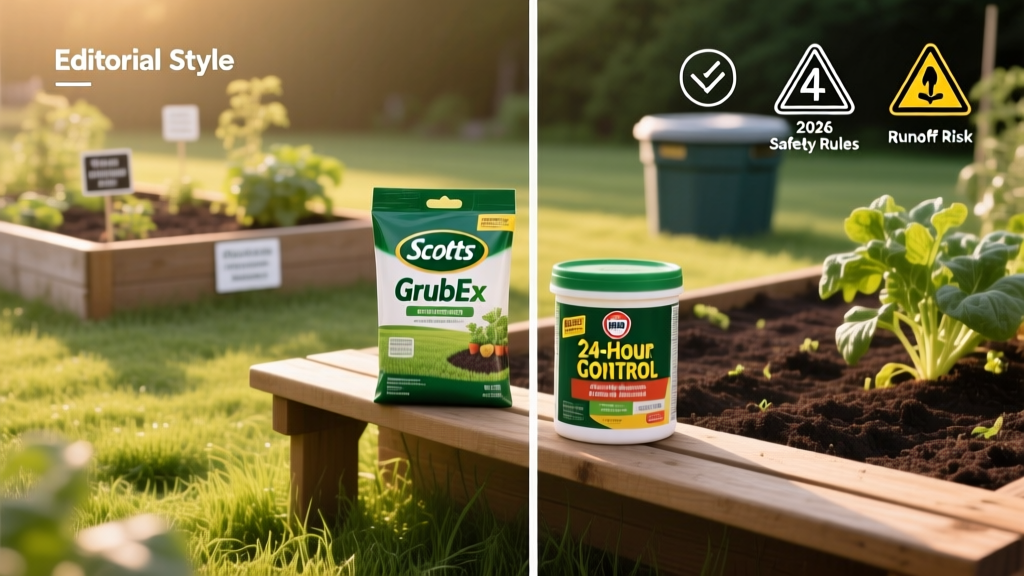
Scotts GrubEx vs Bayer 24-Hour: Raised Bed Safety 2026
Robert HayesPublished
The 2026 Raised Bed Dilemma: Managing Lawn Grubs Near Edibles
As we navigate the 2026 growing season, raised bed vegetable gardening continues to dominate home landscaping. These elevated structures offer superior drainage, warmer soil temperatures, and reduced compaction, making them ideal for high-yield vegetable production. However, the lush, heavily fertilized turfgrass that often surrounds these garden spaces creates a prime breeding ground for white grubs—the larval stage of Japanese beetles, June bugs, and European chafers. When grub populations explode in the lawn, gardeners are frequently tempted to reach for powerful synthetic chemical controls. The two most prominent contenders on the market are Scotts GrubEx and Bayer Advanced 24-Hour Grub Killer. But when your lawn borders a food-producing raised bed, the rules of engagement change dramatically. Understanding the chemical profiles, environmental mobility, and strict label restrictions of these products is essential for protecting your harvest.
Identifying Grub Damage: Lawns vs. Raised Beds
Before selecting a treatment, you must accurately diagnose the problem. In a traditional lawn, grub damage manifests as irregular brown patches of turf that feel spongy underfoot and can be rolled back like a carpet due to severed root systems. Inside a raised vegetable bed, however, the symptoms are entirely different. You will rarely see the rolling carpet effect in loose, amended garden soil. Instead, you will notice sudden, unexplained wilting of deep-rooted crops like tomatoes, peppers, and eggplants, even when soil moisture is perfectly adequate. Root vegetables such as carrots, radishes, and potatoes may suffer direct cosmetic and structural damage, as grubs will happily chew through the taproots. If you spot increased activity from foraging wildlife like crows, skunks, or raccoons tearing up the soil near the wooden or composite walls of your raised beds, you almost certainly have a grub infestation overlapping your garden and lawn spaces.
Scotts GrubEx: The Preventative Approach
Scotts GrubEx relies on the active ingredient chlorantraniliprole, a modern anthranilic diamide insecticide. It is designed as a preventative treatment, meaning it must be applied to the lawn in late spring or early summer before grub eggs hatch. Chlorantraniliprole works by binding tightly to soil organic matter and remaining in the root zone, where it is ingested by newly hatched grubs, disrupting their muscle function and causing them to stop feeding and eventually die. From an environmental standpoint, it has a very low toxicity profile for mammals and birds. However, its tight soil binding and long residual life mean it persists in the environment for months. While this provides excellent season-long protection for your turfgrass, it poses a significant management challenge if your lawn slopes directly toward your raised vegetable beds, as soil particles containing the chemical can easily migrate during heavy rain events.
Bayer Advanced 24-Hour: The Curative Strike
In contrast, Bayer Advanced 24-Hour Grub Killer utilizes trichlorfon (often sold under the brand name Dylox). This is a fast-acting, curative organophosphate insecticide designed to be applied when active grub damage is already visible in late summer or early fall. Trichlorfon is highly water-soluble, allowing it to penetrate the thatch layer and reach the grubs deep in the soil profile rapidly, typically killing them within 24 hours. Because it breaks down relatively quickly in the soil (usually within a few weeks), it does not offer long-term residual protection. For the raised bed gardener, the high water solubility of trichlorfon is a double-edged sword. While it will not persist in the soil for months like chlorantraniliprole, its high mobility means that immediate runoff from a heavy irrigation session or a sudden thunderstorm can easily carry the active ingredient into the porous, compost-rich soil of your adjacent raised beds.
Head-to-Head Comparison for Lawn and Garden Borders
| Feature | Scotts GrubEx | Bayer Advanced 24-Hour |
|---|---|---|
| Active Ingredient | Chlorantraniliprole | Trichlorfon |
| Application Type | Preventative (Spring/Early Summer) | Curative (Late Summer/Fall) |
| Speed of Control | 2 to 4 Weeks | 24 Hours |
| Soil Mobility | Low (Binds tightly to soil) | High (Highly water-soluble) |
| Safe Inside Raised Beds? | NO | NO |
| Required Buffer Zone | Minimum 5 Feet | Minimum 5 Feet |
The Golden Rule: Label Restrictions and Edible Gardens
The most critical factor in the Scotts GrubEx vs. Bayer 24-Hour debate is not which product kills grubs faster, but rather where you are legally and safely allowed to apply them. The Environmental Protection Agency (EPA) strictly mandates that the pesticide label is the law. Neither Scotts GrubEx nor Bayer Advanced 24-Hour Grub Killer is labeled for use on, in, or immediately adjacent to edible crops. Applying these synthetic lawn chemicals inside your raised vegetable beds or directly against the exterior walls where root systems may extend is a violation of federal law and a severe health risk. Root uptake of systemic or soil-bound chemicals can introduce toxic residues into the edible tissues of your leafy greens, root vegetables, and fruiting crops. Therefore, these products must be strictly confined to the ornamental turf and lawn areas, with careful attention paid to buffer zones.
Protecting Raised Beds: Buffer Zones and Runoff Mitigation
If you must treat the lawn surrounding your raised beds, establishing a physical and hydrological buffer is non-negotiable. You should maintain a minimum untreated buffer zone of five feet between the edge of your raised bed and the application line of any synthetic grub killer. If your lawn slopes toward the garden, you must take extra precautions to prevent contaminated runoff. Before applying Bayer 24-Hour, ensure the soil is not already saturated, and water the product in only to the depth required by the label, avoiding excessive irrigation that causes puddling and lateral water movement. For Scotts GrubEx, avoid applying the granular product on windy days to prevent granule drift into the garden soil, and use a broadcast spreader with a deflector shield aimed away from the raised beds. Installing a physical trench or a dense ornamental border between the lawn and the garden can also help intercept soil-bound chemicals before they reach your vegetable roots.
Safe Alternatives for Grubs Inside the Raised Bed
What should you do if the grubs are already inside the raised bed, feasting on your vegetable roots? Since synthetic lawn chemicals are entirely off-limits in this zone, you must turn to biological controls. According to the University of California Integrated Pest Management program, beneficial nematodes are among the most effective and safest biological controls for white grubs in agricultural and garden settings. Specifically, the nematode species Heterorhabditis bacteriophora (often abbreviated as Hb) is a microscopic, unsegmented worm that actively hunts down grubs in the soil, enters their bodies, and releases bacteria that kill the host within 48 hours.
Applying nematodes to your raised beds is incredibly safe for humans, pets, earthworms, and beneficial pollinators. As Penn State Extension notes, the key to successful nematode application is maintaining proper soil moisture and avoiding UV degradation. You must apply the live nematodes in the late evening or on a heavily overcast day, immediately watering them into the top few inches of the raised bed soil so they are protected from the sun. The soil must remain consistently moist for at least two weeks following application to allow the nematodes to move through the soil water film and locate their grub hosts.
Milky Spore: A Long-Term Biological Investment
Another highly effective, raised-bed-safe option for controlling Japanese beetle grubs is Milky Spore (Paenibacillus popilliae). Unlike nematodes, which provide a rapid curative strike, Milky Spore is a long-term biological inoculant. When applied to the soil, the spores are ingested by grubs. As the grubs die and decompose, they release billions of new spores into the soil, creating a self-sustaining cycle of grub control that can last for a decade or more. While it takes one to three years to reach peak efficacy, applying Milky Spore inside your raised beds and in the immediate surrounding borders provides a permanent, organic safety net that eliminates the need to ever risk using synthetic lawn chemicals near your food supply.
Conclusion
When comparing Scotts GrubEx and Bayer Advanced 24-Hour for the 2026 season, the decision ultimately hinges on your lawn's specific needs and your garden's topography. Use GrubEx for long-term lawn prevention and Bayer 24-Hour for rapid lawn curative action, but never allow either product to cross the threshold into your raised vegetable beds. By respecting buffer zones, managing water runoff, and utilizing biological controls like beneficial nematodes and Milky Spore inside the garden, you can maintain a pristine, grub-free lawn while harvesting safe, healthy, and chemical-free vegetables all season long.