Lawn Care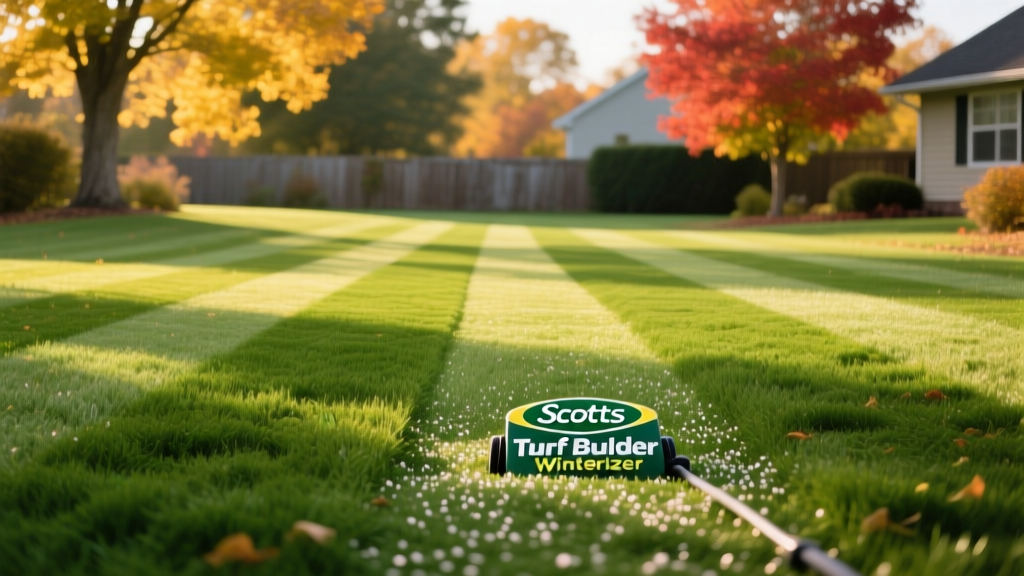
2026 Scotts Turf Builder Winterizer Guide For Lawn Striping
Mike RodriguezPublished
The Secret to Crisp Lawn Stripes Starts in the Fall
When homeowners picture a pristine, stadium-quality lawn featuring sharp checkerboard or diamond striping patterns, they rarely think about autumn. The prevailing myth in lawn care is that striping is entirely dependent on the mower deck, the striper kit, or the spring fertilizer regimen. However, as turfgrass science has continually proven, the aesthetic brilliance of your summer lawn is fundamentally engineered during the fall. For 2026, the gold standard for preparing cool-season grasses to withstand the mechanical stress of heavy striping rollers while maintaining the deep, dark-green canopy required for high-contrast optical illusions is the Scotts Turf Builder WinterGuard Fall Lawn Food.
Striping is not a physical alteration of the grass pigment; it is an optical illusion created by light reflection. When a roller bends the grass blades away from you, the matte underside of the leaf is exposed, creating a dark stripe. When the blades are bent toward you, the glossy top side reflects the sun, creating a light stripe. To achieve this bend without snapping the cellular structure of the blade—and to ensure the grass holds that bend until your next mowing session—the turf requires immense cellular integrity, turgor pressure, and density. This is exactly where a specialized fall winterizer enters the equation.
The Biology of the Bend: Potassium and Turf Density
To understand why Scotts Turf Builder WinterGuard (typically formulated with an NPK ratio of 32-0-10) is critical for lawn striping enthusiasts, we must look at the role of Potassium (K). According to turfgrass researchers at Penn State Turfgrass Science, potassium is the primary macronutrient responsible for regulating water uptake, stomatal function, and the development of thick, rigid cell walls in grass blades.
When you attach a weighted lawn striper kit or a heavy steel roller to your mower in 2026, you are subjecting your turf to significant mechanical friction and crushing force. If your grass lacks sufficient potassium, the cell walls will be weak. Instead of bending elegantly and holding the aesthetic pattern, the blades will fracture, bruise, and turn brown at the crease points. This phenomenon, known as mechanical wilt or roller burn, completely destroys the visual contrast of your striping patterns. The 10% potassium load in the Scotts WinterGuard formula fortifies the grass against this exact type of physical trauma, ensuring the blades remain supple yet resilient.
Nitrogen Storage: Painting the Dark Green Canvas
While potassium builds the structural integrity needed for bending, the 32% Nitrogen (N) component of the winterizer serves a different, equally vital aesthetic purpose: carbohydrate storage and spring green-up. In late fall, cool-season grasses like Kentucky Bluegrass, Tall Fescue, and Perennial Ryegrass shift their biological focus from top-growth to root development and energy storage.
The high-nitrogen formulation of Scotts Turf Builder WinterGuard is absorbed by the roots and stored as complex carbohydrates. When the soil temperatures begin to rise in early spring, these stored reserves are immediately mobilized to produce a hyper-dense, dark-green canopy. For lawn striping, canopy density is non-negotiable. A thin, patchy lawn allows soil and thatch to show through, diffusing light and muting the visual contrast between the light and dark stripes. A thick, winterized carpet of Kentucky Bluegrass provides the plush, velvet-like texture that makes stadium-style checkerboard patterns truly pop.
Timing Your 2026 Winterizer Application
Applying winterizer at the wrong time is a common mistake that can ruin your striping potential. If applied too early in the late summer, the nitrogen will trigger aggressive top-growth, forcing you to mow more frequently and depleting the plant's energy reserves before winter dormancy. If applied too late, after the ground has frozen, the granules will simply sit on the surface and wash away during spring thaws.
For the 2026 season, the ideal application window for Scotts Turf Builder WinterGuard is when the grass has stopped actively growing upward but is still photosynthesizing. This typically occurs when daytime air temperatures consistently hover between 50°F and 60°F, and soil temperatures drop to around 50°F. In northern zones, this is usually late October to mid-November. In transition zones, it may extend into early December.
Spreader Settings and Coverage Chart
Proper calibration of your broadcast spreader is essential. Overlapping applications can lead to fertilizer burn, which manifests as yellow or brown streaks that will severely disrupt the visual continuity of your striping patterns. Below are the standard 2026 baseline settings for Scotts Turf Builder WinterGuard Fall Lawn Food. Always cross-reference with the specific label on your bag, as granule sizes can occasionally vary by manufacturing batch.
| Spreader Model | Recommended Setting | Coverage Area | Striping Impact Note |
|---|---|---|---|
| Scotts EdgeGuard Mini | 3.5 | 5,000 sq ft | Ideal for tight borders and intricate wave patterns. |
| Scotts EdgeGuard DLX | 3.25 | 10,000 sq ft | Best for large, open checkerboard and diamond grids. |
| Scotts Classic Drop | 5.75 | 10,000 sq ft | Drop spreaders prevent overlap burn, preserving stripe contrast. |
| Lesco High Wheel | 14 | 15,000 sq ft | Professional-grade distribution for uniform canopy density. |
Note: In 2026, a standard 14-pound bag of Scotts Turf Builder WinterGuard retails for approximately $38 to $45, covering up to 5,000 square feet. Investing in this specific fall feeding yields a massive return on investment when it comes to the aesthetic curb appeal of your summer lawn.
The Fall-to-Spring Striping Calendar
To maximize the aesthetic benefits of your winterizer application, integrate it into a broader lawn care calendar focused on turf density and blade health.
- Early September (Aeration & Overseeding): Relieve soil compaction. A compacted soil profile restricts root depth, leading to shallow, weak grass that will mat down and die under a striper kit rather than bend.
- Mid-October (Final Heavy Mow): Gradually lower your mowing height to about 2.5 inches. This prevents snow mold and ensures the winterizer reaches the soil surface without being trapped in excessive thatch.
- Late October / Early November (Winterizer Application): Apply the Scotts Turf Builder WinterGuard. Water it in lightly with about 1/4 inch of irrigation to activate the granules and move the nitrogen into the root zone.
- Winter (Dormancy): Keep traffic off the frozen lawn to prevent crown damage.
- Early Spring (The First Stripe): As the stored carbohydrates trigger rapid, dense green-up, wait until the grass reaches 3.5 inches before the first mow. Attach your striper kit and begin with simple alternating lines to test the canopy's bending resilience.
Common Winterizer Mistakes That Ruin Striping Contrast
Even with the best products, improper application can sabotage your aesthetic goals. Turf experts at Michigan State University Extension frequently warn against the 'more is better' fallacy. Applying double the recommended rate of winterizer will not result in thicker grass; it will cause salt toxicity and root burn. A burned root system leads to a thin, pale-green spring canopy that lacks the chlorophyll density required to create the dark, moody stripes seen on professional baseball fields.
Another critical error is neglecting soil pH. If your soil pH is below 6.0 or above 7.2, the grass roots will struggle to uptake the potassium and nitrogen from the Scotts WinterGuard, regardless of how perfectly you calibrate your spreader. Always conduct a soil test in late summer before finalizing your fall fertilization strategy. If the pH is off, apply pelletized lime or sulfur concurrently with your winterizer to ensure the nutrients are bioavailable when the grass needs them most.
Conclusion: Engineering the Ultimate Optical Illusion
Flawless lawn striping is the ultimate intersection of art and agronomy. While a high-quality mower and a weighted striper kit provide the physical mechanism to bend the grass, it is the biological health of the turf that dictates the final visual masterpiece. By strategically applying Scotts Turf Builder WinterGuard in the fall of 2026, you are not merely feeding the lawn for winter survival; you are engineering a hyper-dense, structurally reinforced canopy capable of holding crisp, high-contrast checkerboards, diamonds, and waves. Respect the biology of the bend, time your application to the soil temperature, and prepare to turn your front yard into a neighborhood spectacle next spring.