
Landscaping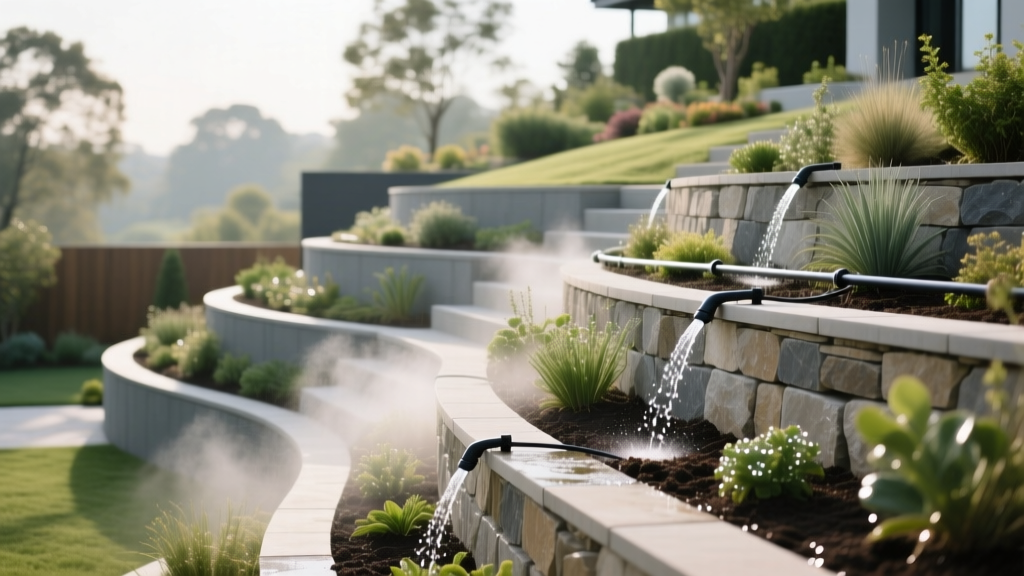
2026 Guide: Irrigating Sloped Terraced Retaining Walls
Mike RodriguezPublished
The Unique Challenge of Terraced Slopes in 2026
Landscaping a sloped backyard is one of the most rewarding yet technically demanding projects a homeowner can undertake. In 2026, the gold standard for managing severe grades and preventing erosion involves terracing with segmental retaining walls (SRWs). While these engineered block systems create beautiful, usable flat spaces out of steep hillsides, they introduce complex hydrology challenges. Gravity is the ultimate enemy of uniform irrigation. Water naturally migrates downward through the soil profile, leading to dry, stressed plants at the top of the terrace and waterlogged, disease-prone soil at the bottom. Furthermore, improper irrigation design can actively compromise the structural integrity of the retaining wall itself. This comprehensive guide explores how to design, install, and program a modern sprinkler and drip irrigation system specifically tailored for sloped backyards featuring segmental retaining walls.
Segmental Retaining Wall Anatomy and Water Management
To irrigate a terraced slope safely, you must first understand how a segmental retaining wall manages water. SRWs are not solid concrete barriers; they are flexible, free-draining structures. According to engineering guidelines from the National Concrete Masonry Association (NCMA), the space immediately behind an SRW must be filled with clean, angular drainage aggregate and a perforated drain pipe to relieve hydrostatic pressure. If your irrigation system over-saturates this backfill zone, you risk overwhelming the drain pipe, increasing lateral earth pressure, and potentially causing the wall to bulge, shift, or fail entirely.
Therefore, your irrigation design must keep excess water away from the wall's geogrid reinforcement and aggregate backfill. The golden rule for slope terracing is to never place high-volume spray heads within 18 inches of the retaining wall cap. Additionally, avoid running PVC mainlines directly behind the wall face where future block settling or soil shifting could shear the pipes and flood the drainage aggregate.
Hydrozoning Your Terraced Slope
A terraced slope must be divided into distinct hydrozones based on elevation and sun exposure. The upper terrace dries out fastest due to gravity pulling moisture downward and increased wind exposure. The lower terrace collects surface runoff and subsurface seepage from the tiers above. In 2026, smart landscaping requires separating these areas into entirely different irrigation valves. The top zone requires higher precipitation rates or longer run times, while the bottom zone needs minimal supplemental water. Using a single valve for the entire slope guarantees that either the top tier dies of thirst or the bottom tier drowns, undermining the base of your retaining wall.
Emitter Selection: Drip vs. Rotary Nozzles
Traditional pop-up spray heads are largely obsolete for sloped terraces. They apply water far too quickly (often 1.5 inches per hour or more), which easily exceeds the infiltration rate of compacted slope soils and causes immediate surface runoff. Instead, modern slope irrigation relies on inline drip tubing or pressure-regulating rotary nozzles. The EPA WaterSense program highly recommends these low-precipitation emitters to maximize water efficiency and prevent soil erosion on grades.
| Emitter Type | Precipitation Rate | Best Use Case on Slopes | Wall Proximity Rule |
|---|---|---|---|
| Inline Drip Tubing | 0.5 to 0.9 GPH (emitter) | Shrub beds, groundcover, and terraced planters | Keep 12 inches from wall face |
| Rotary Nozzles | 0.4 to 0.6 inches/hour | Turfgrass on flat terrace tops | Do not spray directly on wall caps |
| Micro-Sprays | 10 to 20 GPH | Isolated shade plants or deep-rooted perennials | Use only on lower, flat terraces |
| Traditional Sprays | 1.5+ inches/hour | NOT RECOMMENDED for slopes | Avoid entirely on grades > 5% |
Managing Pressure and Low-Head Drainage
Elevation changes drastically alter water pressure within your irrigation system. For every 10 feet of elevation drop, water pressure increases by roughly 4.33 PSI. Conversely, pumping water 10 feet uphill costs 4.33 PSI. If your top terrace is 20 feet above your bottom terrace, the pressure differential between valves can cause uneven emitter performance, misting, and fogging. You must install pressure-regulating valves (PRVs) at each zone manifold to ensure a consistent 30 to 45 PSI for drip lines and rotary nozzles.
Equally important is the installation of check valves on all rotary heads and drip flush valves to prevent low-head drainage. When a zone shuts off, water in the lateral lines will naturally drain out of the lowest emitter on the slope. This wastes hundreds of gallons per cycle and creates a muddy, eroded mess at the base of your retaining wall. Built-in check valves hold the water in the lateral lines until the next scheduled cycle, keeping the lower terraces dry and stable.
Programming for Slopes: The Cycle and Soak Method
The infiltration rate of slope soil is often less than 0.5 inches per hour. If your system applies 1 inch of water in 20 continuous minutes, half of it will run off into the street or pool against your retaining wall. To combat this, you must utilize the cycle and soak method. This technique divides the total required runtime into multiple short bursts, allowing the soil time to absorb the moisture.
For example, if a zone needs 15 minutes of water, program your 2026 smart Wi-Fi controller to run for 5 minutes, wait 45 minutes for the soil to absorb the moisture, run for another 5 minutes, wait again, and finish with the final 5 minutes. Modern smart controllers linked to local weather stations and soil databases can automatically calculate these intervals based on your specific slope grade and soil type data, taking the guesswork out of slope management.
Step-by-Step Installation Best Practices
- Map the Elevation and Trench Carefully: Before digging, map the exact elevation changes. When trenching across a terrace, dig parallel to the retaining wall rather than perpendicular to it, to avoid creating a direct channel for water to flow down the slope and undermine the wall base.
- Install Pressure Regulation Early: Place master PRVs at the backflow preventer or at the individual zone valves. Do not rely solely on point-of-use pressure regulators at the drip emitter level, as the extreme pressure fluctuations on a steep slope can blow out inline fittings.
- Secure Drip Lines on the Grade: Gravity and frost heave will pull drip tubing down the slope over time. Use heavy-duty galvanized landscape staples every 2 to 3 feet to anchor the tubing. For steeper terrace edges, use rigid PVC swing joints to connect the drip manifold to the mainline, allowing for soil settling without breaking the pipes.
- Integrate with Wall Drainage: Ensure that the weep holes or face drains of your segmental retaining wall are never blocked by mulch, soil, or irrigation tubing. The water that naturally drains through the wall face needs a clear path to daylight or a French drain system at the bottom of the slope.
- Program the Smart Controller: Input your soil type (usually clay-loam on graded slopes) and slope percentage into your smart controller. Enable the cycle and soak feature globally for all terrace zones.
Conclusion
Terracing a sloped backyard with segmental retaining walls transforms unusable land into a stunning landscape feature, but it demands a highly specialized approach to irrigation. By respecting the hydrology of the retaining wall, utilizing low-precipitation emitters, managing pressure differentials, and leveraging cycle-and-soak programming, you can maintain a lush, vibrant terraced garden without risking structural failure or water waste. As irrigation technology continues to advance in 2026, combining these foundational landscaping principles with smart, weather-based controllers ensures your sloped oasis remains healthy, stable, and sustainable for decades to come. For more information on sustainable water practices and soil conservation, consult resources provided by the USDA Water Management division.

