Tree Care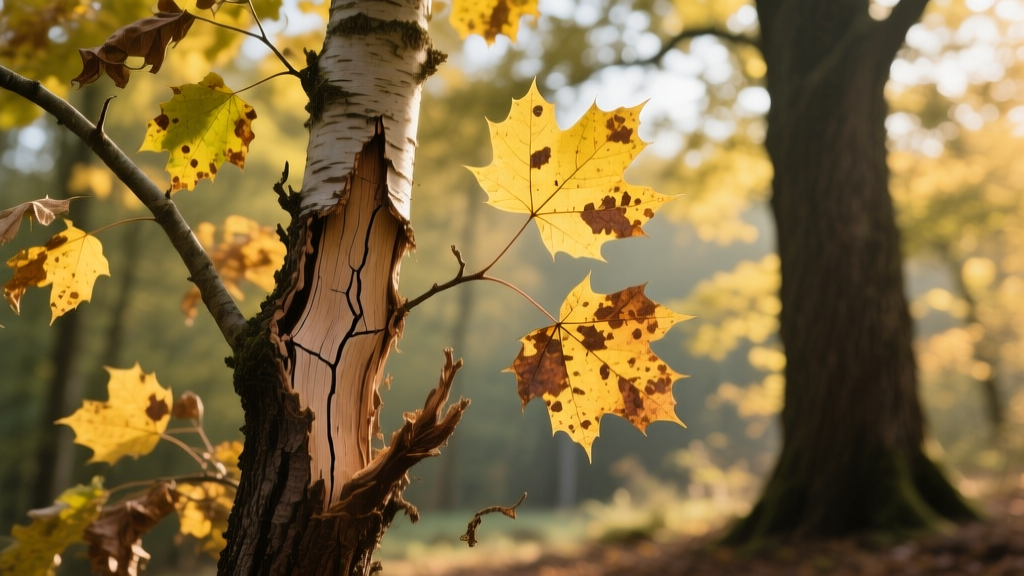
Signs Of Verticillium Wilt In Ash And Maple Trees
Early Detection and Visual Indicators
Verticillium wilt is a soil-borne fungal disease caused primarily by Verticillium dahliae and V. albo-atrum. It invades through roots and colonizes the xylem, disrupting water transport. In ash (Fraxinus spp.) and maple (Acer spp.), symptoms often appear unilaterally—on one side of the crown or branch system—before progressing. This asymmetry distinguishes it from drought stress or root girdling, which typically affect the entire canopy uniformly.
Initial signs include sudden wilting of individual branches during midsummer, even with adequate soil moisture. Leaves may yellow between veins (interveinal chlorosis) while veins remain green—a pattern especially pronounced in red maple (Acer rubrum). In green ash (Fraxinus pennsylvanica), premature browning and curling of leaf margins occur before full desiccation. Unlike anthracnose or tar spot, Verticillium does not produce visible fruiting bodies on foliage.
Internal discoloration is diagnostic: when pruning a symptomatic branch, cut cross-sections reveal olive-green to brown streaks in the sapwood. These vascular streaks are most evident in young wood—typically within 1–2 inches of the cambium—and are absent in healthy tissue. The International Society of Arboriculture (ISA) emphasizes that laboratory confirmation via fungal isolation remains the only definitive diagnosis, as symptoms overlap with other disorders including phytophthora root rot and girdling roots.
Species-Specific Susceptibility and Growth Patterns
Ash Trees: Green Ash vs. White Ash
Green ash exhibits moderate to high susceptibility, with field studies in the Midwest documenting >70% infection rates in urban plantings where soils test positive for V. dahliae. White ash (Fraxinus americana) shows slightly greater tolerance but still succumbs under prolonged drought stress. Green ash grows at an average rate of 1.5–2.5 feet per year in optimal conditions and develops a shallow, wide-spreading root system—up to 3× the tree’s height in radius within 10 years. At maturity, its root zone extends horizontally 40–60 feet from the trunk, making root-zone disturbance during construction a documented vector for disease spread (ISA, 2021).
In contrast, white ash grows more slowly—0.75–1.25 feet annually—and achieves greater longevity (80–120 years), though its root spread is comparable: 35–55 feet in mature specimens. Both species show reduced radial growth in infected trees; dendrochronological analysis from the Morton Arboretum revealed a 32% mean reduction in annual ring width in diseased green ash over five consecutive growing seasons.
Maple Trees: Red Maple and Sugar Maple Responses
Red maple is highly susceptible, particularly cultivars like ‘October Glory’ and ‘Autumn Blaze’. Field surveys across New England indicate mortality within 2–4 years post-symptom onset in >60% of cases. Sugar maple (Acer saccharum) displays intermediate resistance but becomes vulnerable when planted in compacted, poorly drained soils—common in suburban developments near Boston’s Charles River watershed. Sugar maple grows at 1–1.5 feet per year and develops a deeper taproot early in life, though lateral roots dominate after age 15, spreading up to 2.5× the canopy width.
Root architecture matters: red maple lateral roots extend 30–50 feet from the trunk by age 20, while sugar maple roots reach 45–65 feet. Both species exhibit limited regenerative capacity following root damage—especially in clay-rich soils common in Chicago’s Cook County, where compaction reduces oxygen diffusion and increases fungal colonization risk.
Diagnostic Confirmation and Laboratory Protocols
Visual assessment alone carries a false-positive rate of ~40%, per ANSI A300 Part 3 (Pruning) standards. Certified arborists must collect live, symptomatic branch samples (minimum 12 inches long, 1–2 inches diameter) from the transition zone between healthy and wilted tissue. Samples should be refrigerated at 4°C and shipped overnight to accredited labs such as the University of Wisconsin–Madison Plant Disease Diagnostic Clinic or the Ohio State University C. Wayne Ellett Plant and Pest Diagnostic Clinic.
Culturing on selective media (e.g., NP-10 agar) confirms presence of Verticillium spores. Molecular assays—including PCR targeting the Ve1 resistance gene—are increasingly used to differentiate pathogenic strains. ISA-certified professionals follow ANSI A300 Part 9 (Soil Management) guidelines for sample handling, requiring documentation of collection depth, soil texture, and adjacent vegetation history.
Management Strategies Aligned With ANSI A300 Standards
- Prune only during dry, dormant periods (late fall to early spring) to minimize spore dispersal.
- Disinfect pruning tools between cuts using 70% ethanol or 10% sodium hypochlorite solution.
- Maintain soil pH between 6.5–7.2; alkaline conditions suppress V. dahliae viability.
- Avoid nitrogen-heavy fertilizers—excess N increases xylem sucrose, enhancing fungal nutrition.
- Install root barriers at least 30 inches deep when planting near known infested sites.
Root Spread Data and Urban Planning Implications
Understanding root dimensions informs planting distance from infrastructure. The table below synthesizes verified root spread measurements from peer-reviewed urban forestry studies:
| Species | Average Height (ft) | Root Radius at Age 20 (ft) | Root Depth (in) | Canopy Spread (ft) | Soil Type Preference |
|---|---|---|---|---|---|
| Green ash | 50–70 | 45–60 | 12–24 | 40–50 | Loam to clay-loam |
| Red maple | 40–60 | 30–50 | 18–30 | 35–50 | Silt loam, tolerates wet soils |
These metrics directly inform ANSI A300 Part 5 (Tree Risk Assessment), which mandates minimum 15-foot setbacks from sidewalks for species with aggressive lateral roots. In Portland, Oregon’s urban forestry ordinance, green ash is prohibited within 20 feet of sewer laterals due to documented root intrusion incidents linked to Verticillium-compromised root integrity.
When removal is necessary, ISA Best Management Practices (2022) require stump grinding to 12 inches below grade and soil solarization (clear plastic mulch for ≥6 weeks at >30°C surface temps) to reduce inoculum density. Replanting with resistant species—such as ginkgo (Ginkgo biloba) or hawthorn (Crateagus spp.)—is strongly advised. Ginkgo demonstrates zero documented Verticillium infections in 40+ years of monitoring at the Arnold Arboretum in Boston.
Preventive soil testing prior to planting is cost-effective: a single assay costs $85–$120 and detects V. dahliae propagules at concentrations as low as 1 CFU/g dry soil. Early detection allows selection of non-host species before installation—avoiding replacement costs averaging $1,200–$2,800 per mature tree in municipal settings.
Vertical mulching—drilling 2-inch holes 12–18 inches deep within the drip line and backfilling with compost-amended soil—improves aeration and microbial competition against Verticillium. Trials at the Morton Arboretum showed a 27% reduction in symptom progression over three years when combined with mycorrhizal inoculation (Glomus intraradices).
Water management remains foundational: maintaining soil moisture at 15–22% volumetric water content reduces xylem embolism and limits fungal mobility. Drip irrigation systems calibrated to deliver 1–1.5 inches weekly during June–August significantly improve survival odds in newly planted maples.
Monitoring protocols should include quarterly visual inspections and annual trunk diameter measurements. A decline of >1.5 mm/year in basal diameter growth correlates strongly with systemic infection, per longitudinal data from the University of Minnesota’s Urban Forestry Program.
Finally, avoid trenching or grading within the critical root zone—defined as the area extending from the trunk to the dripline, plus 5 feet beyond. Disruption here severs >80% of absorptive roots in both ash and maple, accelerating disease expression even in asymptomatic trees.
Verticillium wilt cannot be cured once established. Proactive planning—grounded in species-specific biology, measurable root architecture, and adherence to ISA and ANSI A300 standards—is the only reliable defense.
