Lawn Care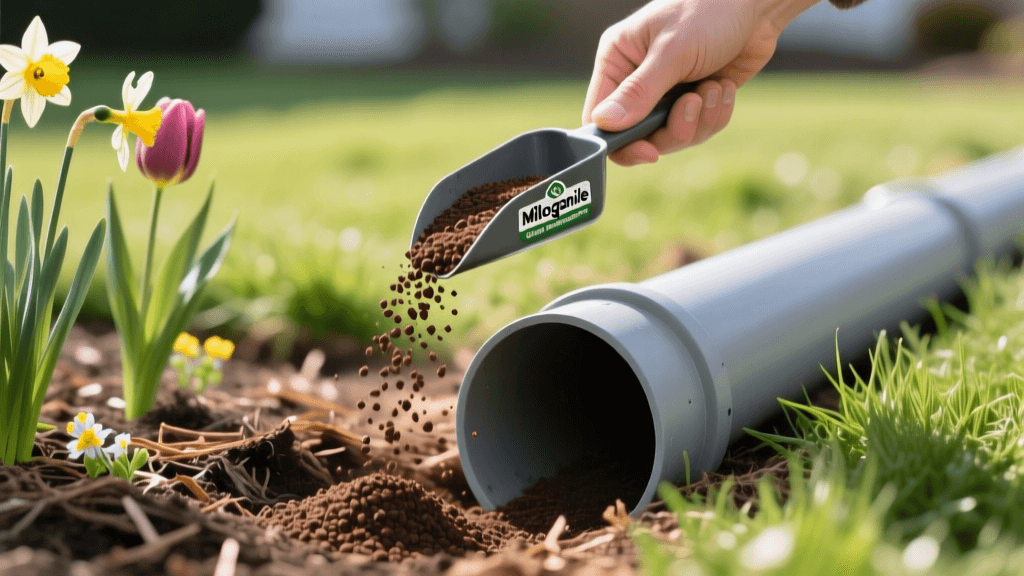
Milorganite Spring Fertilization & Drainage Pipes 2026
The Hidden Conflict: Spring Fertilizer and Landscape Drainage Pipes
As the spring 2026 growing season arrives, homeowners are eager to revive their lawns after a long winter. However, if your property relies on an extensive network of landscape drainage pipes—such as French drains, corrugated slotted tubing, catch basins, and trench drains—your spring fertilization strategy requires careful consideration. Yards that require subsurface drainage infrastructure typically suffer from heavy clay soils, compacted earth, or natural low spots that impede percolation. In these environments, the type of fertilizer you choose directly impacts both your turf health and the structural integrity of your drainage system.
This spring, the smartest approach for lawns with complex drainage networks is utilizing Milorganite, an organic, slow-release biosolid fertilizer. By understanding how fertilizer solubility interacts with landscape drainage pipes, you can achieve a lush, green lawn while protecting your subsurface infrastructure from biological clogs and nutrient leaching.
Why Synthetic Fertilizers Threaten Your Drainage Infrastructure
To understand why Milorganite is the superior choice for drainage-heavy yards, we must first examine the dangers of fast-release synthetic fertilizers. Synthetic options, particularly those high in water-soluble urea or ammonium nitrate, dissolve almost instantly upon contact with moisture. In a yard with poor surface percolation, spring rains push these dissolved salts directly into your catch basins and landscape drainage pipes.
Once inside the dark, consistently moist environment of a corrugated drainage pipe or a French drain wrapped in geotextile fabric, these concentrated nitrogen salts act as a hyper-fuel for biological growth. Homeowners frequently experience unexplained drainage failures in late spring because rapid-release fertilizers trigger massive blooms of algae and bacterial slime inside the pipes. This slime binds with sediment, clogging the perforations of the pipe and blinding the geotextile fabric, effectively ruining the system's ability to move water. Furthermore, the Environmental Protection Agency (EPA) continuously warns that dissolved synthetic nitrogen bypassing the soil profile contributes heavily to groundwater contamination and local watershed pollution.
The Milorganite Advantage: Slow-Release Protection for 2026
Milorganite (5-2-0 NPK) operates on an entirely different biological mechanism. Derived from heat-dried microbes that have digested organic matter, Milorganite is an 85% slow-release nitrogen source. According to turf research highlighted by the University of Massachusetts Amherst Extension, slow-release organic fertilizers require active soil microbes to break down the nitrogen into a plant-available form.
Because Milorganite does not dissolve instantly in water, it remains in the upper soil profile where turf roots can access it over a 10-to-12-week period. Even during heavy spring downpours that activate your landscape drainage pipes, the granules resist washing away. This means the nitrogen stays in your lawn rather than flowing into your catch basins, completely eliminating the risk of triggering pipe-clogging algae blooms. Additionally, the organic matter and 4% iron content in Milorganite help improve soil aggregation over time, which can naturally enhance the soil's long-term percolation rates, reducing the overall burden on your drainage pipes.
Step-by-Step: Applying Milorganite in Yards with Drainage Systems
While Milorganite is highly forgiving, proper application techniques are necessary to ensure granules do not physically obstruct surface drainage grates. Follow this protocol for spring 2026:
1. Map Your Drainage Grates and Trenches
Before spreading any product, walk your property and identify all surface entry points for your drainage system. This includes round catch basin grates, linear trench drain covers, and the exposed gravel termination points of your French drains. Mark these areas mentally or with small flags.
2. Calibrate Your Spreader for 2026 Milorganite Granules
Milorganite granules are relatively uniform but can be dusty. Set your rotary spreader to the manufacturer's recommended setting for a 32 lb bag (typically covering 2,500 square feet). In 2026, a standard 32 lb bag of Milorganite retails for approximately $22 to $26, making it a cost-effective investment for long-term soil health. Ensure your spreader's impeller is clean so the granules are distributed evenly without clumping.
3. Establish a 'No-Granule' Buffer Zone
When approaching a catch basin or trench drain, turn off your spreader 3 to 4 feet away from the grate. Apply the fertilizer in these buffer zones by hand. If any Milorganite granules accidentally land on the plastic or metal grates, use a stiff push broom or a leaf blower to clear them immediately. While Milorganite won't dissolve into a slime clog, a heavy accumulation of physical granules inside a narrow corrugated pipe can still create a minor physical dam if washed in by a torrential downpour.
4. Watering Strategies That Won't Overwhelm Your Pipes
Unlike synthetic fertilizers that demand immediate, heavy watering to prevent turf burn, Milorganite does not require immediate irrigation. It will not burn your grass, even in the warming temperatures of late spring. Wait for a natural, gentle spring rain to begin the microbial breakdown process. If you must irrigate, apply only a light quarter-inch of water. Avoid deep, heavy watering immediately after application, as saturating the soil too quickly will overwhelm your landscape drainage pipes and cause unnecessary surface pooling.
Comparison Chart: Milorganite vs. Synthetic Urea in Drainage Yards
| Feature | Milorganite (Organic Slow-Release) | Synthetic Urea (Fast-Release) |
|---|---|---|
| Water Solubility | Low; requires microbial breakdown | High; dissolves instantly in water |
| Pipe Clogging Risk | Minimal; prevents biological slime | High; fuels algae/bacteria in pipes |
| Soil Aggregation | Improves structure and percolation | Degrades structure via salt buildup |
| Runoff Potential | Very low; stays in root zone | High; easily washes into catch basins |
| Spring Burn Risk | Zero burn risk | High if not heavily watered in |
Long-Term Soil and Pipe Health
The relationship between your lawn's soil biology and your landscape drainage pipes is deeply interconnected. The USGS Water Science School notes that maintaining healthy, biologically active soil is the primary defense against nutrient runoff. By choosing Milorganite for your spring 2026 fertilization, you are feeding the soil food web. Earthworms and beneficial fungi thrive on organic inputs, creating microscopic channels in the soil that improve natural drainage.
Over time, this biological activity reduces the sheer volume of water that your landscape drainage pipes must handle. Your catch basins will stay cleaner, your French drain geotextiles will remain free of nitrogen-fueled bacterial sludge, and your lawn will develop the deep, robust root system necessary to survive the upcoming summer heat. Protect your drainage investment and your local waterways this spring by embracing the slow, steady power of organic nutrition.