Lawn Care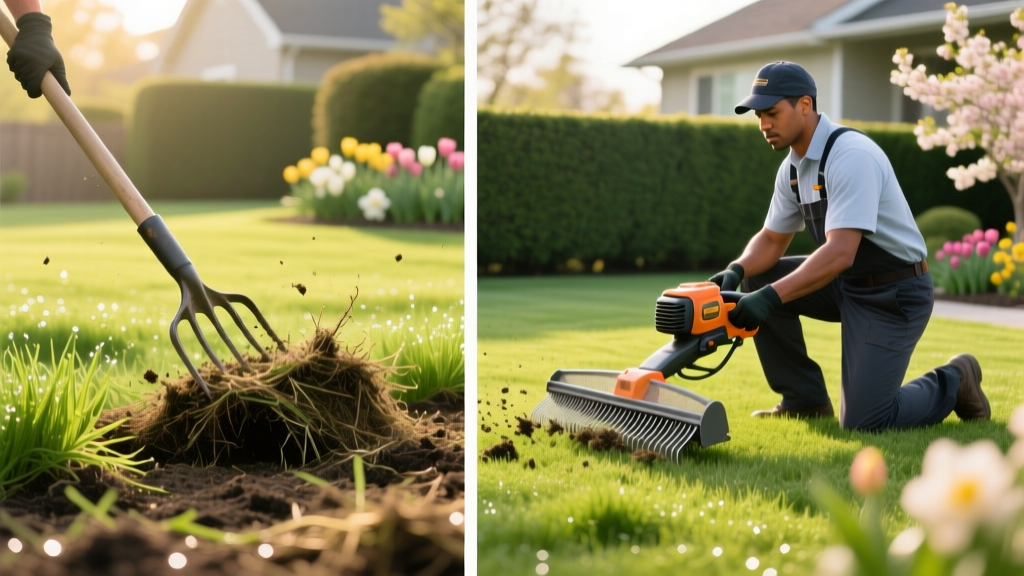
Step By Step Guide To Spring Lawn Thatch Removal
Understanding Thatch and Its Impact on Cool-Season Grasses
Thatch is a tightly interwoven layer of living and dead organic matter—primarily stems, stolons, rhizomes, and roots—that accumulates between the soil surface and green grass blades. While a thin thatch layer (≤½ inch) can insulate soil and reduce moisture loss, excessive buildup (>¾ inch) impedes water infiltration, restricts gas exchange, harbors disease pathogens, and creates an ideal environment for billbugs and sod webworms. In cool-season lawns dominated by Kentucky bluegrass (Poa pratensis), perennial ryegrass (Lolium perenne), and fine fescues (Festuca spp.), thatch accumulation occurs most rapidly under conditions of frequent nitrogen fertilization, overwatering, and infrequent mowing—especially when clippings are not returned or when grass is cut too short.
According to the University of Minnesota Extension, “thatch development is not caused by grass clippings—a common myth—but rather by imbalances in microbial decomposition due to acidic soils (pH < 5.8), compaction, or excessive use of fungicides that suppress beneficial soil microbes” (UMN Extension, 2022). Research from Penn State’s Turfgrass Science Program confirms that Kentucky bluegrass lawns receiving >4 lbs N/1000 ft² annually without core aeration develop 1.2 inches of thatch within 3–4 years—nearly double the rate observed in low-input plots (Penn State, 2021).
When to Dethatch: Seasonal Timing by Region and Grass Type
Dethatching must align with peak growth windows to ensure rapid recovery. For cool-season grasses across the northern U.S., early fall (mid-August to mid-September) is optimal: soil temperatures remain above 55°F, root growth is active, and competition from summer weeds is minimal. Spring dethatching is acceptable only in regions with extended cool springs—such as the Pacific Northwest—but carries higher risk of weed invasion if done before soil temperatures consistently exceed 60°F.
Timing varies by species:
- Kentucky bluegrass: Best dethatched in early fall; avoid May–June when crown rust pressure peaks
- Perennial ryegrass: Tolerates late-summer dethatching but recovers fastest when performed 4–6 weeks before first frost
- Tall fescue (Festuca arundinacea): Can be dethatched in early spring (March–April in USDA Zone 6) or early fall, but avoid July–August heat stress
In Michigan, the MSU Extension recommends scheduling dethatching no later than September 15 to allow at least 21 days of regrowth before average first-frost dates (October 10–20). In contrast, Colorado State University advises against fall dethatching west of the Continental Divide after September 1 due to earlier frosts and reduced snowmelt moisture availability.
Selecting the Right Dethatching Tool
Hand raking works only for small areas (<500 ft²) with light thatch (≤¼ inch). For most residential lawns, mechanical options deliver consistent results:
- Vertical mowers (dethatchers): Equipped with adjustable steel tines, these penetrate ¼–½ inch into the turf. The Agri-Fab 40-Inch 3-Point Dethatcher (Model 45-0297) operates at 180 RPM and removes ~70% of thatch in a single pass at 2.5 mph.
- Aerators with dethatching attachments: The Brinly-Hardy PA-40BH Tow-Behind Aerator adds optional dethatching tines; set tine depth to ⅜ inch for Kentucky bluegrass.
- Power rakes: Less aggressive than vertical mowers; best for lawns with ⅜–½ inch thatch. The Sun Joe AJC1201 operates at 3,200 rpm and covers 1,200 ft²/hour.
Never use dethatchers on dormant or drought-stressed turf. Soil moisture should be at field capacity—test by squeezing a handful: it should hold shape but crumble slightly when poked. Avoid dethatching when air temperatures exceed 85°F or when rainfall is forecasted within 48 hours.
Step-by-Step Dethatching Procedure
Begin by mowing the lawn to 2 inches—1 inch shorter than normal—to expose thatch and improve tine penetration. Wait 2–3 days for the grass to recover from mowing stress before proceeding. Calibrate your dethatcher: for Kentucky bluegrass, set tine spacing to ½ inch and depth to ⅜ inch; for fine fescue, reduce depth to ¼ inch to protect shallow crowns.
Make parallel passes at 3–4 mph, overlapping each pass by 25%. Then make a second set of perpendicular passes to ensure full coverage. Collect debris immediately using a leaf rake or tow-behind sweeper—leaving thatch on the lawn invites fungal growth. After removal, measure residual thatch thickness with a straight-edge ruler and trowel: insert the trowel vertically at multiple locations and note the gap between soil and green tissue.
Post-dethatching care is non-negotiable. Apply 0.5 lb N/1000 ft² using a slow-release fertilizer like Scotts Turf Builder WinterGuard (22-0-14) within 48 hours. Water deeply (0.75 inch) every third day for 10 days—avoid light, daily sprinkling, which encourages shallow rooting.
Preventing Future Thatch Buildup
Prevention relies on cultural practices validated by decades of turf research. Maintain soil pH between 6.2 and 6.8 using lime applications calibrated to soil test results—University of Wisconsin–Madison recommends 50 lbs dolomitic limestone/1000 ft² for soils with pH 5.6 (UW-Madison, 2020). Mow cool-season grasses at 3–3.5 inches during active growth; never remove more than one-third of blade height in a single mowing.
Fertilize based on tissue testing—not calendar dates. Kentucky bluegrass requires only 2–3 lbs N/1000 ft²/year, applied in split applications: 1 lb in early September, 0.5 lb in late October, and 0.5–1 lb in May. Over-fertilizing with quick-release urea increases thatch by 40% compared to polymer-coated urea (Michigan State University, 2019).
Core aeration every 12–18 months reduces compaction and stimulates microbial activity. Use ¾-inch tines spaced 2–3 inches apart, penetrating 3 inches deep. In high-traffic zones like those near driveways in suburban Columbus, Ohio, aerate twice yearly—in April and September.
“Dethatching is a corrective practice—not routine maintenance. Most lawns need it only once every 2–5 years, depending on management intensity and soil type.” — Dr. Eric Watkins, Professor of Turfgrass Science, University of Minnesota
Recommended Fertilizer Application Rates
Apply nutrients only after dethatching and when soil temperatures are stable:
| Grass Species | N (lb/1000 ft²) | P₂O₅ (lb/1000 ft²) | K₂O (lb/1000 ft²) | Application Window |
|---|---|---|---|---|
| Kentucky bluegrass | 0.5 | 0.2 | 0.4 | Within 48 hrs post-dethatch |
| Perennial ryegrass | 0.75 | 0.1 | 0.3 | Within 48 hrs post-dethatch |
| Tall fescue | 0.5 | 0.0 | 0.5 | Within 48 hrs post-dethatch |
Watering Protocol After Dethatching
Follow this schedule for the first 14 days:
- Days 1–3: 0.25 inch every morning (6–8 a.m.)
- Days 4–7: 0.5 inch every other day
- Days 8–14: 0.75 inch twice weekly, always before noon
Monitor soil moisture at 2-inch depth with a screwdriver probe—if resistance exceeds 15 lbs force, increase irrigation volume by 10%. In sandy soils common in coastal Maine, reduce frequency by 20% but increase volume per session to prevent leaching.
Monitoring Recovery and Scheduling Next Intervention
Assess recovery at 21 days: healthy lawns show new tillering at crowns and uniform green color. Measure thatch again at 6 months using the same trowel method. If thickness exceeds ½ inch, re-evaluate cultural inputs—especially nitrogen rate and mowing height. Keep records of dethatching dates, equipment settings, and post-treatment observations. The Purdue Turf Doctor app (v3.2) allows geotagged logging and generates regional timing alerts based on local GDD accumulation.
Repeat dethatching only when measurements confirm ≥¾ inch of thatch. In well-managed lawns in central Indiana, this interval averages 4.2 years; in high-input lawns in suburban Chicago, it drops to 2.1 years (Purdue Extension, 2023). Consistent monitoring—not calendar-based schedules—determines true need.
Always consult your state’s Cooperative Extension Service before applying amendments. Free soil testing is available through Rutgers Cooperative Extension (New Jersey), OSU Extension (Ohio), and VT Extension (Vermont). Their labs analyze organic matter content, CEC, and microbial respiration rates—key indicators of long-term thatch resilience.
Thatch management is fundamentally about balance: matching inputs to biological decomposition capacity. When Kentucky bluegrass receives appropriate nitrogen, maintains optimal pH, and experiences periodic mechanical disruption via aeration, its natural turnover rate keeps thatch below problematic thresholds. This ecological approach—grounded in university research and field-tested across diverse climates—is far more sustainable than reactive, tool-driven interventions.
Remember: a healthy soil microbiome decomposes 90% of annual plant residue. Your job is to nurture that system—not override it with machinery.