Tree Care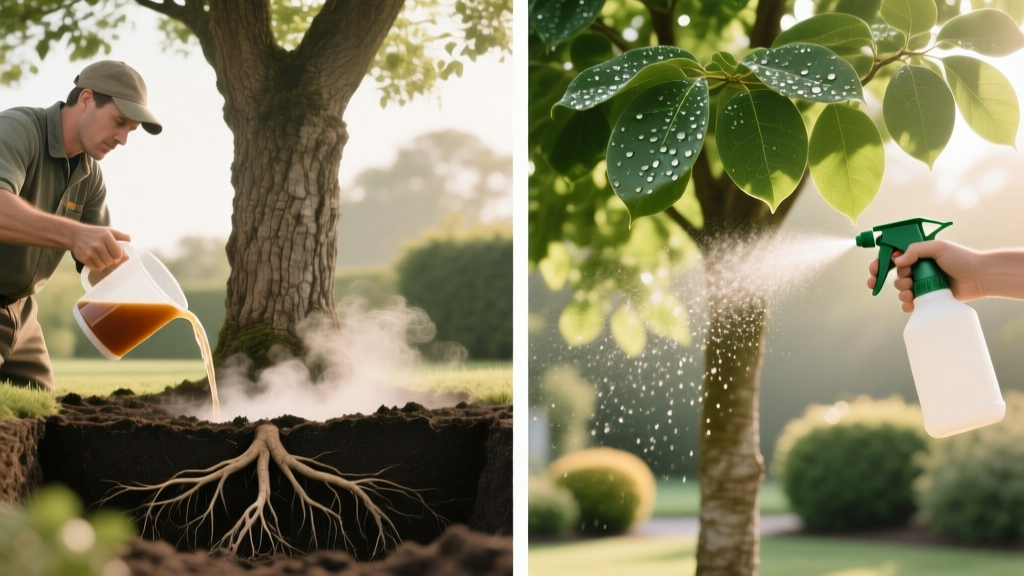
Systemic Drench vs Foliar Spray for Tree Pest Control
David ParkPublished
The Battle Against Tree Pests: Systemic vs. Contact Treatments
Trees are the anchor of any beautiful landscape, providing essential shade, improving air quality, and boosting property values. However, they are constantly under siege from a variety of insect pests, ranging from sap-sucking aphids to destructive wood-boring beetles. When an infestation threatens the health of your trees, homeowners and property managers are typically faced with two primary chemical intervention strategies: systemic soil drenches and contact foliar sprays. Choosing the wrong method can result in wasted money, environmental harm, and the eventual loss of the tree.
In this comprehensive guide, we will compare two of the most popular and effective consumer-grade tree pest control products on the market: Bayer Advanced 12-Month Tree & Shrub Insect Control (a systemic soil drench utilizing Imidacloprid) and Bonide Captain Jack's Deadbug Brew (a foliar spray utilizing Spinosad). By examining their active ingredients, application methods, target pests, and environmental impacts, you will be equipped to make an informed decision for your specific tree care needs.
Product A: Systemic Soil Drench (Imidacloprid)
Systemic insecticides like the Bayer Advanced 12-Month Tree & Shrub Insect Control utilize the active ingredient Imidacloprid, a neonicotinoid. Unlike topical sprays that sit on the surface of the leaves, a systemic drench is applied directly to the soil at the base of the tree. The tree's root system absorbs the chemical and translocates it upward through the xylem, distributing the insecticide throughout the trunk, branches, and leaves.
Application and Timing
To apply a soil drench, you must first measure the circumference of the tree trunk at chest height. The standard measurement for most liquid imidacloprid products is 1 fluid ounce of concentrate per inch of trunk circumference. This concentrate is then mixed with 1 to 5 gallons of water (depending on soil moisture and tree size) and poured evenly in a circle around the tree's drip line. The ideal timing for a systemic drench is early spring, just before the tree pushes new growth, or in the fall after leaves have dropped. This allows the roots time to absorb the chemical before target pests become highly active.
Cost and Longevity
A 32-ounce bottle of systemic drench typically costs between $25 and $35. Because it is highly concentrated and measured by trunk circumference, a single bottle can treat multiple large trees or several smaller ornamentals. The primary advantage of this product is its longevity; a single application provides up to 12 months of continuous, rain-proof protection.
Product B: Foliar Spray (Spinosad)
Foliar sprays like Bonide Captain Jack's Deadbug Brew rely on Spinosad, a natural substance derived from soil-dwelling bacteria (Saccharopolyspora spinosa). Spinosad acts as both a contact and ingestion poison. When sprayed directly onto the tree's canopy, it kills pests that come into contact with the wet residue or consume the treated foliage.
Application and Timing
Foliar sprays require thorough coverage. The standard mixing ratio is typically 2 fluid ounces of concentrate per gallon of water. Using a pump sprayer, you must coat both the upper and lower surfaces of the leaves, as well as the smaller branches, until the point of runoff. Timing is critical: sprays must be applied when pests are actively visible and feeding. Furthermore, because Spinosad can be harmful to bees while wet, applications should be done in the late evening or early morning when pollinators are inactive. Reapplication is usually required every 7 to 14 days during heavy infestations or after significant rainfall.
Cost and Longevity
A 16-ounce bottle of Spinosad concentrate costs around $18 to $22. While the upfront cost is lower than a systemic drench, the cost per treatment can add up quickly for large, mature trees that require multiple gallons of mixed spray to achieve full canopy coverage. Additionally, its residual control lasts only about 7 to 14 days, requiring vigilant monitoring and repeat applications.
Head-to-Head Comparison Chart
The following table breaks down the core differences between these two tree pest management strategies to help you visualize which product fits your landscape needs.
| Feature | Systemic Soil Drench (Imidacloprid) | Foliar Spray (Spinosad) |
|---|---|---|
| Active Ingredient | Imidacloprid (Neonicotinoid) | Spinosad (Bacterial metabolite) |
| Application Method | Soil pour at root zone / drip line | Canopy and trunk foliar spray |
| Target Pests | Borers, aphids, scale, adelgids, leaf miners | Caterpillars, webworms, tent caterpillars, thrips |
| Duration of Control | Up to 12 months | 7 to 14 days per application |
| Rainfastness | 100% rainproof once absorbed by roots | Washes off; requires reapplication after rain |
| Tree Size Limitation | Effective on trees of any height | Limited by sprayer reach (usually under 25 ft) |
| Average Cost | $25 - $35 per 32 oz bottle | $18 - $22 per 16 oz bottle |
Application Scenarios: Which Product Wins?
Neither product is universally superior; the 'best' choice depends entirely on the specific pest, the size of the tree, and the time of year. Let us explore three common landscape scenarios.
Scenario 1: Bark Borers and Wood-Boring Insects
If your ash, birch, or pine trees are under attack by wood-boring insects like the Emerald Ash Borer or Bronze Birch Borer, the systemic soil drench is the undisputed winner. Borers live deep beneath the bark, completely protected from topical foliar sprays. A systemic drench allows the Imidacloprid to enter the tree's vascular system, poisoning the borers as they feed on the inner cambium layer. Foliar sprays are entirely ineffective against established boring insects.
Scenario 2: Defoliators and Caterpillars
When tent caterpillars, fall webworms, or gypsy moths are rapidly stripping the leaves off your ornamental trees, the foliar spray (Spinosad) is the better choice. Caterpillars cause immediate, visible damage and require a rapid 'knockdown' effect. A systemic drench can take several weeks to fully translocate to the upper canopy, during which time the caterpillars could completely defoliate the tree. Spraying the canopy with Spinosad halts the feeding damage almost immediately.
Scenario 3: Sucking Insects on Tall Trees
For aphids, scale insects, or lace bugs infesting a mature, 50-foot-tall oak or maple tree, the systemic soil drench is the only practical option. Homeowners rarely possess the commercial spraying equipment necessary to reach the upper canopy of a mature shade tree. By applying a drench to the root zone, you allow the tree's natural biology to deliver the insecticide to the highest leaves, bypassing the need for ladders or expensive professional spraying equipment.
Environmental Impact and Pollinator Safety
Modern tree care requires a deep consideration of environmental stewardship, particularly regarding pollinator health. The Environmental Protection Agency (EPA) has issued stringent guidelines regarding the use of neonicotinoids like Imidacloprid due to their potential impact on bee populations. Because systemic drenches are absorbed into the tree's tissues, they can be present in the nectar and pollen of flowering trees. Therefore, systemic drenches should never be applied to trees that are currently in bloom or to species that are highly attractive to foraging bees, such as lindens or fruit trees. Always apply drenches after the spring bloom has completely finished.
Spinosad, on the other hand, is generally considered safer for the environment once it has dried. While it is highly toxic to bees when wet, the residue becomes virtually non-toxic to pollinators within a few hours of drying. To minimize risk, apply Spinosad sprays at dusk when bees have returned to their hives.
Integrating Chemical Controls with Holistic Tree Care
Chemical interventions should never be the sole strategy for maintaining tree health. Pests are often secondary invaders, targeting trees that are already weakened by drought, poor soil compaction, or improper pruning. The International Society of Arboriculture (ISA) emphasizes that proper cultural practices are the foundation of integrated pest management (IPM).
According to the USDA Forest Service, maintaining overall tree vigor through proper watering and mulching is the first line of defense against secondary pest invasions. A stressed tree emits chemical signals that actually attract boring insects from miles away.
To maximize the effectiveness of your pest control products, pair them with these essential tree care practices:
- Proper Mulching: Apply a 2-to-3-inch layer of organic wood chip mulch around the root zone to retain moisture and regulate soil temperature. Avoid 'volcano mulching' (piling mulch against the trunk), which invites fungal rot and rodent damage.
- Deep Watering: During periods of drought, provide slow, deep watering using a soaker hose placed at the tree's drip line. This encourages deep root growth, making the tree more resilient to pest stress.
- Sanitation Pruning: Remove dead, diseased, or heavily infested branches during the dormant season to reduce overwintering pest populations and improve air circulation through the canopy.
Final Verdict
When choosing between a systemic soil drench and a foliar spray, let the pest and the tree's physical characteristics guide your decision. Reach for the Systemic Soil Drench (Imidacloprid) when dealing with sucking insects, wood-boring beetles, or when treating very tall trees where canopy spray is impossible. It offers unparalleled, year-long protection with a single application. Conversely, choose the Foliar Spray (Spinosad) when you need immediate relief from leaf-eating caterpillars, webworms, or when treating smaller ornamental trees where thorough coverage is easily achievable. By understanding the unique mechanics of both products, you can protect your landscape investments safely, efficiently, and cost-effectively.