Lawn Care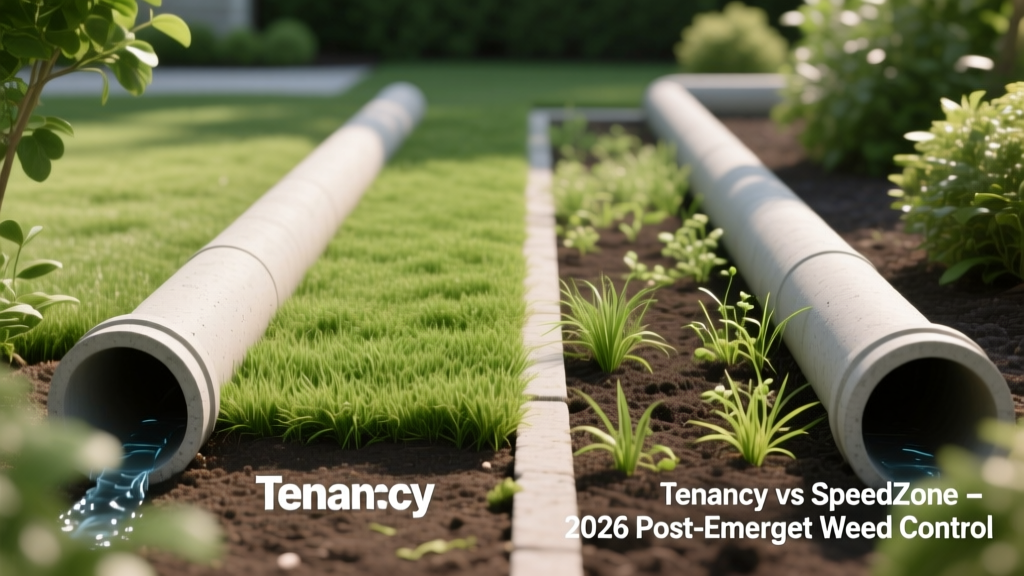
Tenacity vs SpeedZone 2026: Weed Control Near Drainage Pipes
Lisa ThompsonPublished
The Hidden Weed Problem Around Landscape Drainage Pipes
Installing landscape drainage pipe systems—such as 4-inch corrugated tubing, PVC French drains, or shallow swale channels—is one of the most effective ways to eliminate standing water and protect your home’s foundation. However, as we move through the 2026 growing season, turfgrass managers and homeowners are increasingly recognizing a secondary issue caused by these subsurface water management systems: severe, localized weed pressure. The soil directly above and adjacent to landscape drainage pipes creates a unique microclimate. The backfilled trenches often suffer from differential settling, localized compaction, and altered moisture retention. These conditions stress desirable cool-season and warm-season turfgrasses, opening the canopy for aggressive, moisture-loving weeds to invade.
When dealing with weed invasions over drainage trenches, choosing the correct post-emergent herbicide is not just about killing the weed; it is about protecting the surrounding recovering turf and preventing chemical runoff into the very drainage infrastructure designed to move water away from your property. In 2026, the two most prominent post-emergent solutions debated by lawn care professionals are Tenacity (mesotrione) and SpeedZone (a four-way blend of 2,4-D, MCPP, dicamba, and carfentrazone). Both are highly effective, but they operate through entirely different mechanisms and carry distinct environmental profiles that must be considered when spraying near catch basins, dry wells, and storm drain outflows.
Understanding the Drainage Trench Microclimate
Before comparing herbicides, it is vital to understand why weeds thrive near landscape drainage pipes. When a trench is dug and backfilled with gravel and topsoil, the soil structure is permanently altered. The ground above the pipe often remains moister longer than the surrounding undisturbed soil, as the pipe continuously draws water through the gravel matrix. According to turfgrass researchers at the University of Minnesota Extension, weeds like yellow nutsedge, creeping bentgrass, and broadleaf plantain are highly adapted to these poorly aerated, consistently moist soil profiles. Furthermore, the physical act of trenching brings dormant weed seeds to the surface, triggering germination when exposed to sunlight and moisture.
Tenacity (Mesotrione): The Systemic Bleacher
Tenacity, powered by the active ingredient mesotrione, is an HPPD inhibitor herbicide. It works by preventing weeds from producing carotenoids, essentially causing them to bleach white and starve from the inside out. In 2026, Tenacity remains the gold standard for post-emergent control of grassy weeds like creeping bentgrass and nimblewill, as well as sedges like yellow nutsedge, which are notorious for colonizing wet drainage swales.
Pros for Drainage Zones
- Grassy Weed Control: SpeedZone will not kill grassy weeds. If your drainage trench is invaded by creeping bentgrass or Poa annua, Tenacity is mandatory.
- Overseeding Safety: If the turf over your drainage pipe has thinned out and requires fall overseeding, Tenacity is one of the few post-emergent herbicides that can be applied at the time of seeding without harming new Kentucky bluegrass or tall fescue germination.
- Systemic Action: It translocates to the roots, which is crucial for killing the deep rhizomes of nutsedge that often wrap around corrugated drainage pipes.
Cons and Precautions
Tenacity requires a non-ionic surfactant (NIS) for proper foliar absorption. Additionally, it possesses a soil residual activity of up to 30 days. While this prevents new weeds from sprouting in the trench, it also means that heavy rainfall can mobilize the active ingredient. If your landscape drainage pipe outlets directly into a natural pond, stream, or garden bed, the residual mesotrione can bleach sensitive ornamental plants or aquatic vegetation.
SpeedZone: The Broadleaf Blitz
SpeedZone is a synthetic auxin herbicide combined with carfentrazone for rapid contact burn. It mimics plant growth hormones, causing broadleaf weeds to grow themselves to death. The 2026 formulation of SpeedZone remains incredibly popular for its lightning-fast knockdown of stubborn broadleaves that love the compacted soil over buried drainage pipes, such as dandelion, clover, ground ivy, and broadleaf plantain.
Pros for Drainage Zones
- Rapid Knockdown: You will see visible wilting and necrosis within hours, which is satisfying and prevents broadleaves from shading out new turf over the trench.
- No Soil Residual: SpeedZone breaks down rapidly in the soil. This makes it significantly safer to use near landscape drainage pipe outflows, catch basins, and French drain daylighting zones where water rapidly exits the property. There is virtually zero risk of residual herbicide traveling through the pipe and damaging off-site vegetation.
- Cool-Season Turf Safety: It is exceptionally safe on established tall fescue, Kentucky bluegrass, and perennial ryegrass, allowing the turf over the drainage pipe to recover and fill in bare spots quickly.
Cons and Precautions
SpeedZone is completely ineffective against grassy weeds and sedges. If your drainage swale is choked with nutsedge, SpeedZone will only kill the broadleaves, leaving the grassy invaders to thrive. Furthermore, it cannot be used near newly seeded areas or during the peak heat of summer (above 85°F) without risking severe phytotoxicity to the surrounding desirable turf.
2026 Comparison Chart: Tenacity vs. SpeedZone
| Feature | Tenacity (Mesotrione) | SpeedZone (4-Way Blend) |
|---|---|---|
| Primary Target | Grassy weeds, sedges, select broadleaves | Broadleaf weeds (plantain, clover, ivy) |
| Speed of Kill | Slow (2-3 weeks for full bleaching) | Fast (24-48 hours for visible burn) |
| Soil Residual | Yes (up to 30 days) | No (minimal to none) |
| Runoff Risk Near Pipes | Moderate (can harm outflow vegetation) | Low (safe for catch basins/outflows) |
| Surfactant Required | Yes (Non-Ionic Surfactant) | No (formulated with built-in adjuvants) |
| 2026 Avg. Cost per 1k sq ft | ~$4.50 | ~$2.15 |
Environmental Safety: Protecting Your Drainage Outflow
The most critical factor when applying herbicides over landscape drainage pipes is understanding where the water goes. Subsurface drainage systems are designed to rapidly move water away from the root zone. If you apply a herbicide with high soil mobility or heavy residual activity directly over a catch basin or a gravel-filled French drain, the next heavy rainstorm will wash those chemicals directly into the pipe and out to the termination point.
The Environmental Protection Agency (EPA) strictly advises homeowners and professionals to avoid pesticide application in areas where surface runoff or direct drainage to water bodies is likely. Because landscape drainage pipes act as artificial, high-speed conduits for surface and shallow subsurface water, they bypass the natural soil filtration process that normally breaks down chemicals. Therefore, maintaining a 3-to-5-foot buffer zone around any visible catch basin grate, trench drain, or pipe outflow is a mandatory best practice in 2026. In these buffer zones, rely on mechanical removal or highly targeted spot-spraying with a low-residual product like SpeedZone, rather than blanket applications of systemic chemicals like Tenacity.
Application Best Practices for Trench Lines and Swales
To effectively manage weeds along landscape drainage pipe routes without compromising your turf or the environment, follow this integrated approach:
- Map Your Infrastructure: Before spraying, use your property’s drainage plan or a ground-penetrating tool to mark the exact route of your corrugated pipes and the location of all catch basins. Mark these with small landscape flags.
- Identify the Weed Pressure: Walk the trench lines. If you see nutsedge and bentgrass, you must use Tenacity. If the trench is suffering from compaction and is covered in plantain and clover, use SpeedZone.
- Adjust Your Nozzle and Pressure: When spraying over drainage swales, use an air-induction nozzle (like a TeeJet AIXR) at a lower pressure (around 20-25 PSI). This produces larger, heavier droplets that are less likely to drift into nearby ornamental beds or bounce off the wet, compacted soil often found over drainage lines.
- Time the Application with the Weather: Never apply herbicides if a heavy rain event is forecasted within 24 hours. While Tenacity requires a few hours to become rainfast, the sheer volume of water moving through a landscape drainage pipe system can cause localized flooding, washing the chemical off the leaf surface and into the gravel trench before it can translocate.
- Address the Root Cause: Herbicides are a temporary fix. If weeds continually return over your drainage pipe, it indicates the turf above it is failing due to poor soil structure or excessive shade. Consider core aerating the trench line in the fall and top-dressing with compost to improve the soil biology and give your desirable turfgrass the competitive edge it needs to outcompete future weed invasions.
Conclusion
Managing weeds around landscape drainage pipes requires a nuanced understanding of both turfgrass science and hydrology. Tenacity and SpeedZone are both exceptional tools in the 2026 lawn care arsenal, but they serve entirely different purposes. Use Tenacity when grassy weeds and sedges threaten to overtake your drainage swales, and when you need to overseed bare patches over the trench. Rely on SpeedZone for rapid, safe elimination of broadleaf weeds, especially near catch basins and outflow zones where soil residual activity poses an environmental risk. By mapping your drainage infrastructure, selecting the right chemistry, and respecting environmental buffer zones, you can maintain a pristine, weed-free lawn that drains perfectly year-round.