Lawn Care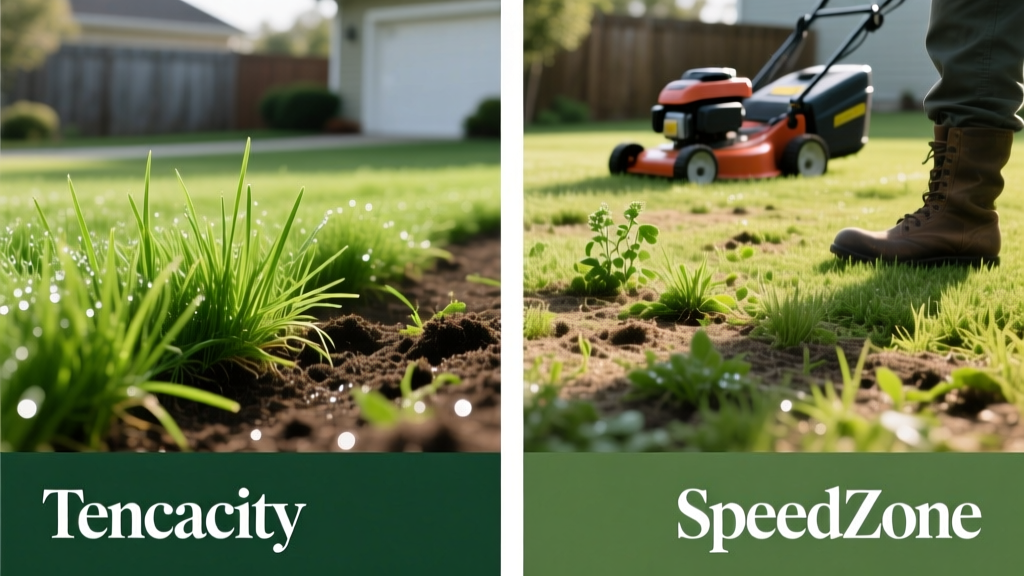
Tenacity vs SpeedZone 2026: Weed Control for Overseeding Lawns
Mike RodriguezPublished
The 2026 Aeration and Overseeding Dilemma
Welcome to the 2026 lawn care season. For homeowners and turf professionals alike, core aeration and overseeding remain the undisputed pillars of cultivating a thick, resilient, and drought-tolerant lawn. However, the transition periods of early fall and spring present a massive challenge: weed competition. When you aerate your soil and introduce new grass seed, you are simultaneously creating the perfect environment for weed seeds to germinate and existing broadleaf weeds to thrive.
The fundamental dilemma lies in herbicide timing. Most conventional weed killers will either prevent your expensive grass seed from germinating or severely stunt the growth of tender new seedlings. In 2026, the two most prominent chemical solutions discussed in turf management circles are Tenacity (Mesotrione) and SpeedZone (a four-way broadleaf blend). But which one should you use when prepping for aeration, and which is safe for the day of seeding?
In this comprehensive guide, we break down the science, application timelines, and 2026 cost structures of Tenacity versus SpeedZone, specifically through the lens of aeration and overseeding routines for cool-season and warm-season grasses.
Understanding Tenacity (Mesotrione) for Seeding
Tenacity is a revolutionary selective herbicide powered by the active ingredient Mesotrione. Originally derived from the bottlebrush plant, Mesotrione is an HPPD inhibitor. It works by blocking photosynthesis in susceptible weeds, causing them to turn stark white and eventually die off within two to three weeks.
From an overseeding perspective, Tenacity is widely considered a miracle product for cool-season lawns (Kentucky Bluegrass, Tall Fescue, and Perennial Ryegrass). According to turfgrass researchers at University of Minnesota Extension, Mesotrione is unique because it can be applied at the exact time of seeding without harming the germinating cool-season grass seed. Furthermore, it provides residual pre-emergent control against crabgrass and certain broadleaf weeds for up to 30 days, protecting your vulnerable seedlings during their critical establishment phase.
Tenacity Limitations
- Speed of Kill: It is a slow killer. Weeds bleach out and die over 14 to 21 days.
- Warm-Season Caution: While safe for Centipedegrass and St. Augustine, it can severely damage or kill Bermudagrass and Zoysiagrass if applied during their active growing season.
- Surfactant Required: Tenacity requires a non-ionic surfactant (NIS) for proper foliar absorption, adding a slight step to your mixing routine.
Understanding SpeedZone for Broadleaf Knockdown
SpeedZone is a powerhouse, fast-acting post-emergent herbicide formulated with four active ingredients: 2,4-D, MCPP-p, Dicamba, and Carfentrazone-ethyl. This ester-based formulation is designed for rapid penetration and devastating knockdown of over 100 species of broadleaf weeds, including stubborn dandelions, clover, plantain, and thistle.
When preparing a lawn for aeration, SpeedZone is an invaluable tool for 'cleaning the slate.' Because the carfentrazone component accelerates the burn-down process, you will often see weeds wilting within 24 to 48 hours. However, SpeedZone is not safe for newly seeded lawns. The active ingredients will severely damage or kill germinating grass seedlings and young turf that has not yet been mowed at least two to three times.
SpeedZone Limitations
- Seeding Restrictions: You must wait at least 3 to 4 weeks after applying SpeedZone before you can safely aerate and overseed. Conversely, if you seed first, you must wait until the new grass has been mowed 3 times before applying.
- No Pre-Emergent Activity: SpeedZone only kills weeds that are already present and actively growing. It offers zero residual protection against future weed germination.
- Temperature Sensitivity: Ester-based herbicides like SpeedZone can volatilize and damage desirable plants if applied when temperatures exceed 85°F.
Tenacity vs. SpeedZone: 2026 Head-to-Head Comparison
To help you make the right decision for your 2026 lawn care calendar, review the side-by-side comparison below:
| Feature | Tenacity (Mesotrione) | SpeedZone (4-Way Broadleaf) |
|---|---|---|
| Primary Use | Pre & Post-emergent / Seeding Shield | Rapid Post-emergent Broadleaf Knockdown |
| Safe at Seeding? | Yes (Cool-season grasses) | No (Wait 3-4 weeks or until 3rd mow) |
| Speed of Kill | 14 - 21 Days (Bleaching effect) | 24 - 72 Hours (Rapid burn-down) |
| Target Weeds | Crabgrass, Nimblewill, Bentgrass, Select Broadleaves | Dandelion, Clover, Plantain, Thistle, Spurge |
| Residual Control | Up to 30 Days (Pre-emergent barrier) | None |
| 2026 Avg. Cost | ~$65 per 8 oz bottle (Covers ~4 acres) | ~$130 per Gallon (Covers ~4 acres) |
Strategic Timelines: Integrating Herbicides with Aeration
Timing is everything when combining weed control with soil aeration and overseeding. Core aeration pulls physical plugs of soil from the ground, which can disrupt pre-emergent chemical barriers. Therefore, your herbicide strategy must be meticulously planned around your aeration date.
Strategy 1: The Pre-Aeration Clean-Up (Using SpeedZone)
If your lawn is heavily infested with mature broadleaf weeds in late summer, do not seed directly into the weeds. They will outcompete your grass seed for water, sunlight, and soil nutrients.
- 4 Weeks Before Aeration: Apply SpeedZone to actively growing weeds. Ensure the lawn is well-hydrated and temperatures are below 85°F to prevent turf stress.
- 2 Weeks Before Aeration: Weeds will be completely dead and decaying. Mow the lawn short and bag the clippings to expose the soil.
- Day of Aeration & Seeding: Perform your core aeration and drop your seed. Because the SpeedZone was applied a month prior, the chemical residue has broken down enough in the soil to safely allow grass seed germination.
Strategy 2: The Day-of-Seeding Shield (Using Tenacity)
If your primary concern is crabgrass, goosegrass, or seedling broadleaf weeds that emerge alongside your new grass, Tenacity is your go-to solution.
- Day of Aeration & Seeding: Aerate the lawn, spread your starter fertilizer, and broadcast your grass seed.
- Immediate Application: Mix Tenacity at the label rate for seeding (typically 4 oz per 100 gallons of water, or roughly 1/2 teaspoon per 1,000 sq ft) along with a non-ionic surfactant.
- Watering In: Spray the lawn evenly. Your first irrigation cycle will water the seed into the soil while simultaneously activating the Tenacity as a pre-emergent barrier in the top layer of soil.
According to weed management guidelines published by Penn State Extension, utilizing Mesotrione at seeding drastically reduces the need for post-emergent rescue treatments later in the fall, saving both time and chemical costs.
2026 Application Rates and Mixing Best Practices
Herbicide formulations and recommended carrier volumes have seen slight refinements in 2026 to promote better soil absorption and reduce environmental runoff. Always read the most current manufacturer label on your specific bottle, but standard professional guidelines remain consistent.
Mixing Tenacity
- Rate: 4 to 8 fluid ounces per acre. For a standard 5,000 sq ft lawn, you will need approximately 0.15 to 0.30 fluid ounces (about 1 to 1.5 teaspoons).
- Carrier: Use 1 to 2 gallons of water per 1,000 sq ft to ensure even coverage without excessive runoff.
- Surfactant: Add 1 to 2 teaspoons of Non-Ionic Surfactant (NIS) per gallon of water. Without this, the Tenacity will bead up on the waxy leaves of weeds and fail to absorb.
- Pro-Tip: Tenacity can temporarily bleach the tips of desirable Kentucky Bluegrass and Fescue. This is a cosmetic effect and the grass will recover within 10 days. Do not panic when your lawn looks slightly frosty after application.
Mixing SpeedZone
- Rate: 2 to 3 fluid ounces per 1,000 sq ft.
- Carrier: 1 to 2 gallons of water per 1,000 sq ft.
- Surfactant: SpeedZone typically contains built-in surfactants and penetrants, so additional adjuvants are rarely necessary unless dealing with extremely drought-stressed, waxy weeds.
- Pro-Tip: Never apply SpeedZone if rain is expected within 4 hours, and avoid watering your lawn for 24 hours post-application to allow the ester formulation to fully penetrate the weed leaf cuticle.
Final Thoughts for the 2026 Season
Choosing between Tenacity and SpeedZone is not about finding a single 'best' herbicide; it is about selecting the right tool for your specific aeration and seeding timeline. If you are weeks away from overseeding and need to eradicate mature broadleaf weeds, SpeedZone provides the rapid knockdown required to prep the canvas. If you are standing on the precipice of seeding day and need to protect your new investment from crabgrass and seedling weeds, Tenacity is an irreplaceable ally.
By understanding the chemical restrictions and synergistic benefits of these two products, you can execute a flawless 2026 aeration and overseeding campaign, resulting in a dense, weed-free turf that will be the envy of the neighborhood.