Gardening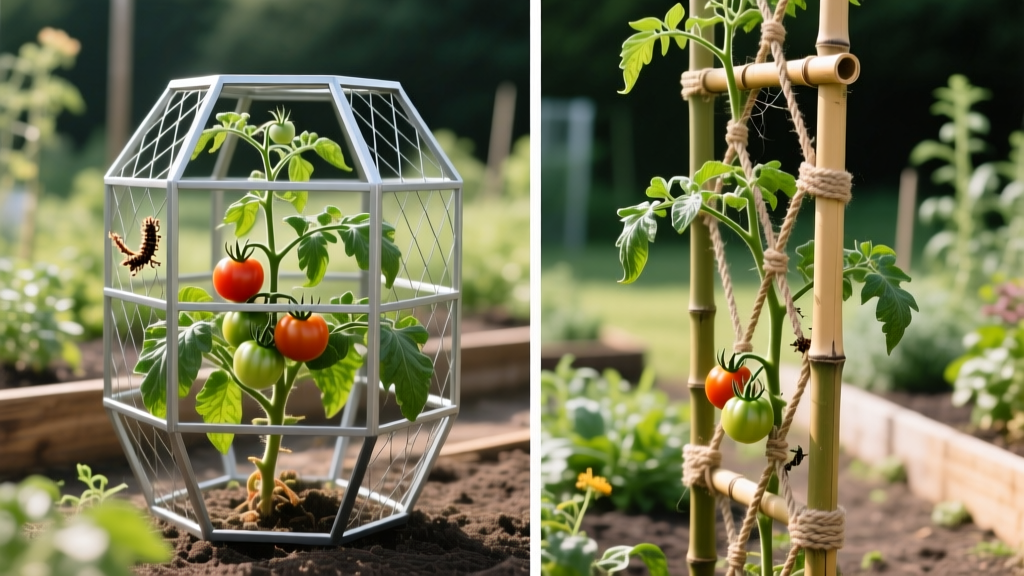
Tomato Cage vs Trellis 2026: Pest Control & Yield Comparison
Lisa ThompsonPublished
The Arborist's Lens: Why Support Structures Dictate Pest Pressure
As a specialist in Tree Web Worm Control, I spend my springs and summers battling Hyphantria cunea—the fall webworm—which spins massive, protective silken tents in the canopies of pecan, mulberry, and ornamental trees. My core philosophy in pest management is simple: pests thrive in tangled, poorly ventilated canopies where biological sprays cannot penetrate and natural predators cannot reach. When I transition from the orchard to my home vegetable garden, I apply this exact same lens to my tomato plants. The age-old debate of tomato cage vs trellis is not just about aesthetics, garden geometry, or harvest convenience; it is fundamentally about canopy management, airflow, and pest visibility.
When homeowners ask me which support method is superior for the 2026 growing season, I rarely talk about the initial setup time. Instead, I talk about microclimates. Just as webworms use dense, unpruned tree branches to anchor their webs and hide from parasitic wasps, tomato pests like spider mites, hornworms, and fungal blights use dense, caged foliage to evade detection and treatment. Let us break down the tomato cage vs trellis comparison through the eyes of an integrated pest management (IPM) expert, evaluating the latest 2026 materials, costs, and biological outcomes.
The Biology of the Canopy: What Webworms Teach Us About Tomatoes
In tree care, we use a technique called open-center pruning to eliminate the dark, humid, stagnant air pockets where webworms and tent caterpillars establish their colonies. Sunlight and wind are the ultimate natural sanitizers. When you apply this logic to indeterminate tomato varieties, the structural support you choose dictates the architecture of the plant's canopy.
A dense canopy traps humidity, creating the perfect incubator for early and late blight. Furthermore, web-building pests—such as the twospotted spider mite, which creates fine silken webbing on the undersides of tomato leaves similar to miniature tree webworms—thrive in stagnant air. According to the University of Kentucky Entomology, spider mite populations explode in hot, dry, and dusty conditions, but their webbing protects them from topical miticides and predatory insects. If your support structure prevents thorough spray coverage, you will lose the battle before it begins.
Tomato Cages in 2026: The Containment Trap
The traditional wire tomato cone is largely considered obsolete by serious growers, but the 2026 market has seen a surge in heavy-duty, modular cage systems designed for massive indeterminate varieties. Products like the TitanTall Heavy-Duty Steel Cages and the K-Brands Modular Polymer Cages dominate the current market, retailing between $35 and $45 per unit in 2026. These cages are structurally magnificent, capable of holding 15 pounds of fruit without buckling.
The Pest Management Drawbacks
From a pest control perspective, however, these cages are a nightmare. Cages force the tomato plant into a cylindrical, bushy growth habit. As the plant pushes against the wires, lateral branches (suckers) tangle and overlap, creating an impenetrable thicket of foliage.
- Spray Penetration: When attempting to apply organic treatments like Neem oil or Bacillus thuringiensis (Bt) for hornworms, the cage wires physically block your sprayer wand. The inner canopy remains completely untreated, serving as a safe harbor for pests.
- Moisture Retention: After a heavy summer rain or morning irrigation, the dense center of a caged tomato plant can take hours to dry out. This prolonged leaf wetness is the primary catalyst for fungal diseases.
- Pest Visibility: Spotting the early signs of an aphid infestation or the frass (droppings) of a tomato hornworm is nearly impossible when you cannot see through the outer layer of leaves.
Trellising Systems: Open-Canopy Pest Management
Trellising, particularly the Florida Weave method or the use of 16-foot galvanized cattle panels, mimics the open-center pruning we use in commercial orchards. In 2026, the shift toward biodegradable jute twine for the Florida Weave and powder-coated steel T-posts has made trellising more accessible and environmentally friendly than ever. A single 16-foot cattle panel costs roughly $35 to $40 in 2026 and can support up to six indeterminate tomato plants for a decade or more.
The Pest Management Advantages
By training tomatoes to a trellis using a single or double leader method (aggressively pruning all suckers), you create a flat, two-dimensional canopy. This is the gold standard for pest management.
- Maximum Airflow: Wind passes directly through the foliage, rapidly drying leaves after rainfall and drastically reducing the incidence of septoria leaf spot and blight.
- Unobstructed Spraying: When you need to apply a biological fungicide or an insecticidal soap, every single leaf surface is exposed and accessible. There are no hidden pockets for spider mites to weave their protective webs.
- Predator Access: Beneficial insects, such as lacewings and parasitic wasps, can easily navigate the open canopy to hunt down aphids and caterpillars without getting trapped in a tangled mess of stems.
2026 Data Comparison: Cages vs. Trellises
Below is a side-by-side comparison of the leading support methods for the 2026 season, evaluated specifically on pest management metrics, yield potential, and structural economics.
| Feature | Heavy-Duty Modular Cage | Cattle Panel Trellis | Florida Weave (T-Posts & Twine) |
|---|---|---|---|
| 2026 Avg. Cost Per Plant | $35.00 - $45.00 | $6.00 - $8.00 | $1.50 - $3.00 |
| Canopy Airflow | Poor (Traps humidity) | Excellent (Open 2D plane) | Very Good (Linear row) |
| Pest Visibility | Low (Hidden inner core) | High (Fully exposed) | High (Linear exposure) |
| Spray Penetration | Severely Restricted | Unobstructed | Unobstructed |
| Pruning Requirement | Minimal (Bush habit) | High (Sucker removal) | Moderate (Topping/Weaving) |
| End-of-Season Cleanup | Difficult (Tangled debris) | Easy (Drop and compost) | Easy (Cut twine and pull) |
Applying Tree Web Worm Control Tactics to Tomatoes
When managing orchards for fall webworm, we rely on three pillars of IPM: canopy manipulation, targeted biological sprays, and rigorous sanitation. The UC Statewide IPM Program recommends these exact same pillars for commercial and home tomato production. Here is how you apply tree-care tactics to your 2026 tomato trellis:
1. Aggressive Canopy Pruning (Sucker Removal)
Just as we prune water sprouts from apple trees to deter tent caterpillars, you must prune tomato suckers (the shoots that grow in the crotch between the main stem and the branches). On a trellis, maintaining a single leader ensures the plant's energy goes into fruit production and disease resistance, rather than creating a dense, pest-friendly jungle. The University of Minnesota Extension notes that proper pruning on trellised indeterminate varieties significantly reduces the humidity microclimate that leads to fungal outbreaks.
2. Targeted Biological Sprays
Because a trellis keeps the foliage off the ground and exposes the undersides of the leaves, you can effectively use biological controls. For instance, applying a Bt kurstaki spray in the early evening will target hornworms without harming pollinators. In a cage, the Bt spray would only coat the outermost leaves, leaving the inner pests to continue feeding. On a trellis, you achieve 100% coverage.
3. Rigorous End-of-Season Sanitation
Webworms overwinter as pupae in the leaf litter beneath host trees. Similarly, tomato hornworms pupate in the soil, and blight spores overwinter on infected plant debris left in the garden. At the end of the 2026 harvest, pulling a tangled, cage-bound tomato plant out of the ground often results in snapping the main stem and leaving infected roots and debris behind. With a trellis, you simply snip the jute twine or unclip the plant from the cattle panel, allowing you to remove the entire root ball and vine in one clean motion, denying overwintering pests their habitat.
Final Verdict for the 2026 Growing Season
If your primary goal is a low-maintenance, hands-off garden and you do not mind sacrificing a portion of your yield to fungal diseases and hidden pests, a heavy-duty 2026 modular cage will suffice. However, if you want to adopt the rigorous, canopy-conscious strategies of professional arborists and pest control experts, the trellis is the undisputed champion.
By utilizing cattle panels or the Florida Weave, you transform your tomato plants from a tangled, pest-harboring thicket into an open, highly productive, and easily treatable agricultural crop. In the battle against blight, spider mites, and hornworms, sunlight, airflow, and spray penetration are your greatest weapons—and a trellis ensures you never have to fight with your support structure to use them.
