Gardening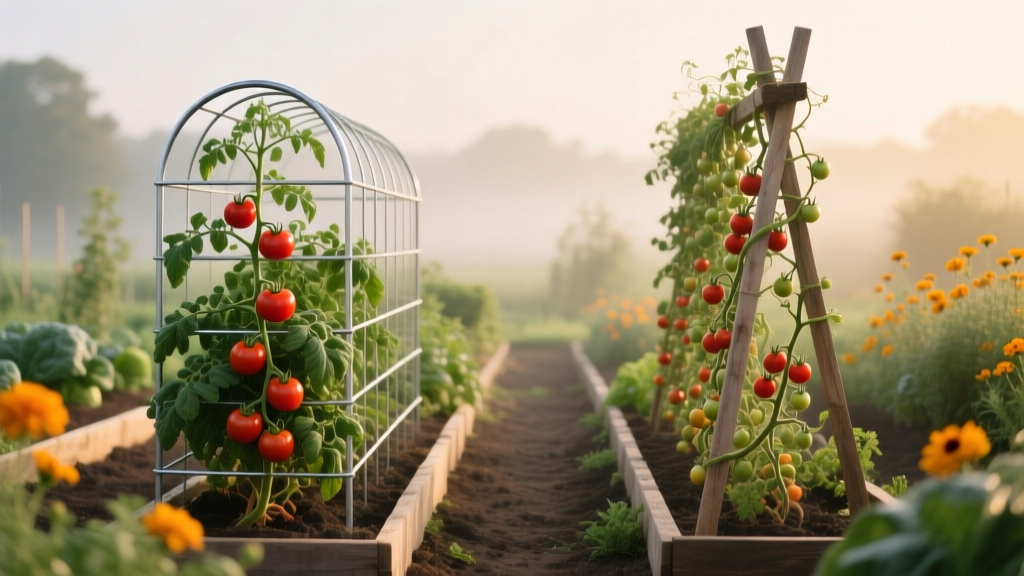
Tomato Cage vs Trellis: Aesthetic Garden Patterns 2026
David ParkPublished
The Intersection of Lawn Aesthetics and Vegetable Gardening
Welcome to 2026, where the boundary between the meticulously manicured lawn and the edible garden has completely dissolved. Homeowners who spend hours perfecting lawn striping patterns, checkerboards, and diamond motifs with their zero-turn mowers are now applying those same principles of visual geometry to their vegetable beds. A beautifully striped lawn demands an equally intentional landscape design in the garden. When it comes to growing tomatoes, the choice between a tomato cage and a trellis is no longer just an agricultural decision about yield; it is a fundamental landscape architecture choice that dictates the visual flow, sightlines, and aesthetic patterns of your outdoor space.
Just as a lawn striper bends grass blades to reflect light and create contrasting lines, garden hardscaping and plant supports create shadows, structural lines, and geometric patterns. Choosing the right support method for your tomatoes allows you to extend the visual harmony of your lawn directly into your vegetable patches. Let us explore how tomato cages and trellises compare through the lens of aesthetic garden design and geometric patterns.
Trellis Systems: Linear Geometry and Garden 'Striping'
If lawn striping is all about drawing the eye down long, parallel lines to create a sense of depth and order, trellis systems are the vegetable garden's equivalent. Trellises—including cattle panel arches, wooden lattices, vertical A-frames, and tensioned wire systems—create strong linear perspectives. When planted in long, uniform rows, trellised tomatoes act like the stripes on a freshly mowed lawn, establishing powerful sightlines that guide the viewer's eye toward a focal point, such as a garden bench, a water feature, or the horizon.
In 2026, the prevailing aesthetic trend for trellises leans heavily toward matte-black powder-coated steel T-posts paired with heavy-duty, UV-resistant biodegradable jute netting or rigid steel grids. This dark, minimalist hardware allows the vibrant green foliage and bright red, yellow, and purple fruits to pop visually, much like the dark, rich soil contrasts with bright green turfgrass. Trellising is primarily used for indeterminate tomato varieties, which continue to grow and produce fruit throughout the season. By training these vines vertically using the 'Florida Weave' method or single-leader string trellising, you create a living wall of vegetation that serves as a striking, structured backdrop for the rest of your garden.
Tomato Cages: Radial Symmetry and Focal Points
While trellises provide linear structure, tomato cages introduce radial symmetry and circular geometry to the landscape. In lawn design, circular patterns—such as a curved island bed, a circular driveway, or a round patio—serve to break up the monotony of parallel stripes, providing a resting place for the eye and a distinct focal point. Tomato cages function identically in the vegetable garden.
Modern tomato cages have evolved far beyond the flimsy, conical wire structures of the past. Today's aesthetic gardeners utilize heavy-duty concrete remesh cylinders, corten steel rings, and custom-welded galvanized steel hoops. These structures create a rounded, voluminous silhouette. When placed in a staggered or grid-like formation within a raised bed, cages create a polka-dot or radial pattern that contrasts beautifully with the linear edges of the garden beds. Cages are best suited for determinate (bush) tomato varieties, which grow to a compact, predetermined height and produce their fruit all at once, filling out the cylindrical space with a dense, rounded canopy of leaves and fruit.
Head-to-Head Comparison: Cages vs. Trellises
To help you decide which support method best complements your landscape design and lawn patterns, review the comprehensive comparison below.
| Feature | Trellis Systems (Linear) | Tomato Cages (Radial) |
|---|---|---|
| Visual Pattern | Parallel lines, sightlines, living walls | Circular focal points, radial symmetry, grid dots |
| Best Tomato Type | Indeterminate (vining) | Determinate (bush) or semi-determinate |
| 2026 Material Trend | Matte-black steel posts, jute netting, cedar frames | Corten steel rings, concrete remesh, powder-coated hoops |
| Airflow & Disease | Excellent (maximizes vertical air circulation) | Good (if properly spaced and lower leaves are pruned) |
| Pruning Requirement | High (requires regular sucker removal for single/double leaders) | Low to Moderate (minimal pruning, mostly lower leaf removal) |
| Space Efficiency | High (plants can be spaced 18-24 inches apart in rows) | Low (requires 36+ inches of radial clearance per plant) |
| Winter Storage | Panels and posts stack flat; netting is composted | Cylinders can be bulky; remesh can be rolled or stacked |
Designing Your 2026 Aesthetic Tomato Layout
Integrating your tomato supports into the broader aesthetic of your yard requires precision. Just as you would use a GPS-guided mower or a striping kit to ensure your lawn lines are perfectly straight, you must use mason lines and measuring tapes to lay out your garden supports.
Layout Strategy for Trellises
If your lawn features long, parallel stripes, mirror this in your garden by installing a long cattle panel or wooden trellis along the northern edge of your vegetable plot. This prevents the tall plants from shading shorter crops. Drive your steel T-posts exactly 8 feet apart, using a string line to ensure they are perfectly flush and level. Plant your indeterminate tomatoes 18 inches apart at the base of the trellis. As they grow, weave them through the 5-inch by 5-inch grid of the trellis netting. The resulting flat, vertical plane of greenery will echo the clean, flat planes of your striped turf.
Layout Strategy for Cages
If your lawn features a checkerboard or diamond pattern, utilize tomato cages to create a geometric grid in your raised beds. Place large, 24-inch diameter steel cages in a staggered triangular grid, ensuring exactly 36 inches of clearance between the outside edges of each cage. This radial layout creates a sense of organized abundance and provides ample room for companion planting—such as marigolds and basil—in the negative space between the circular cages.
Plant Health, Airflow, and Yield Considerations
Aesthetic patterns must never compromise plant health. The geometric arrangement of your supports directly impacts airflow, sunlight penetration, and disease resistance. According to the University of Minnesota Extension, proper staking and trellising are critical for keeping tomato foliage off the ground, which drastically reduces the risk of soil-borne fungal diseases like early blight and septoria leaf spot. Trellises excel in this regard, as the strict vertical training opens the plant canopy to maximum air circulation.
However, trellising indeterminate varieties requires a commitment to pruning. The Texas A&M AgriLife Extension emphasizes that removing 'suckers'—the side shoots that grow in the axils of the leaves—is essential for maintaining a clean, single-leader or double-leader vine on a trellis. This pruning not only keeps the linear aesthetic sharp and untangled but also directs the plant's energy into fruit production rather than excess foliage.
For those using cages, the pruning requirements are less intensive, but maintenance is still required to maintain the radial aesthetic. The Penn State Extension notes that even caged tomatoes benefit from the removal of the bottom 10 to 12 inches of foliage once the plant is established. This prevents soil splash-back onto the lower leaves and creates a clean, elevated 'trunk' that enhances the visual appeal of the circular cage, making the plant look more like a structured topiary than a wild bush.
Conclusion: Blending the Lawn and the Harvest
The debate between tomato cages and trellises is ultimately a conversation about the visual language of your landscape. If your goal is to extend the crisp, parallel, and highly structured aesthetic of a striped lawn into your edible garden, trellises are your best tool. They provide linear geometry, maximize space, and create breathtaking living walls. Conversely, if you wish to introduce radial symmetry, soften hard lines, and create distinct circular focal points within your garden beds, heavy-duty tomato cages offer a beautiful, low-maintenance solution. By thoughtfully selecting your support structures in 2026, you can cultivate a vegetable garden that is as visually stunning and geometrically precise as your most prized lawn.
