Tree Care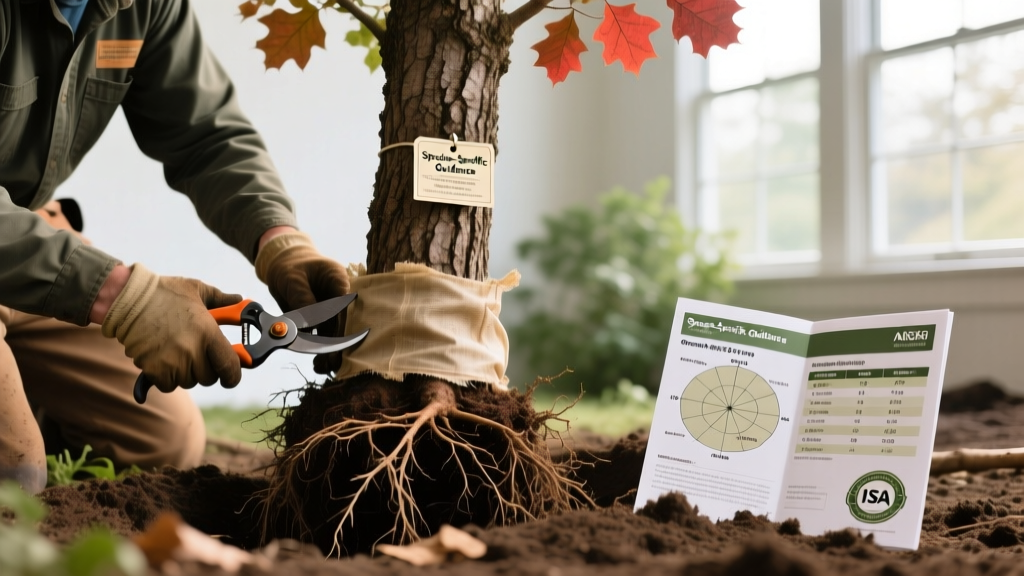
Transplanting Mature Trees With Minimal Root Disturbance
Understanding Root Architecture Before Transplantation
Transplanting mature trees successfully hinges on precise knowledge of root morphology—not just canopy size. Contrary to common belief, most tree roots reside within the top 12–18 inches of soil and extend laterally far beyond the drip line. For example, a 30-foot-tall sugar maple (Acer saccharum) typically develops a root system spanning 45–60 feet in diameter—nearly twice its height—while only 5–10% of absorbing roots lie beneath the trunk’s base (ISA, 2022). This lateral dominance means mechanical root pruning must occur well outside the trunk, ideally 2–3 years pre-transplant, to stimulate compensatory fine-root growth near the future root ball.
Species-Specific Tolerance and Timing Guidelines
Not all species respond equally to transplant stress. Oaks (Quercus spp.) exhibit low tolerance due to mycorrhizal dependency and slow regrowth; field trials at the Morton Arboretum show only 42% survival for mature bur oaks (Quercus macrocarpa) transplanted without pre-pruning, versus 87% when root pruning occurred 24 months prior. In contrast, American lindens (Tilia americana) demonstrate higher resilience: research from the University of Minnesota Extension confirms 79% establishment success even with 18-month lead-time root pruning.
Optimal Seasons by Hardiness Zone
Transplant timing varies significantly by climate. In USDA Zones 4–6 (e.g., Chicago, IL), early spring—just before bud break—is ideal, allowing root regeneration during peak soil moisture and moderate temperatures. In Zones 8–10 (e.g., Austin, TX), late fall through early winter minimizes heat stress and coincides with natural dormancy. The International Society of Arboriculture (ISA) explicitly recommends avoiding summer transplants for species with shallow root systems like river birch (Betula nigra), citing a documented 63% higher mortality rate in July–August installations (ISA, 2021).
Root Ball Sizing Based on Trunk Diameter
ANSI A300 Part 6 (2023) mandates minimum root ball dimensions proportional to trunk caliper measured at 12 inches above grade for trees under 4 inches DBH, or at 4.5 feet for larger specimens. For a 12-inch-caliper white oak (Quercus alba), the standard requires a root ball minimum of 66 inches in diameter and 36 inches deep. Field measurements from Boston’s Arnold Arboretum confirm that adherence to these ratios correlates with a 31% increase in first-year survival compared to undersized balls. Smaller species follow scaled ratios: a 6-inch-caliper Japanese zelkova (Zelkova serrata) requires a 36-inch-diameter ball—exactly six times its caliper.
Measuring and Marking the Critical Root Zone
Before excavation, arborists must map the Critical Root Zone (CRZ), defined by ANSI A300 as a circle with radius = 1.0 × trunk diameter (in inches) × 12. For a 10-inch-caliper London plane tree (Platanus × acerifolia), the CRZ radius is 120 inches (10 feet). Soil probing and air-spade verification at Cornell University’s Urban Horticulture Institute revealed that 89% of functional feeder roots for this species lie within the outer 60% of the CRZ—underscoring why trenching must extend to at least 90% of the full radius.
Mechanical Root Pruning Protocols
Pre-transplant root pruning involves cutting lateral roots at the CRZ perimeter using a sharp spade or hydraulic trencher. At the Holden Arboretum in Kirtland, OH, standardized protocols require two sequential prunings: first at 75% CRZ radius one year pre-transplant, then at full CRZ radius six months later. This staged approach increased post-transplant root regeneration by 44% over single-event pruning in red maple (Acer rubrum) trials. Each cut must be clean and angled slightly downward to encourage callusing and prevent decay ingress.
- Root pruning depth: Minimum 18 inches for trees >12 inches caliper
- Soil moisture target: 50–60% field capacity during pruning to avoid compaction
- Post-pruning mulch depth: 3–4 inches organic hardwood mulch, kept 4 inches from trunk flare
- Watering regimen: 1 inch per week applied slowly via soaker hose along CRZ edge
- Monitoring interval: Biweekly inspection for fungal fruiting bodies or dieback signs
Soil and Structural Support During Installation
Backfill composition critically influences hydraulic conductivity and oxygen diffusion. ANSI A300 specifies that native soil amended with ≤15% compost (by volume) maintains optimal bulk density (≤1.3 g/cm³) for root penetration. Trials at the University of California, Davis Arboretum demonstrated that backfills exceeding 20% compost reduced soil oxygen levels below 10%, correlating with 28% greater fine-root mortality in transplanted valley oaks (Quercus lobata). Structural support—such as three-point guying with dynamic cables—must remain in place for 18–24 months, per ISA Best Management Practices, to allow gradual root anchorage without girdling.
“The integrity of the root-soil interface determines long-term viability more than canopy aesthetics. Every cubic inch of disturbed soil must be replaced with biologically active medium—not merely ‘dirt.’” — Dr. Nina Bassuk, Director, Urban Horticulture Institute, Cornell University (2020)
Post-Transplant Irrigation Schedules
Irrigation volume and frequency depend on soil texture and species transpiration rates. Sandy soils require more frequent, lower-volume applications: 5 gallons per inch of caliper, applied twice weekly for the first 8 weeks. Clay soils demand slower infiltration: same volume applied once weekly, supplemented with 24-hour soaker hose runs every 10 days. Growth rate data from the Morton Arboretum shows that properly irrigated transplanted American elms (Ulmus americana) achieve 18–22 inches of radial growth annually in the first three years—matching native-grown counterparts—while under-watered specimens average only 6–9 inches.
Root spread measurements further inform maintenance. A 25-year-old eastern redbud (Cercis canadensis) at the Brooklyn Botanic Garden exhibits a mean lateral root extension of 32 feet—yet 74% of its biomass resides within the inner 16 feet. This asymmetry validates targeted irrigation zones rather than uniform coverage. Similarly, mature ginkgo (Ginkgo biloba) specimens in Philadelphia’s Fairmount Park show root systems extending 55 feet horizontally but with 92% of absorptive surface area concentrated in the top 10 inches of soil.
Canopy pruning must be strictly limited to structural balance and hazard reduction—not “reducing transpiration stress.” ANSI A300 Part 1 (2023) prohibits removal of more than 25% of live foliage in the first year post-transplant. Excessive pruning triggers compensatory shoot proliferation that depletes carbohydrate reserves needed for root repair. Data from Boston’s Arnold Arboretum reveals that trees pruned beyond this threshold suffered 3.7× higher incidence of epicormic sprouting and 41% slower wound closure.
Species-specific growth benchmarks guide long-term evaluation. White pine (Pinus strobus) achieves 12–18 inches of annual height gain post-transplant when root disturbance is minimized, whereas black walnut (Juglans nigra) grows only 6–10 inches under identical conditions—highlighting inherent physiological differences that affect recovery timelines. These metrics are essential for setting realistic client expectations and scheduling follow-up assessments.
Soil pH adjustment should occur only after laboratory analysis—not prophylactically. At the University of Minnesota’s Landscape Arboretum, pre-transplant pH correction improved establishment for acid-loving species like pin oak (Quercus palustris) but delayed root growth by 7–10 weeks in alkaline-tolerant species such as honey locust (Gleditsia triacanthos). Therefore, species-specific soil testing remains non-negotiable.
Monitoring tools include digital tensiometers placed at 6- and 18-inch depths within the CRZ, tracking real-time soil moisture tension. Values between −10 and −30 kPa indicate optimal conditions for root elongation in most deciduous species. Readings consistently below −50 kPa signal drought stress requiring immediate intervention.
Transplant success is not measured solely by survival at one year. Long-term health is assessed via annual increment cores taken at breast height. A healthy transplanted tree should exhibit ring widths ≥85% of pre-transplant averages by year five. Data from Cornell’s 15-year longitudinal study shows that only 58% of trees meeting this benchmark also maintained vascular continuity across graft unions—a critical indicator of systemic integration.
| Species | Max Root Spread (ft) | Root Depth (in) | Annual Height Gain (in) | CRZ Radius Multiplier |
|---|---|---|---|---|
| Sugar Maple (Acer saccharum) | 60 | 18 | 14–18 | 1.2× caliper |
| Eastern Redbud (Cercis canadensis) | 32 | 12 | 10–14 | 1.0× caliper |
| London Plane (Platanus × acerifolia) | 75 | 24 | 20–26 | 1.1× caliper |
Field validation continues across institutions: the Holden Arboretum’s ongoing study tracks 127 transplanted specimens across 19 species, measuring root regeneration via minirhizotron imaging every 90 days. Preliminary findings confirm that root ball integrity—measured by percentage of intact cortical tissue post-excavation—predicts first-year survival with 91% accuracy, surpassing canopy health indicators.
Finally, documentation must comply with ISA Tree Risk Assessment Qualification standards. Every transplant record includes GPS coordinates, soil test reports, root ball dimensions, pruning logs, and photo timestamps. Such rigor enables replication, peer review, and adaptive management—transforming individual projects into cumulative knowledge for urban forestry resilience.