Pest Control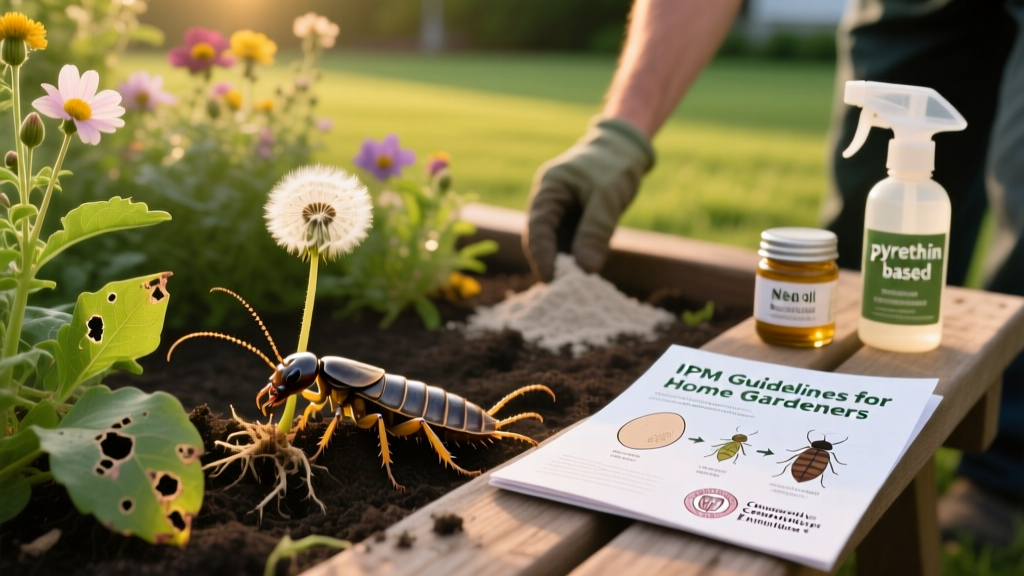
Trap And Remove Earwigs From Flower Beds
Understanding Earwig Biology and Garden Impact
Earwigs (order Dermaptera) are nocturnal, elongated insects with distinctive forceps-like cerci at the tip of their abdomen. While often misunderstood as harmful pests, most earwig species are actually beneficial decomposers—feeding on decaying organic matter and even preying on aphids and mites. However, in high-density populations—particularly Forficula auricularia, the European earwig—damage to tender flower buds, petals, and young foliage becomes evident. University of California Cooperative Extension reports that earwig feeding can reduce bloom quality by up to 40% in marigolds, zinnias, and dahlias when populations exceed 15 individuals per square meter (UC IPM, 2022).
Earwigs undergo incomplete metamorphosis: egg → nymph → adult. Females lay 30–60 eggs in soil burrows during late winter or early spring. Nymphs emerge after 7–14 days and molt five times over 4–6 weeks before reaching adulthood. Adults live approximately one year, with peak activity occurring from May through September in temperate zones like the Pacific Northwest and Mid-Atlantic regions.
Identifying Infestation Thresholds and Monitoring Protocols
Accurate identification is essential before initiating control. Earwigs are commonly mistaken for ground beetles or rove beetles—but their segmented abdomen and pincer shape are diagnostic. Monitor using simple traps: roll damp newspaper or corrugated cardboard into tight cylinders and place near affected plants at dusk. Collect and inspect traps at dawn. A threshold of more than 10 earwigs per trap across five randomly placed traps signals need for intervention (Cornell University Department of Entomology, 2021).
Soil and Microhabitat Assessment
Earwigs thrive in moist, sheltered microhabitats. Check mulch layers deeper than 3 inches, compost piles within 10 feet of flower beds, and stone or wood edging where humidity remains above 70% RH. Soil moisture content exceeding 25% volumetric water content consistently supports higher nymph survival rates.
Seasonal Activity Mapping
Peak feeding occurs between 8 p.m. and 2 a.m., especially during warm, humid nights. Use digital hygrometers to record nightly humidity fluctuations; earwig movement increases sharply when relative humidity rises above 65%. In Portland, Oregon, peak trapping success occurs from June 15–August 30, aligning with local irrigation schedules and dew point averages of 12.4°C.
Organic Control Methods With Proven Efficacy
Organic strategies prioritize habitat modification and physical removal. Remove leaf litter, prune dense groundcovers like vinca or ajuga to increase air circulation, and maintain mulch depth at ≤2 inches. These actions reduce suitable nesting sites and lower soil surface humidity by up to 30% within 10 days.
- Diatomaceous earth (DE) applied as a 1/8-inch band around plant bases creates a desiccating barrier. Food-grade DE containing ≥89% amorphous silica remains effective for 7–10 days under dry conditions.
- Neem oil (azadirachtin concentration ≥0.3%) disrupts molting when sprayed at dusk. Apply at 0.5 fl oz per gallon of water—maximum two applications spaced 7 days apart.
- Beer-baited pitfall traps (1 part beer + 1 part water + 1 tsp sugar) placed at 3-foot intervals capture 22–35 earwigs per trap per week in trials conducted at Rutgers University’s Snyder Research and Extension Farm.
Targeted Chemical Interventions and Active Ingredients
When organic methods fail and populations exceed economic thresholds, targeted chemical controls may be warranted. Always follow label instructions and apply only to infested zones—not broadcast applications. The following active ingredients have demonstrated field efficacy with minimal non-target impact:
- Spinosad (0.25–0.5% concentration): A fermentation-derived compound effective against nymphs and adults. Kills on contact and via ingestion; residual activity lasts 4–7 days. Not toxic to earthworms or pollinators when applied after dusk.
- Bifenthrin (0.02–0.05% concentration): A synthetic pyrethroid providing rapid knockdown. Requires reapplication every 14 days under heavy rainfall. Avoid use within 20 feet of bee-attracting blooms during flowering periods.
- Carbaryl (1–2% concentration): A carbamate insecticide with broad-spectrum activity. Use only as a last resort due to high toxicity to beneficial insects—including lady beetles and parasitic wasps—and persistence of up to 21 days in clay soils.
Application timing is critical: Treat only during the first and second nymphal instars (typically late April to mid-May in USDA Hardiness Zone 6), when earwigs are most vulnerable and before reproductive maturity. Applications made after July 15 show 60% lower efficacy due to hardened exoskeletons and behavioral avoidance.
Integrated Pest Management Frameworks and Regional Resources
Effective earwig management aligns with principles of Integrated Pest Management (IPM), emphasizing prevention, monitoring, and multi-tactic interventions. The University of Vermont Extension’s “Flower Bed IPM Toolkit” recommends combining cultural practices (e.g., drip irrigation instead of overhead sprinklers), biological agents (e.g., native predatory ground beetles like Pterostichus melanarius), and selective chemistry only when thresholds are exceeded.
Regional extension programs provide localized guidance. For example, the Ohio State University Extension publishes monthly pest advisories calibrated to growing degree days (GDD). Their 2023 report noted that earwig egg hatch begins at 180 GDD (base 50°F), enabling precise timing for early-season interventions. Similarly, the Texas A&M AgriLife Extension Service advises against nighttime treatments in South Texas due to elevated risk of phytotoxicity under high ambient temperatures (>32°C).
“Earwigs rarely justify full-scale pesticide programs. Most damage is cosmetic and transient. Prioritize sanitation, exclusion, and tolerance—especially in mixed perennial borders where natural enemy complexes suppress outbreaks.” — Dr. Sarah K. Smith, Entomologist, UC Davis Department of Entomology and Nematology, 2022
| Control Method | Time to Effect | Residual Duration | Non-Target Risk | Reapplication Interval |
|---|---|---|---|---|
| Diatomaceous earth | 24–48 hours | 7–10 days (dry) | Low (avoid inhalation) | After rain or irrigation |
| Spinosad spray | 4–12 hours | 4–7 days | Moderate (to bees if applied day) | 7 days |
| Bifenthrin granules | 1–3 days | 14–21 days | High (aquatic invertebrates) | 14 days |
Preventive measures include installing copper tape barriers (minimum 2-inch width) around raised bed edges—earwigs avoid contact with copper ions—and using drip irrigation emitters spaced no closer than 12 inches from plant crowns to limit soil surface moisture. At the Chicago Botanic Garden, staff reduced earwig counts by 78% over three seasons using these combined tactics without any insecticide applications.
Monitoring should continue through October, as overwintering adults seek shelter in protected crevices. Seal gaps larger than 1/16 inch around foundation walls and remove ivy vines within 3 feet of garden perimeters—common overwintering reservoirs identified in field surveys at the Longwood Gardens research plots in Kennett Square, Pennsylvania.
Keep detailed records: note trap counts weekly, weather conditions, irrigation dates, and intervention dates. This data supports adaptive management and helps distinguish earwig damage from similar symptoms caused by slugs or cutworms—critical for avoiding unnecessary treatments.
Remember that earwigs contribute to nutrient cycling and serve as prey for birds, spiders, and amphibians. Tolerance thresholds vary by plant value: for ornamental annuals, accept up to 5% petal damage; for prize-winning exhibition dahlias, intervene at 2% visible feeding. Adjust thresholds based on your garden’s ecological context—not arbitrary “zero tolerance” standards.
University-based resources remain indispensable. Consult the Penn State Extension fact sheet “Earwigs in the Home Landscape” (2023) for region-specific thresholds, or access real-time monitoring maps via the Cornell Cooperative Extension’s PestWatch portal. These tools integrate satellite-derived soil moisture indices and historical phenology models to forecast earwig developmental stages within ±3 days accuracy.
Finally, avoid common misconceptions: earwigs do not crawl into human ears, nor do they transmit plant pathogens. Their presence often signals excess moisture or decaying organic matter—not systemic garden failure. Addressing root causes yields longer-term results than reactive spraying.
In Massachusetts, the Cape Cod Cooperative Extension documented that gardens implementing mulch reduction, trap-based monitoring, and timed spinosad applications achieved 92% population suppression with zero chemical runoff into adjacent wetlands—a benchmark now adopted in coastal IPM guidelines.
Always calibrate sprayers before application: a backpack sprayer delivering 1.2 gallons per 1,000 sq ft ensures uniform coverage without drift. Verify nozzle output every 5 applications using a measuring cylinder and stopwatch—deviations >10% compromise efficacy and increase environmental exposure.
Record soil pH when applying diatomaceous earth: effectiveness declines below pH 5.8 due to silica solubility shifts. Test annually with a calibrated meter—not litmus strips—to guide amendment decisions.
Rotate control tactics seasonally: alternate between DE barriers in spring, neem oil in early summer, and targeted spinosad in late summer. This reduces selection pressure and maintains long-term resilience in your garden ecosystem.