Tree Care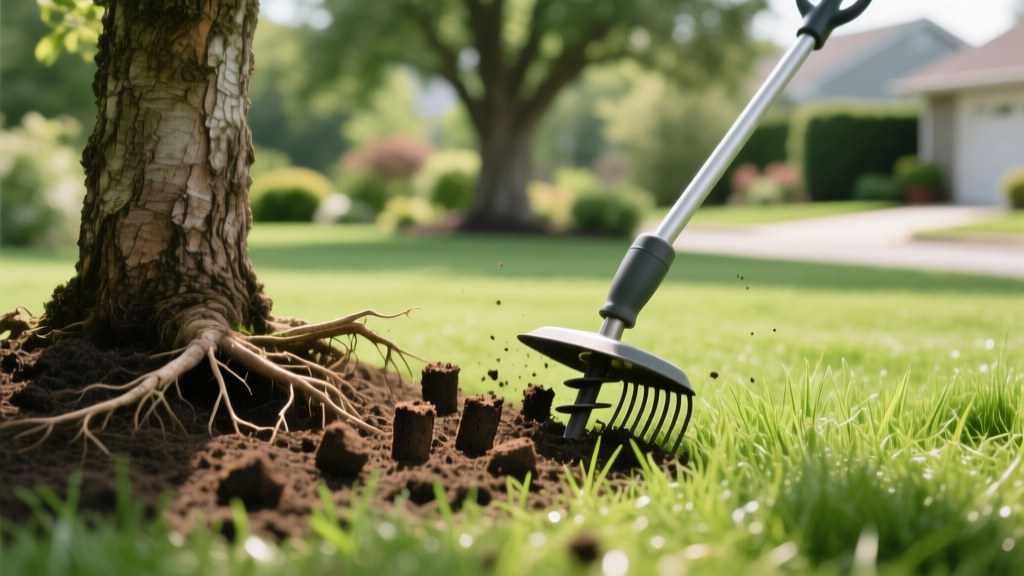
Tree Root Zone Aeration and Safe Lawn Overseeding Guide
James MillerPublished
The Intersection of Lawn Care and Tree Health
Most homeowners view lawn aeration and overseeding as strictly turf-management tasks. However, when your lawn intersects with the Critical Root Zone (CRZ) of mature trees, these routine practices become vital tree-care operations. The soil beneath your lawn is the same soil that supports the structural and biological needs of your trees. Mismanaging this shared space can lead to severe root damage, soil compaction, and ultimately, the decline of your most valuable landscape assets.
According to the Penn State Extension, the vast majority of a tree's fine, water-absorbing roots are located in the top 12 to 18 inches of soil, often extending well beyond the drip line. Because these roots share the exact same profile as your turfgrass roots, standard lawn care equipment can easily wreak havoc on tree health if not applied with arboricultural best practices in mind.
Why Standard Lawn Aeration Harms Trees
Core aeration is a fantastic practice for relieving soil compaction in open lawn areas. The process involves pulling 2-to-3-inch plugs of soil from the ground, allowing oxygen, water, and nutrients to penetrate the turf root zone. However, driving a heavy, gas-powered core aerator over the Critical Root Zone of a mature tree is highly discouraged.
The solid metal tines of a core aerator act like guillotines to the fine, fibrous feeder roots of a tree. While a healthy tree can survive minor root pruning, repeated severing of the upper soil profile roots—combined with the heavy weight of the machine compacting the soil further—creates a stress cycle that invites opportunistic pests and fungal pathogens. Furthermore, the International Society of Arboriculture (ISA) explicitly warns against mechanical damage and soil grade changes near the trunk, as these are leading causes of urban tree decline.
Professional Tree Root Zone Aeration Techniques
To alleviate soil compaction around trees without destroying the root system, arborists utilize specialized techniques designed to introduce oxygen into the soil matrix while preserving root integrity.
1. Radial Trenching
Radial trenching involves digging narrow trenches in a wheel-spoke pattern radiating outward from the trunk. Using an air knife or specialized narrow trencher, arborists dig trenches approximately 3 to 4 inches wide and 8 to 12 inches deep. These trenches begin at least 3 feet away from the trunk to avoid damaging major structural anchor roots and extend out to the drip line. The trenches are then backfilled with a mix of compost, coarse sand, and slow-release organic fertilizer, creating permanent channels for air and water infiltration.
2. Air Spading (Pneumatic Excavation)
Air spading is the gold standard for tree root zone aeration. An Air Spade uses highly compressed air (up to 1200 mph) to blast away compacted soil without cutting or tearing the flexible tree roots. This tool allows arborists to safely expose the root flare, diagnose girdling roots, and fracture compacted soil layers deep in the profile. The loosened soil is then amended with organic matter and gently raked back over the roots.
3. Vertical Mulching
Vertical mulching involves drilling a grid of 2-inch wide holes, about 12 to 18 inches deep, throughout the CRZ using a manual post-hole digger or specialized auger. These holes are filled with a porous mixture of pea gravel, calcined clay, and compost. This technique is highly effective for breaking up heavy clay soils and providing long-term oxygen pathways to deeper root zones.
Comparison Chart: Soil Aeration Methods for Trees
| Method | Best Application | Estimated Cost | Root Damage Risk |
|---|---|---|---|
| Standard Core Aeration | Open lawn areas only (outside CRZ) | $15 - $25 per 1,000 sq ft | High (Severs feeder roots) |
| Radial Trenching | Moderately compacted soils under mature canopies | $300 - $600 per tree | Low (Avoids anchor roots) |
| Air Spading | Severe compaction, root flare excavation, girdling roots | $150 - $250 per hour | None (Non-invasive) |
| Vertical Mulching | Heavy clay soils, poorly drained urban sites | $200 - $400 per tree | Very Low (Small diameter holes) |
Best Practices for Overseeding Under the Drip Line
Once the soil is properly aerated, homeowners often wish to overseed the thinning grass beneath the tree's canopy. Overseeding in the shade of a mature tree requires a delicate balance between establishing turf and protecting the tree's root flare and soil grade.
Managing the Root Flare
The most critical rule of overseeding near trees is to never bury the root flare. The root flare is the area at the base of the trunk where the roots begin to spread outward. Burying this area with topsoil, compost, or thick layers of grass seed mulch cuts off oxygen to the phloem and cambium layers, leading to trunk rot and suffocation. Always maintain a 2-to-3-foot mulch ring (using wood chips, not grass) around the base of the trunk where no seed or topsoil is applied.
Choosing the Right Seed
Standard Kentucky Bluegrass will fail under a dense tree canopy due to lack of sunlight and intense competition for water. Instead, opt for fine fescues. Creeping red fescue, chewings fescue, and hard fescue are highly shade-tolerant and require significantly less water and nitrogen, reducing the competitive stress on the tree's root system.
Topdressing Safely
When overseeding, it is common to apply a layer of compost or topsoil (topdressing) to protect the seed. Under a tree's drip line, this layer must not exceed 1/4 inch in thickness. Any deeper, and you risk altering the soil grade, which the ISA notes can severely restrict gas exchange and lead to the slow decline of the tree over several years.
Arborist Pro-Tip: Never use a heavy thatch rake or power dethatcher beneath the drip line of a tree. The aggressive metal tines will strip away the thin layer of topsoil and sever the microscopic mycorrhizal fungi networks that partner with tree roots to absorb phosphorus and water.
Step-by-Step Seasonal Schedule for Turf and Tree Coexistence
To successfully manage the intersection of lawn care and tree health, follow this seasonal schedule tailored for the cool-season transition zones:
- Early Spring (April): Inspect the tree's root flare. Carefully remove any soil or mulch that has accumulated against the trunk over the winter. Hand-pull weeds within a 3-foot radius of the trunk and apply a 2-inch layer of coarse arborist wood chips.
- Late Spring (May): If soil compaction is evident (water pools on the surface, or a screwdriver cannot easily penetrate the soil), hire an ISA-certified arborist to perform Air Spading or radial trenching. Do not attempt to core aerate the CRZ.
- Early Fall (September): This is the optimal window for overseeding. Mow the existing shade turf to 1.5 inches. Spread your fine fescue seed blend at a rate of 4 to 5 pounds per 1,000 square feet.
- Early Fall (Post-Seeding): Apply a maximum 1/4 inch layer of screened compost over the seed, strictly avoiding the 3-foot trunk mulch ring. Water lightly twice a day for 14 days until germination occurs.
- Late Fall (November): Rake fallen leaves gently off the new grass. Do not let wet leaves mat against the trunk, as this encourages fungal bark diseases and provides winter habitat for rodents that chew tree bark.
Conclusion
Aeration and overseeding are essential practices for a lush, vibrant landscape, but they must be adapted when working beneath the canopy of mature trees. By abandoning aggressive mechanical core aeration in the Critical Root Zone in favor of pneumatic or radial techniques, and by carefully managing topdressing depths during overseeding, you can maintain a beautiful shade lawn without sacrificing the long-term health and structural integrity of your trees. Remember, a healthy tree and a healthy lawn start with the exact same foundation: uncompacted, oxygen-rich soil.