Tree Care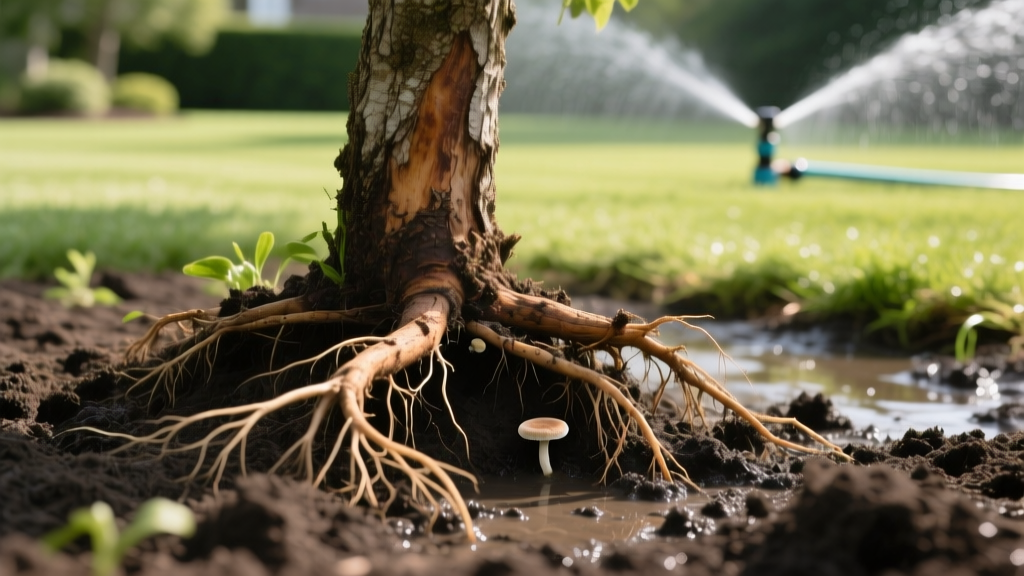
Tree Root Rot Identification and Treatment in Lawns
Robert HayesPublished
The Hidden Link Between Lawn Care and Tree Root Rot
Homeowners spend countless hours and dollars treating lawn diseases like brown patch, dollar spot, and Pythium blight. However, the very irrigation practices used to maintain a lush turfgrass canopy are often silently killing the mature shade trees in the same landscape. From a lawn disease identification and treatment perspective, excess soil moisture is the primary catalyst for fungal outbreaks. While turfgrass might recover from a seasonal fungal flare-up with a targeted fungicide application, trees suffering from moisture-induced root rot face a much graver threat. Understanding the intersection of lawn care and tree health is critical for holistic landscape management.
The Irrigation Paradox: Shallow Watering vs. Deep Roots
Turfgrass and trees have vastly different watering requirements. Most cool-season and warm-season lawn grasses thrive on frequent, relatively shallow watering that keeps the top two to four inches of soil consistently moist. Trees, conversely, require deep, infrequent watering to encourage taproots and deep lateral roots to anchor and seek moisture. When homeowners apply a lawn-centric irrigation schedule—watering for 15 to 20 minutes every morning—they create a perpetually saturated topsoil layer. This shallow water table displaces vital oxygen in the soil pore spaces. Tree feeder roots, which are concentrated in the top 12 to 18 inches of soil, essentially suffocate and begin to die. This anaerobic, moisture-logged environment is the exact breeding ground required by aggressive soil-borne pathogens.
Conducting a Soil Percolation Test
Before treating any suspected root disease, you must evaluate your soil drainage. Dig a hole approximately 12 inches deep and 12 inches wide in the lawn near the tree's drip line. Fill it with water and let it drain completely. Refill it a second time and
Identifying the Culprits: Phytophthora vs. Armillaria
To effectively treat the problem, you must first correctly identify the pathogen attacking your tree's root system. While both thrive in over-irrigated lawns, their biological mechanisms and visual symptoms differ significantly.
Phytophthora Root Rot (The Water Mold)
Despite being historically classified as fungi, Phytophthora species are actually oomycetes, or 'water molds.' They produce motile zoospores that literally swim through saturated soil to find and infect susceptible tree roots. According to the University of Wisconsin-Madison Plant Disease Diagnostics Clinic, Phytophthora root rot is one of the most destructive diseases of woody ornamentals in poorly drained or overwatered landscapes. Symptoms often include a rapid, unexplained wilting of the canopy, chlorosis (yellowing) of leaves, and dark, water-soaked cankers on the lower trunk that may ooze a reddish-black sap.
Armillaria Root Rot (Oak Root Fungus)
Armillaria is a true fungus that attacks trees already weakened by environmental stress, such as the chronic drought-stress paradox caused by root suffocation in wet lawns. The Clemson University Home & Garden Information Center notes that Armillaria is identifiable by the presence of white, fan-like mycelial mats growing just beneath the bark of the lower trunk and a distinct mushroom odor. In the autumn, you may also see clusters of honey-colored mushrooms fruiting at the base of the tree or emerging in the surrounding lawn.
| Feature | Phytophthora Root Rot | Armillaria Root Rot |
|---|---|---|
| Pathogen Type | Oomycete (Water Mold) | True Fungus (Basidiomycete) |
| Primary Trigger | Heavy clay soils, chronic overwatering | Tree stress, drought, root damage, poor drainage |
| Trunk Symptoms | Dark cankers, oozing reddish sap | White mycelial fans under bark, mushroom odor |
| Lawn Symptoms | Rarely visible above ground | Honey-colored mushrooms at tree base in fall |
| Highly Susceptible Trees | Dogwood, Beech, Cedar, Rhododendron | Oak, Pine, Birch, Fruit Trees |
Actionable Treatment and Recovery Strategies
Treating tree root rot requires a multi-pronged approach that addresses both the pathogen and the underlying lawn care practices that invited it.
Step 1: Recalibrate Lawn Irrigation Schedules
You must immediately alter the microclimate of the soil. Transition your lawn irrigation from daily shallow watering to deep, infrequent soaking. Apply approximately 1 to 1.5 inches of water per week, divided into two or three deep watering sessions. Use a soil probe or a long screwdriver to test moisture; it should easily penetrate 6 to 8 inches into the soil after watering, but the top 2 inches should be allowed to dry out between sessions. This restores oxygen to the root zone and halts the swimming capability of Phytophthora zoospores.
Step 2: Root Crown Excavation and Aeration
Many trees in lawns suffer from 'volcano mulching' or soil grade changes that bury the root flare. Carefully excavate the soil and mulch away from the trunk using a hand trowel or an air spade until the root flare is fully exposed. The University of Minnesota Extension emphasizes that exposing the root collar to air and sunlight helps dry out the infected tissue and slows the progression of Armillaria and Phytophthora. Additionally, use a core aerator on the surrounding lawn to alleviate soil compaction and improve subsurface drainage without severing major structural roots.
Step 3: Targeted Fungicide Applications
Chemical intervention is only effective when paired with cultural corrections. For Phytophthora, systemic fungicides containing phosphorous acid (phosphonates), such as Agri-Fos or Monterey Garden Phos, can be applied as a basal trunk spray or a soil drench. These products boost the tree's natural immune response and inhibit the pathogen's growth. For severe cases, professional arborists may use trunk injections of propiconazole or fosetyl-al. Note that chemical control for Armillaria is largely ineffective once the mycelial mats have girdled the trunk; treatment for Armillaria focuses entirely on cultural practices, extending the tree's life through rigorous stress reduction and soil aeration.
Preventative Landscape Management
Once a tree is stabilized, maintaining a healthy landscape requires ongoing vigilance. Implementing the following protocols will protect both your turfgrass and your trees from moisture-related diseases.
- Proper Mulching: Apply a 2 to 3-inch layer of organic wood chip mulch over the tree's root zone to retain moisture and regulate soil temperature. Crucially, keep the mulch at least 3 to 4 inches away from the trunk itself to prevent bark decay and rodent damage. Never pile mulch against the trunk in a 'volcano' shape.
- Lawn Fungicide Awareness: When applying preventative lawn fungicides for turf diseases, be aware that some active ingredients (like certain strobilurins) have limited efficacy against oomycetes like Phytophthora. Always select products specifically labeled for root rot pathogens if treating the soil beneath the tree canopy.
- Sanitation and Removal: If a tree succumbs to Armillaria, remove the stump and as much of the root system as possible before replanting in that area. The fungus can survive in dead wood for decades and spread via root-to-root contact to adjacent trees and shrubs.
- Resistant Species Selection: When replacing a lost tree in a poorly drained lawn area, select species with natural resistance to root rots, such as Bald Cypress, Willow Oak, or River Birch, which are adapted to wetter soil conditions.
'The most common cause of tree decline in residential landscapes is not a lack of water, but an excess of it, driven by irrigation schedules designed exclusively for turfgrass. Treating the tree requires treating the soil environment first.'
Conclusion
Bridging the gap between lawn disease management and tree care is essential for a thriving, sustainable landscape. By identifying the signs of root rot early, conducting simple soil drainage tests, and adjusting your irrigation and soil management practices, you can save your mature shade trees. A holistic approach to landscape hydration ensures that your turfgrass remains dense and green while your trees maintain the deep, robust root systems necessary to weather environmental stress and resist fatal fungal pathogens.