Pest Control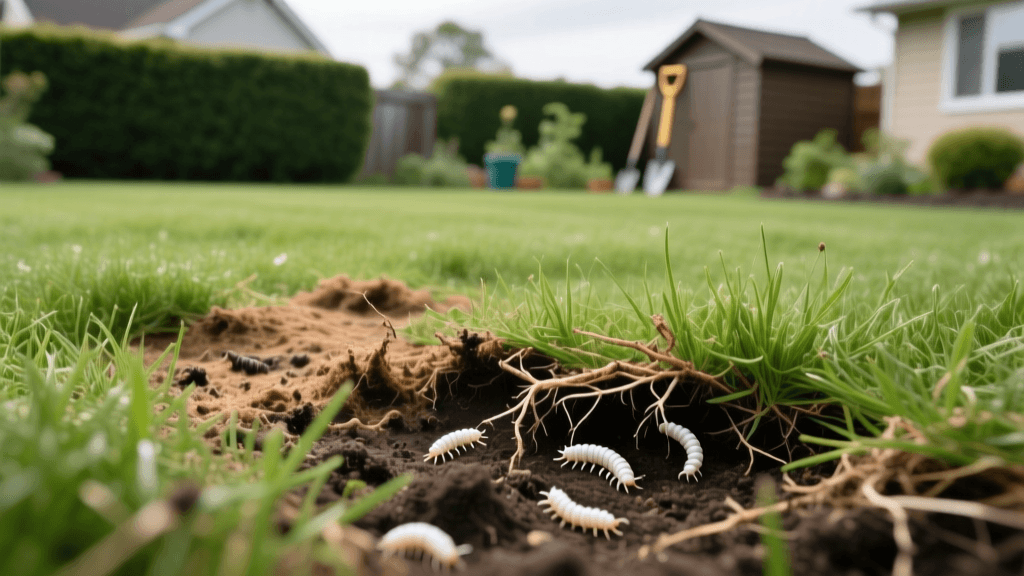
Troubleshooting Lawn Grub Damage: Diagnosis and Treatment
Introduction: Why Is My Lawn Still Dying?
Few things are more frustrating for a homeowner than applying a premium grub control product, only to watch the lawn continue to turn brown and deteriorate. White grubs—the larval stage of scarab beetles like Japanese beetles, European chafers, and June bugs—are notorious for destroying turfgrass root systems. However, misdiagnosis, improper application timing, and environmental barriers frequently lead to treatment failures. If you are dealing with persistent lawn decline, it is time to shift into problem diagnosis and troubleshooting mode. This comprehensive guide will help you accurately identify grub damage, understand why your previous treatments may have failed, and implement a robust Integrated Pest Management (IPM) strategy to save your turf.
Step 1: Accurate Diagnosis (Is it Really Grubs?)
Before troubleshooting a failed chemical or biological application, you must confirm that grubs are actually the culprit. Brown patches in the lawn are frequently misdiagnosed. Drought stress, dog urine spots, and fungal diseases like Brown Patch or Dollar Spot can mimic grub damage. According to the University of California Statewide IPM Program, accurate identification is the cornerstone of any successful pest management plan.
The Tug Test and Visual Inspection
Grubs feed on the roots of grass, severing the plant from its water and nutrient supply. To perform the 'tug test,' grab a handful of brown grass at the edge of a damaged patch and pull gently. If the grass pulls up easily like a loose carpet, the roots have likely been severed by grubs. If the grass resists and holds firm, you are likely dealing with a fungal issue or drought stress.
The 12x12 Inch Soil Sampling Method
To confirm an infestation and gauge its severity, you must dig. Use a spade to cut three sides of a 12-inch by 12-inch square in the turf, about 2 to 3 inches deep. Peel back the sod flap and inspect the soil and roots. Count the number of C-shaped, white grubs with brown heads.
- Low Threshold (0-5 grubs per sq. ft.): Healthy lawns can usually tolerate this level of feeding without visible damage. No treatment is necessary.
- Action Threshold (5-10+ grubs per sq. ft.): Treatment is required to prevent severe turf loss and secondary damage from foraging wildlife.
Step 2: Troubleshooting Treatment Failures
If you have confirmed a grub infestation but your lawn is still suffering, your treatment protocol likely failed due to one of the following common errors.
Failure 1: Incorrect Timing of Preventatives
The most common mistake homeowners make is applying preventative grub control products too late. Active ingredients like Chlorantraniliprole (e.g., Scotts GrubEx) and Imidacloprid (e.g., Bayer Advanced) are systemic and must be taken up by the grass roots. They are highly effective against young, newly hatched grubs (instars) but virtually useless against large, mature grubs in late summer or early fall.
The Fix: Preventatives must be applied between April and early July, depending on your region, allowing the chemical to translocate through the grass before the eggs hatch in late July and August. Research from Michigan State University Extension highlights that applying Chlorantraniliprole in April or May provides excellent season-long control, whereas applying it in August will result in complete treatment failure.
Failure 2: Using Curatives at the Wrong Time
If you missed the preventative window and discover grubs in September, you must use a fast-acting curative insecticide like Trichlorfon (e.g., Dylox). However, applying curatives in the spring is a waste of money. By spring, grubs are mature, near the soil surface, and preparing to pupate into adult beetles. They do minimal feeding, and the curative will degrade in the soil before the next generation hatches.
Failure 3: Failure to Water In Granular Products
Granular insecticides sit on the soil surface and thatch layer until they are washed down to the root zone where the grubs are feeding. If you apply a granular product and rely on morning dew or a light drizzle, the active ingredient will break down via UV exposure before reaching the pests.
The Fix: You must irrigate the lawn with exactly 0.25 to 0.5 inches of water immediately after application. Use an empty tuna can placed on the lawn to measure when your sprinkler has delivered the correct volume of water.
Failure 4: The Thatch Barrier
If your lawn has a thatch layer thicker than 0.5 inches, the thatch will bind the chemical molecules, preventing them from reaching the soil. Grubs will happily feed on the roots beneath the thatch barrier, completely untouched by the insecticide.
The Fix: Core aerate or dethatch the lawn before applying chemical treatments. Alternatively, use a liquid surfactant or a liquid hose-end spray formulation to help the active ingredient penetrate the thatch layer.
Grub Control Products: Troubleshooting Comparison Chart
Selecting the wrong product for the current season guarantees failure. Use this troubleshooting table to match your current situation with the correct active ingredient.
| Active Ingredient | Product Type | Best Application Window | Target Grub Stage | Est. Cost per 5,000 sq. ft. |
|---|---|---|---|---|
| Chlorantraniliprole | Preventative | April - Early June | Young Instars (Eggs/Hatching) | $15 - $20 |
| Imidacloprid | Preventative | June - Mid-July | Young Instars (Eggs/Hatching) | $12 - $18 |
| Trichlorfon | Curative | August - October | All Stages (Active Feeders) | $18 - $25 |
| Carbaryl | Curative | August - October | All Stages (Active Feeders) | $15 - $22 |
| Heterorhabditis Nematodes | Biological | August - September | Young to Medium Instars | $35 - $50 |
Step 3: Troubleshooting Secondary Damage
Sometimes, the grub control product worked perfectly, but the lawn still looks destroyed. If your turf features erratic, torn-up patches and deep divots, you are dealing with secondary pest damage. Skunks, raccoons, armadillos, and crows will actively tear up a lawn to feast on the protein-rich grubs beneath the soil.
Pro-Tip: Even if your insecticide successfully kills the grubs, the dead grubs remain in the soil and continue to emit a scent that attracts foraging wildlife for several weeks. To troubleshoot this, apply a wildlife repellent containing castor oil or use physical barriers like bird netting over highly damaged areas until the turf recovers.
Advanced IPM: Troubleshooting with Biological Controls
For homeowners looking to reduce synthetic chemical use, biological controls offer an excellent long-term IPM strategy. However, biologicals are living organisms and are highly susceptible to environmental troubleshooting errors.
Beneficial Nematodes (Heterorhabditis bacteriophora)
These microscopic worms seek out grubs, enter their bodies, and release bacteria that kill the host within 48 hours. Common Failure: Applying nematodes to hot, dry soil. Nematodes require moisture to move through the soil profile and will die rapidly if exposed to UV light or temperatures above 85°F.
The Fix: Apply nematodes in the late evening when soil temperatures are between 60°F and 70°F. Irrigate the lawn with 0.25 inches of water immediately before and after application to wash them off the grass blades and into the soil. According to Penn State Extension, maintaining consistent soil moisture for 7 to 10 days post-application is critical for nematode survival and efficacy.
Milky Spore (Paenibacillus popilliae)
Milky Spore is a naturally occurring bacterium that specifically targets Japanese Beetle grubs. Common Failure: Expecting immediate results. Milky Spore is not a curative treatment; it takes 2 to 4 years to build up sufficient spore counts in the soil to provide meaningful control. Furthermore, it is entirely ineffective against European Chafer or June Bug grubs.
Conclusion: Patience and Proper Lawn Care
Troubleshooting grub damage requires a methodical approach. By accurately diagnosing the pest, understanding the life cycle of the scarab beetle, and matching the correct active ingredient to the correct season, you can eliminate treatment failures. Remember that a thick, healthy lawn with a robust root system and proper soil fertility can tolerate low-level grub feeding without showing visual damage. Focus on core aeration, proper mowing heights (3 inches or higher), and deep, infrequent watering to build a turfgrass stand that naturally resists severe pest outbreaks.