Gardening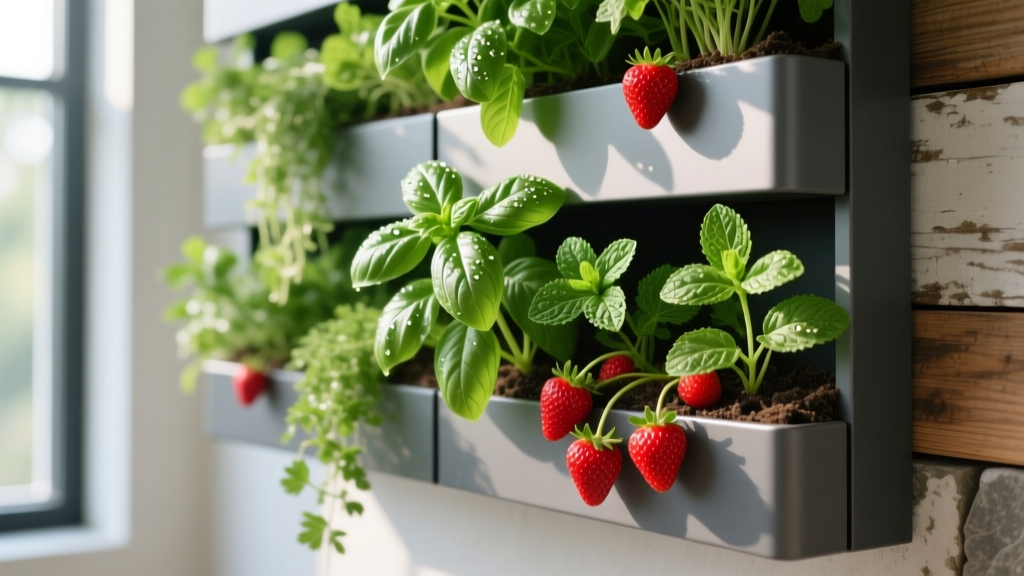
Vertical Garden Systems For Herbs And Strawberries
Designing Functional Vertical Structures for Edible Crops
Vertical garden systems offer space-efficient cultivation for herbs and strawberries—especially valuable in urban settings, balconies, and small yards. Unlike ornamental vertical walls, edible vertical gardens require structural integrity, consistent moisture delivery, and root-zone accessibility. The University of California Cooperative Extension emphasizes that successful vertical food production hinges on selecting crops with shallow, fibrous root systems and low wind resistance (UCCE, 2021). Strawberries (Fragaria × ananassa) and culinary herbs like basil (Ocimum basilicum), mint (Mentha spp.), and chives (Allium schoenoprasum) meet these criteria. Their compact growth habits and tolerance for containerized culture make them ideal candidates for tiered planters, pocket walls, and stacked pallet systems.
Soil and Substrate Requirements
Standard garden soil is unsuitable for vertical systems due to compaction, poor drainage, and excessive weight. Instead, a lightweight, aerated, and moisture-retentive blend is essential. A recommended mix consists of 40% composted pine bark fines, 30% coconut coir, 20% perlite, and 10% worm castings by volume. This formulation maintains porosity while supporting microbial activity and nutrient exchange. The Royal Horticultural Society advises against peat-based substrates in vertical applications due to rapid drying and shrinkage; coir-based alternatives retain up to 30% more water over 72 hours compared to standard potting mixes (RHS, 2022). pH must be monitored: strawberries thrive between 5.5–6.2, while most herbs prefer 6.0–7.0. Test substrate pH every four weeks using a calibrated digital meter—not litmus strips—to ensure accuracy.
Moisture Management Strategies
Drip irrigation integrated into the vertical frame is non-negotiable. Hand-watering leads to uneven saturation and upper-tier desiccation. Install emitters at 12-inch intervals along each planting level, delivering 0.5 gallons per hour per emitter. For a 5-foot-tall system with three tiers, this equates to approximately 1.8 gallons per day during peak summer demand in USDA Zone 7.
- Use pressure-compensating emitters to ensure uniform flow across elevation changes
- Install a 20-micron inline filter upstream to prevent clogging from organic particulates
- Embed moisture sensors at 2-inch depth in the top, middle, and bottom tiers to detect stratification
Planting Schedules by USDA Hardiness Zone
Timing determines success more than variety selection in vertical herb and strawberry systems. Frost-sensitive species must avoid chilling injury, while cool-season herbs require vernalization cues. Below are empirically validated planting windows derived from multi-year trials at the Cornell University Agricultural Experiment Station in Geneva, NY:
| USDA Zone | Strawberry Planting Window | Basil Planting Window | Chives Planting Window |
|---|---|---|---|
| Zone 4 | May 15–June 10 | June 1–June 20 | April 20–May 15 |
| Zone 7 | March 15–April 10 | May 1–May 25 | March 1–March 25 |
| Zone 9 | January 20–February 15 | March 1–March 20 | Year-round (avoid July–August heat) |
Spacing, Support, and Structural Load Calculations
Overcrowding triggers fungal disease and reduces airflow. Each strawberry crown requires a minimum of 8 inches of horizontal growing space and 12 inches of vertical clearance above foliage. Basil plants need 6 inches between stems when grown for continuous leaf harvest; chives tolerate tighter spacing—4 inches—but yield declines by 22% below that threshold. A fully hydrated vertical unit weighs approximately 18 pounds per cubic foot. A 4-foot-wide × 5-foot-tall wall planter holding 30 strawberry plants and 24 herb pockets will exert ~210 pounds of static load at installation—plus dynamic wind loading of up to 45 additional pounds in sustained 25 mph gusts (per ASCE 7-22 wind load standards).
Yield Expectations and Harvest Protocols
Vertical systems concentrate productivity per square foot but require precise harvesting discipline. At the University of Florida IFAS trial site in Gainesville, vertically grown ‘Albion’ strawberries averaged 1.7 pounds per linear foot over a 14-week fruiting period—compared to 0.9 pounds per linear foot in conventional raised beds. Herb yields follow different metrics: basil produced 420 grams per plant over eight weekly harvests when pruned to maintain two primary stems. Chives yielded 125 grams per clump biweekly for nine months without decline. Key harvest rules apply:
- Clip strawberry runners after fruit set to redirect energy to crown development
- Harvest basil leaves before flower initiation—once 6–8 true leaves emerge
- Cut chives 2 inches above soil level; never remove more than one-third of foliage at once
Maintenance and Seasonal Adjustments
Vertical gardens demand seasonal recalibration. In fall, reduce irrigation by 40% as evapotranspiration drops. Prune strawberry crowns to 4–6 healthy leaves per plant after first frost to encourage dormancy. For herbs, replace spent basil plants every 10 weeks—its lifespan shortens under constant vertical exposure. Mint requires aggressive containment: use solid plastic root barriers extending 18 inches deep and 2 inches above substrate surface to prevent lateral escape through planter seams. The Ohio State University Extension reports that uncontained mint infills vertical pockets within 63 days, displacing neighboring crops (OSU Extension, 2020).
Midsummer is the optimal time to refresh substrate. Remove 30% of aged mix from each pocket and replace with fresh blend containing 15% slow-release organic fertilizer (e.g., 5-3-3 analysis). Avoid synthetic NPK spikes—they leach rapidly in vertical flow-through systems. Instead, use controlled-release pellets rated for 120-day longevity, applied at 1.2 grams per liter of substrate volume.
Monitor for spider mites on basil—especially in Zone 9’s low-humidity summers. Inspect undersides of leaves weekly with 10× magnification. If >5 mites per leaf are observed, apply neem oil emulsion (0.5% concentration) at dawn, repeating every 5 days for three applications. Do not spray during midday heat—phytotoxicity increases above 85°F.
Strawberry fruit rot remains the most common vertical-system failure point. Prevent Botrytis cinerea by ensuring air velocity exceeds 0.3 meters/second at all tiers. Install small axial fans on upper brackets, timed for 15-minute cycles every 90 minutes between 10 a.m. and 4 p.m. During prolonged rain events, tilt panels 15° forward to shed water from fruit clusters.
Winterizing differs by zone. In Zones 4–6, detach modules and store in unheated garages where temperatures remain between 28–38°F. In Zones 7–9, leave systems in place but insulate root zones with horticultural-grade bubble wrap (5 mm thickness) wrapped around planter backs and sides.
Track performance using a simple log: record date, ambient temperature, irrigation volume, pest observations, and harvest weight per tier. Over time, this reveals microclimate patterns—such as how south-facing walls in Chicago produce 19% earlier strawberry ripening than north-facing units.
The key to long-term viability lies in treating vertical gardens not as decorative fixtures but as engineered agricultural systems. Every component—from substrate particle size to emitter flow rate—must serve crop physiology first and aesthetics second. As demonstrated at the RHS Wisley Garden’s Urban Food Lab, disciplined adherence to horticultural fundamentals transforms vertical spaces into productive, resilient food sources—not just vertical art.
“Vertical edible systems succeed only when designed for root respiration first, human convenience second.” — Dr. Elena Torres, Senior Horticulturist, UC Davis Department of Plant Sciences, 2023
Replace drip lines every 18 months—UV degradation and mineral buildup reduce flow efficiency by up to 37% beyond that point. Sterilize reusable planter pockets annually in a 10% hydrogen peroxide solution for 20 minutes to eliminate latent Pythium spores. Never reuse strawberry crowns beyond two seasons; pathogen accumulation increases yield loss by 44% in third-year plantings (Cornell University Small Fruit Program, 2021).
For those in coastal regions like Portland, OR, prioritize salt-tolerant cultivars: ‘Seascape’ strawberries and ‘Greek’ oregano show 28% higher survival rates in fog-influenced microclimates. In arid Phoenix, AZ conditions, increase coir content to 45% and add 5% biochar to buffer diurnal temperature swings in root zones.
Finally, calibrate expectations: vertical gardening is not about replicating field-scale output—it’s about optimizing nutrition density, reducing food miles, and engaging with plant biology at human scale. A single 4-foot module can supply fresh strawberries for two people and herbs for four meals weekly—without requiring a single square foot of ground.
