
Landscaping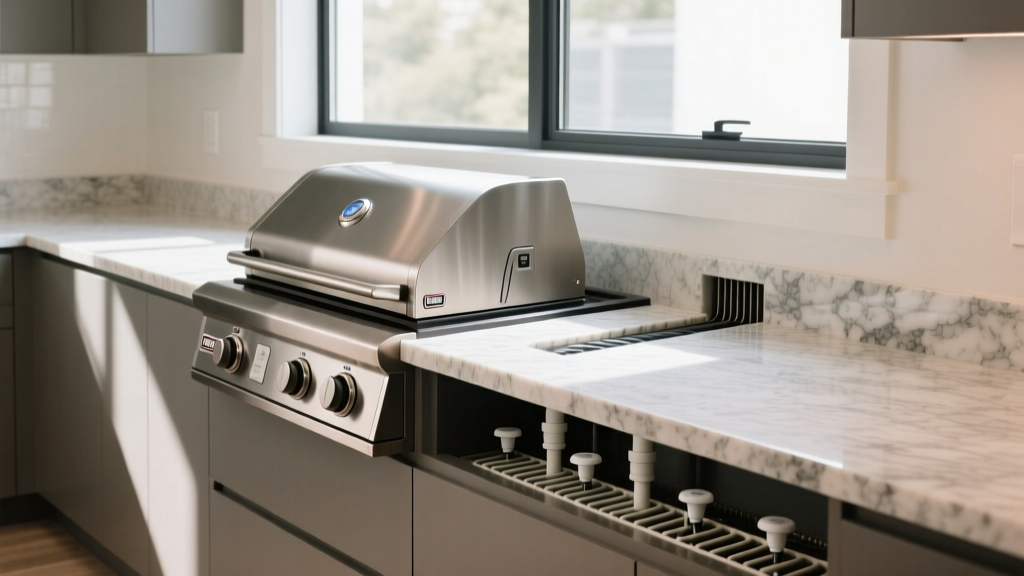
2026 Irrigation Guide For Weber Summit Granite Outdoor Kitchens
Anna KowalskiPublished
The 2026 Standard for Outdoor Kitchen Landscaping
As we navigate the landscaping trends of 2026, the outdoor kitchen has evolved from a simple patio grill station into a fully integrated, high-performance culinary environment. Homeowners are increasingly investing in premium hardscaping setups, with the Weber Summit grill series and custom-cut granite countertops leading the market in luxury outdoor living. However, integrating these high-end features into your landscape requires a meticulous approach to your sprinkler and irrigation systems. A poorly designed irrigation layout can silently destroy your investment through water damage, mineral staining, and premature corrosion. Designing an irrigation plan that respects the hardscape footprint is no longer optional; it is a critical component of modern landscape architecture.
Protecting Granite Countertops from Hard Water and Overspray
Granite is an incredibly durable igneous rock, making it a top choice for outdoor kitchen countertops. However, it is not entirely impervious. Granite features microscopic pores that, even when professionally sealed, can absorb moisture and dissolved minerals over time. When traditional spray-head sprinklers operate near your outdoor kitchen, wind drift frequently carries a fine mist of water onto the granite surfaces. As this water evaporates in the sun, it leaves behind calcium, magnesium, and chlorine deposits.
Over a single summer season, this continuous cycle of wetting and drying leads to severe efflorescence, white hazing, and stubborn hard water stains that are incredibly difficult to remove without stripping the stone's protective sealant. Furthermore, alkaline municipal water can slowly degrade the chemical bonds of the granite sealer, leaving the stone vulnerable to oil stains from food prep and darkening from rain. To protect your granite, your irrigation design must eliminate fine-mist overspray entirely, relying instead on heavy-stream rotary nozzles or subsurface drip lines that keep the water strictly at the root zone of your surrounding plants.
Shielding Your Weber Summit Grill from Moisture Damage
The 2026 lineup of Weber Summit grills, including the popular Summit FS38X freestanding models and the Summit S-660 built-in units, represent the pinnacle of outdoor cooking technology. These units feature 304-grade stainless steel exteriors, integrated Weber Connect smart hubs, advanced LED lighting, and high-BTU sear stations. While 304 stainless steel is highly rust-resistant, it is not rust-proof. Constant exposure to chlorinated municipal water or salt-laden air from irrigation overspray can cause micro-pitting and surface corrosion on the stainless steel fascia and control knobs.
More critically, water ingress into the grill's internal firebox or electronic smart-probe ports can cause catastrophic failures. Burner tubes can clog with mineral deposits, and the sensitive electronics of the Weber Connect system can short-circuit if subjected to daily sprinkler mist. When planning your sprinkler heads, the outdoor kitchen island must be treated as a strict 'no-spray zone.' You must calculate the prevailing wind direction during your typical morning or evening watering windows to ensure that no rotor or spray head is positioned upwind of the grill station.
Strategic Sprinkler Zoning and Layouts
To maintain a lush landscape without compromising your hardscape investment, you must divide your yard into highly specific micro-zones. The area immediately surrounding the outdoor kitchen requires specialized irrigation components that prioritize precision over broad coverage. Below is the recommended 2026 irrigation layout for a Weber Summit and granite kitchen island:
| Irrigation Component | Recommended Type | Minimum Distance from Kitchen | Primary Purpose |
|---|---|---|---|
| Lawn Perimeter | MP Rotator / Rotary Nozzle | 36 inches | Low wind drift, precise arc adjustment to avoid hardscape |
| Kitchen Herb Bed | Inline Drip Tubing (Netafim) | 12 inches | Targeted root watering for culinary herbs, zero surface splash |
| Hardscape Border | Micro-Spray (Low Angle) | 24 inches | Cooling ambient air temperature without overspray reach |
| Foundation Plantings | Bubbler Drip Emitters | 18 inches | Deep watering for shrubs without wetting the granite base |
By utilizing MP Rotators for the adjacent lawn areas, you drastically reduce wind drift. Unlike traditional spray heads that atomize water into a fine fog, MP Rotators shoot heavy, multi-trajectory streams that cut through the breeze, ensuring the water lands exactly where you want it—on the grass, not on your Weber Summit's rotisserie motor.
Smart Controllers and Hyper-Local Weather Tracking
In 2026, relying on a basic timer for your irrigation system is a recipe for hardscape damage. Smart irrigation controllers, such as the Rachio 4 or Hunter Hydrawise Pro, utilize hyper-local weather data and on-site soil moisture sensors to adjust watering schedules dynamically. If a sudden afternoon thunderstorm rolls in, or if wind speeds exceed 15 mph, the smart controller will automatically skip or delay the watering cycle. This prevents the system from running during high-wind events, which is the primary cause of accidental overspray onto granite countertops and grill surfaces.
According to the EPA WaterSense program, smart irrigation controllers can save the average home thousands of gallons of water annually while preventing the exact type of runoff and overspray that damages outdoor living spaces. By setting up custom 'no-water' windows during your peak outdoor cooking hours, you ensure that your landscape remains pristine and dry while you are entertaining guests around the Summit grill.
Managing Runoff and Hardscape Drainage
Irrigation planning does not end at the sprinkler head; it must also account for where the water goes after it hits the soil. The area surrounding an outdoor kitchen is heavily compacted and often features impermeable surfaces like pavers or stamped concrete. When your lawn zones run, excess water can pool against the base of the granite island, leading to sub-surface moisture migration and freeze-thaw cracking in colder climates.
The University of Minnesota Extension emphasizes the importance of matching irrigation application rates to soil infiltration rates to prevent hardscape damage. To mitigate this, install a concealed trench drain or a French drain system along the perimeter of the outdoor kitchen's concrete pad. Ensure that the grading of the soil slopes away from the granite base at a minimum 2% grade. For the planting beds immediately adjacent to the kitchen, utilize permeable pavers or a thick layer of river rock over landscape fabric to allow rapid drainage without soil splashing back onto the stainless steel cabinetry.
Seasonal Winterization for Hardscapes and Irrigation
As the 2026 growing season comes to a close, proper winterization of your irrigation system is paramount to protecting both the plumbing and the outdoor kitchen. Trapped water in irrigation lines that run beneath or adjacent to the outdoor kitchen pad can freeze, expand, and heave the concrete foundation, causing your granite countertops to crack or shift out of level. Always schedule a professional compressed-air blowout of your irrigation lines before the first hard freeze.
Additionally, ensure that all above-ground irrigation valves and backflow preventers located near the kitchen are fully drained and insulated. Cover your Weber Summit grill with a premium, breathable, waterproof cover, and apply a fresh coat of penetrating siloxane sealer to your granite countertops. This dual-layered approach to winterization ensures that when spring arrives, your irrigation system is ready to support a vibrant landscape, and your outdoor kitchen remains in flawless, show-ready condition.

