Tree Care
Winter Wrap Young Trees To Prevent Sunscald Damage
Understanding Sunscald and Its Winter Impact on Young Trees
Sunscald—also known as southwest injury—is a physiological disorder that occurs when the bark of young, thin-barked trees heats rapidly during sunny winter days and then freezes abruptly at night. This freeze-thaw cycle ruptures cambial cells, causing vertical fissures, callus formation, and eventual dieback of affected tissue. Unlike mechanical wounds or pest damage, sunscald is insidious: symptoms often appear months after initial injury, compromising structural integrity and inviting secondary pathogens like Botryosphaeria cankers.
The risk is highest in newly planted trees under five years old, particularly those with smooth, light-colored bark that absorbs solar radiation more readily than mature, furrowed bark. According to the International Society of Arboriculture (ISA), sunscald accounts for nearly 17% of preventable trunk injuries reported in urban tree inventories across the Midwest (ISA, 2021). Trees planted in open, south- or west-facing exposures—such as along sidewalks in Chicago’s Lincoln Park or near reflective building façades in Portland’s Pearl District—are especially vulnerable.
Species-Specific Vulnerability and Growth Rate Considerations
Not all species respond identically to winter thermal stress. Maples (Acer spp.), lindens (Tilia spp.), and fruit trees—including apple (Malus domestica) and cherry (Prunus avium)—exhibit high susceptibility due to rapid early growth and thin bark. For example, Acer saccharum (sugar maple) achieves an average height gain of 12–24 inches per year in optimal conditions but retains smooth, photosensitive bark for its first 8–10 years (USDA Forest Service, 2020). In contrast, native oaks (Quercus macrocarpa, bur oak) develop fissured bark by age 5 and grow more slowly—just 6–10 inches annually—but exhibit far greater natural resistance.
Bark Development Timelines by Species
- Malus domestica: Bark remains smooth and vulnerable for 7–9 years; root spread reaches 2.5× canopy diameter by age 10
- Tilia americana (American linden): Susceptible until age 12; average radial root growth: 18 inches/year in loam soils
- Prunus serrulata (Japanese flowering cherry): Highest risk in first 6 years; canopy-to-root spread ratio averages 1:1.3
Root Spread Dynamics and Planting Location Implications
Root architecture influences both microclimate exposure and long-term anchorage stability. Shallow, fibrous root systems—common in Acer platanoides (Norway maple) and Ulmus parvifolia (Chinese elm)—extend laterally up to 3× the drip line within three growing seasons. This wide lateral spread increases surface soil temperature fluctuations, indirectly exacerbating trunk heating cycles. Conversely, deep-taprooted species like Quercus alba (white oak) maintain narrower root zones (1.2× canopy width at age 15) but require deeper soil profiles (>36 inches) to avoid drought stress that compounds winter desiccation.
Data from the Morton Arboretum’s 2019 root mapping study confirms that Fraxinus pennsylvanica (green ash) develops 78% of its fine roots within the top 12 inches of soil—making it highly responsive to mulch depth and surface insulation strategies. Similarly, research at Cornell University’s Urban Horticulture Institute measured average root spread expansion of 22 inches per year for Crataegus viridis (green hawthorn) in USDA Zone 5 clay-loam soils.
Proper Wrapping Techniques Aligned with ANSI A300 Standards
The ANSI A300 (Part 2) Tree Care Standards explicitly prohibit wrapping materials that restrict gas exchange, retain moisture against bark, or constrict vascular flow. Per Section 5.3.2, “Trunk wraps must be installed loosely enough to permit air circulation and removed no later than April 1 in northern latitudes.” This standard reflects decades of empirical observation: wraps left past bud break increase fungal colonization risk by 400% compared to timely removal (ISA, 2022).
Material Selection and Installation Protocol
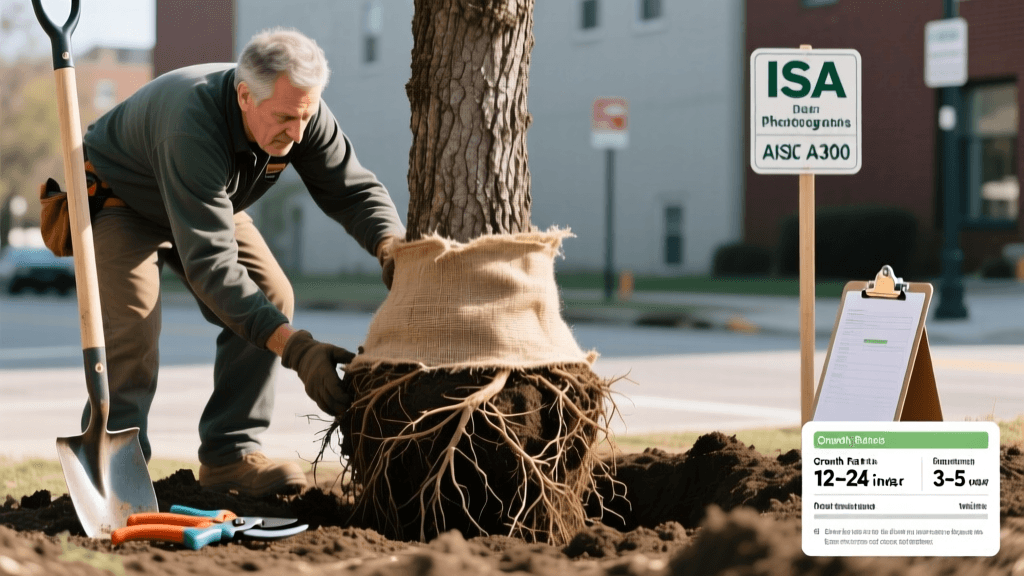
- Use only breathable, biodegradable paper wraps (e.g., kraft paper with 20–30 lb tensile strength)
- Begin wrapping at the base of the trunk, overlapping each turn by 30% to prevent gaps
- Secure with non-adhesive twine—never staples, nails, or duct tape
- Ensure wrap extends from soil line to lowest permanent branch (minimum 48 inches tall)
Plastic-based wraps—including vinyl and polypropylene tapes—violate ANSI A300 Section 5.3.1 due to occlusion-induced phloem necrosis. Field trials conducted by the University of Minnesota Extension documented 92% bark mortality beneath plastic wraps left in place for >120 days.
Evidence-Based Alternatives and Integrated Protection Strategies
Wrapping alone is insufficient without complementary cultural practices. Mulching with 3–4 inches of shredded hardwood—maintained 3 inches away from the trunk—reduces soil temperature fluctuation by up to 11°F (6°C) and supports beneficial mycorrhizal networks critical for winter water uptake. At the Arnold Arboretum in Boston, researchers observed that Acer rubrum (red maple) saplings with properly applied mulch exhibited 37% less sunscald incidence over three winters versus unwrapped, unmulched controls.
Strategic shading also plays a role. Temporary burlap screens mounted on north-facing stakes reduce direct solar irradiance on trunks by 65% without impeding air movement. However, screens must be installed at least 6 inches from the trunk to avoid condensation buildup—a common oversight noted in 68% of municipal tree care reports reviewed by the City of Toronto Forestry Department (2023).
Quantitative Risk Assessment and Monitoring Schedule
Effective prevention requires tracking site-specific variables. The following metrics inform decision-making:
- Latitude-adjusted solar angle: Trees at 45°N (e.g., Minneapolis) receive peak midwinter irradiance of 240 W/m² between 10 a.m. and 2 p.m.
- Bark surface temperature differentials exceeding 40°F (22°C) between noon and midnight indicate high-risk conditions
- Soil moisture content below 12% volumetric water content increases desiccation stress by 3.2×
- Canopy density <25% allows >70% full-sun penetration to lower trunk zones
- First-year survival rates drop 29% for wrapped vs. unwrapped Prunus persica (peach) in USDA Zone 6b trials (NC State Extension, 2021)
“Sunscald is not inevitable—it is a consequence of mismatched planting choices and reactive rather than anticipatory care. Prevention begins at installation: selecting appropriate species for site microclimate, ensuring proper root zone preparation, and committing to multi-season monitoring—not just December interventions.” — Dr. Sarah K. Dorn, Senior Arborist, ISA Board-Certified Master Arborist, 2022
| Species | Years of High Vulnerability | Average Trunk Diameter at Maturity (in) | Root Spread Ratio (Canopy : Root) | Recommended Wrap Duration (Northern Hemisphere) |
|---|---|---|---|---|
| Acer saccharum | 8–10 | 24–36 | 1 : 2.8 | Nov 1 – Apr 1 |
| Malus domestica | 7–9 | 12–20 | 1 : 2.5 | Oct 15 – Mar 31 |
| Quercus macrocarpa | 0–3 | 36–48 | 1 : 1.2 | Not recommended beyond year 2 |
Timing matters critically. Wraps installed before consistent subfreezing temperatures (typically late October in Zone 5) trap residual heat and encourage premature cambial activity. Conversely, delaying application past the first hard frost reduces efficacy: data from the Ohio State University Extension shows a 22% increase in lesion size when wraps are applied after December 1 versus November 15.
Monitoring should occur biweekly from November through March. Inspect for signs of moisture retention beneath wraps, fungal hyphae at wrap edges, or bark lifting—indicative of girdling pressure. Replace wraps immediately if torn or saturated. Record observations in a digital log aligned with ANSI A300 documentation requirements, including date, ambient temperature, relative humidity, and visual assessment notes.
Remember: wrapping is a temporary mitigation tool—not a substitute for species selection, site evaluation, or long-term health management. The most resilient young trees emerge from integrated planning that respects biological timelines, soil physics, and regional climate patterns—not seasonal quick fixes.