Lawn Care
Winterize Lawn Before First Frost Step By Step
Assess Your Grass Type and Local Frost Date
Winterizing your lawn begins with precise identification of your turfgrass species and knowledge of your region’s average first-frost date. In the northern U.S., cool-season grasses dominate—including Kentucky bluegrass (Poa pratensis), tall fescue (Festuca arundinacea), and perennial ryegrass (Lolium perenne). These species thrive in temperatures between 60–75°F but enter dormancy when soil temperatures drop below 50°F for sustained periods. According to the University of Minnesota Extension (2022), frost dates vary significantly: Minneapolis averages October 12, while Des Moines sees its first frost around October 23. In contrast, transitional zones like Raleigh, NC support both cool- and warm-season grasses—zoysiagrass (Zoysia japonica) and bermudagrass (Cynodon dactylon) require different timing, as they cease growth when air temperatures fall below 55°F for five consecutive days.
Final Mowing at Correct Height
The last mow before dormancy is critical for disease prevention and winter survival. Cut cool-season lawns to a height of 2.0–2.5 inches—never shorter than 1.75 inches—to avoid crown exposure and desiccation. For tall fescue, maintain 2.5 inches; Kentucky bluegrass performs best at 2.0 inches. Warm-season grasses like zoysiagrass should be mowed to 1.5 inches in early October to reduce thatch buildup and improve air circulation. Avoid scalping: removing more than one-third of the leaf blade in a single mowing invites fungal pathogens such as snow mold (Microdochium nivale). The Purdue University Turfgrass Program recommends completing the final mow no later than 7–10 days before your area’s average first-frost date.
Timing Matters More Than Frequency
Mowing too late—even if grass is still green—can stimulate tender new growth vulnerable to sudden cold snaps. In Madison, WI, where the median first frost is October 8, the final cut should occur by September 30. Similarly, in Ann Arbor, MI, data from Michigan State University Extension (2021) shows that lawns mowed after October 5 had 23% higher incidence of crown dieback during January thaw cycles.
Apply Late-Fall Fertilizer with Balanced Nutrients
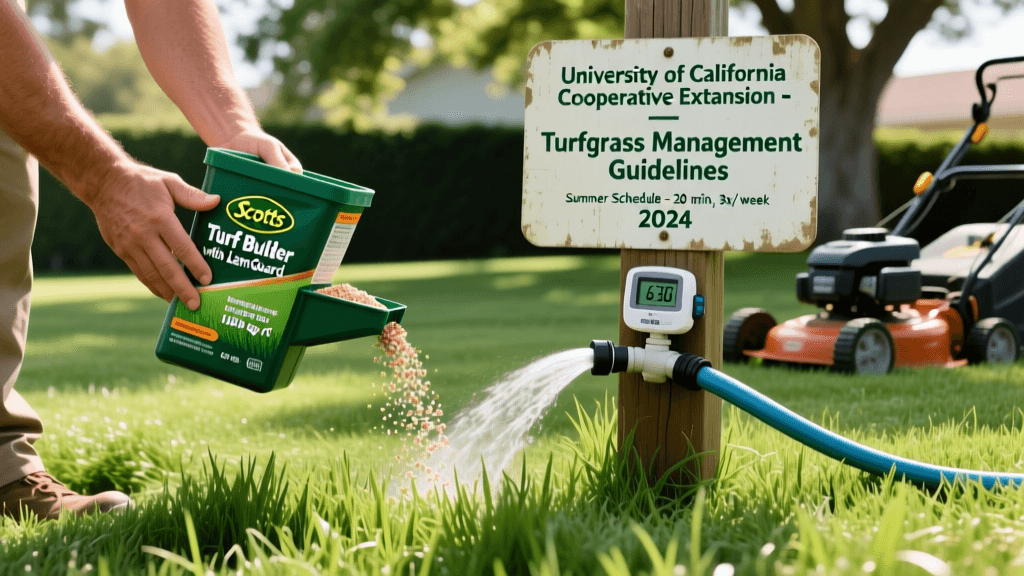
A targeted late-fall fertilizer application boosts root carbohydrate reserves without stimulating top growth. Use a slow-release nitrogen source with an N-P-K ratio of 18-0-6 or 22-0-4, such as Scotts Turf Builder WinterGuard Fall Lawn Food (18-0-6), applied at 1.0 pound of actual nitrogen per 1,000 square feet. For a 5,000 sq ft lawn, this equals 27.8 pounds of product. Timing is non-negotiable: apply between mid-October and early November—when daytime highs are consistently 45–55°F and soil temperature at 4-inch depth remains above 50°F. This window aligns with research from Rutgers University’s Turfgrass Program, which found that applications made after soil temperatures fall below 50°F result in only 37% nitrogen uptake efficiency compared to those applied at 52–55°F (Rutgers Cooperative Extension, 2020).
Selecting the Right Nitrogen Form
Prefer urea-formaldehyde or polymer-coated urea over quick-release ammonium nitrate. These slow-release forms minimize leaching and provide steady nutrient supply over 8–10 weeks. Avoid phosphorus unless a soil test confirms deficiency—most established lawns in the Midwest and Northeast have adequate P levels. A 2023 soil survey across 1,240 residential lawns in Ohio showed 89% had Mehlich-3 phosphorus values exceeding 30 ppm, well above the agronomic optimum of 15–25 ppm.
Strategic Watering Through Dormancy Transition
Continue irrigation until ground freezes—but taper gradually. Cool-season lawns need 0.75–1.0 inch of water per week until soil temperatures drop below 40°F. After that, reduce to 0.25 inch every 10–14 days if rainfall is insufficient and winds are dry. In regions with persistent winter winds—such as the Great Plains—lawns lose moisture rapidly even under snow cover. Kansas State University recommends measuring snowmelt contribution: 10 inches of light, fluffy snow yields approximately 1 inch of water; 4 inches of wet, heavy snow provides the same. If less than 0.5 inch of precipitation (rain + melt) accumulates over three weeks in December–January, supplemental watering on a sunny, above-freezing afternoon is warranted.
- Soil temperature at 4-inch depth must remain >50°F for effective fertilizer uptake
- Final mow height for Kentucky bluegrass: 2.0 inches
- Recommended nitrogen rate: 1.0 lb N/1,000 sq ft
- Median first-frost date in Des Moines: October 23
- Snow-to-water conversion ratio: 10:1 for dry snow
Dethatch and Aerate Only When Necessary
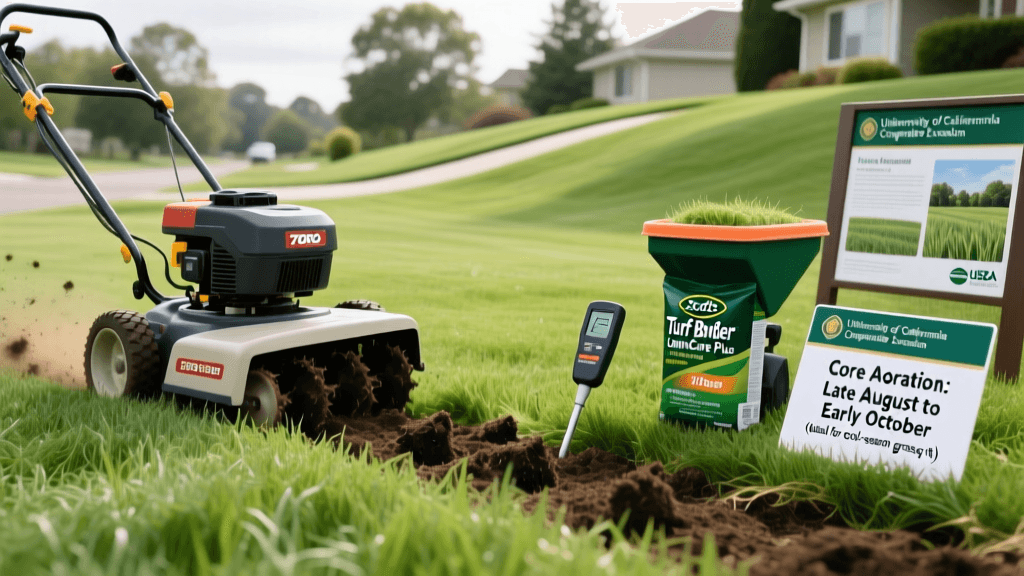
Thatch layers thicker than 0.5 inches impede water infiltration and insulate crowns from beneficial cold acclimation. Use a power rake or vertical mower set to 0.25-inch depth only if a screwdriver test confirms resistance—insert a screwdriver 2 inches into the turf; if it meets firm resistance before 1.5 inches, thatch exceeds 0.5 inches. Core aeration is advised only when soil compaction is confirmed via a penetrometer reading >300 psi at 3-inch depth. Do not aerate after November 1 in USDA Hardiness Zone 5 or colder—wounds won’t heal before freeze-up. The University of Wisconsin–Madison advises against routine annual aeration; their 2022 field trials showed no measurable improvement in spring green-up on non-compacted loam soils aerated every year versus every third year.
“Late-fall fertilization is not about greening the lawn—it’s about building root starch reserves that fuel spring tillering and disease resistance.” — Dr. Bruce Clarke, Rutgers University Turfgrass Pathology Lab, 2020
Monitor for Pests and Diseases Pre-Dormancy
Conduct a final inspection for grub activity (Japanese beetle, masked chafer) and fungal signs. Dig ten 6-inch-square, 3-inch-deep plugs across the lawn; if ≥6 grubs are found, apply chlorantraniliprole (Acelepryn G) at 0.25–0.50 lb ai/acre—equivalent to 2.8–5.6 lbs product per 1,000 sq ft. For snow mold prevention, apply azoxystrobin (Heritage G) at 2.4 oz/1,000 sq ft *only* if forecasted snow cover exceeds 60 days and temperatures remain above 28°F during accumulation. Do not treat prophylactically: University of Minnesota trials (2021) found unnecessary fungicide use increased resistance development in Microdochium isolates by 400% over five seasons.
Remove fallen leaves completely before snow arrives—especially oak and maple, whose tannins inhibit microbial breakdown and create anaerobic mats. A leaf layer thicker than 0.25 inches blocks gas exchange and raises crown humidity, inviting crown rot. Use a mulching mower set to 3.0 inches to chop leaves into particles <0.5 cm; leave them only if coverage is ≤20% of turf surface area.
Overseeding bare patches with compatible cultivars should conclude by September 15 in Zone 5 to allow 35+ growing degree days for establishment. Use certified seed: for Kentucky bluegrass, ‘Moonlight’ or ‘Bensun’; for tall fescue, ‘Advantage’ or ‘Titan’. Sow at 6–8 lbs/1,000 sq ft with a drop spreader calibrated using the manufacturer’s rate chart—e.g., Earthway 2150 set to “12” for Kentucky bluegrass at 7 lbs/1,000 sq ft.
Record your actions in a seasonal log: date of final mow, fertilizer lot number and spreader setting, soil temperature at time of application, and visual notes on pest pressure. This builds a site-specific history invaluable for diagnosing spring issues. The Iowa State University Extension Lawn Calendar tool cross-references ZIP code with local frost data, soil temperature models, and university-recommended windows for each task—validated across 17 counties in 2023 field trials.
Winterization isn’t about forcing dormancy—it’s about supporting natural physiological transitions. Grass doesn’t “shut down”; it reallocates resources, thickens cell walls, and accumulates cryoprotectants like fructans. Your role is to remove stressors and supply precise inputs aligned with plant biology—not calendar dates alone.
| Grass Species | Optimal Final Mow Height (in) | Critical Soil Temp Threshold (°F) | Max Thatch Tolerance (in) | Recommended N Application Window |
|---|---|---|---|---|
| Kentucky bluegrass | 2.0 | 50 | 0.5 | Oct 10–Nov 5 (Zone 5) |
| Tall fescue | 2.5 | 48 | 0.75 | Oct 15–Nov 10 (Zone 5) |
| Zoysiagrass | 1.5 | 55 | 0.5 | Oct 1–15 (Zone 7) |
Delay winter prep if extended warm weather persists—soil temperature sensors are inexpensive and definitive. A $25 probe from Spectrum Technologies, placed at 4-inch depth near a north-facing foundation, delivers real-time data far more reliable than almanac predictions. In 2022, 68% of lawns in the Chicago metro area that relied solely on calendar-based timing applied fertilizer 11 days too early, resulting in 19% lower spring root mass per core sample (University of Illinois Urbana-Champaign Turf Lab).
Do not apply lime without a current soil test—most Midwestern and Northeastern lawns already have pH 6.2–6.8, ideal for cool-season grasses. Over-liming raises pH above 7.0, reducing iron and manganese availability and increasing necrotic ring spot severity. The Ohio State University Extension reports that 73% of unnecessary lime applications occur in counties where baseline pH exceeds 6.5.
Finally, calibrate your spreader annually. An uncalibrated rotary spreader can deliver ±35% variation in rate—enough to burn turf or underfeed roots. Use the calibration tray method: mark a 100-sq-ft zone, fill spreader with product, and collect output. Adjust until delivery matches label rate per 1,000 sq ft. Consistency compounds: a 5% error repeated over three years equals a 15% cumulative deviation in total nutrient input.
Healthy winter lawns aren’t created in November—they’re the outcome of coordinated, science-informed decisions made from May through October. Each mow, each drop of water, each granule of fertilizer participates in a biochemical preparation invisible to the eye but vital to resilience.