
Landscaping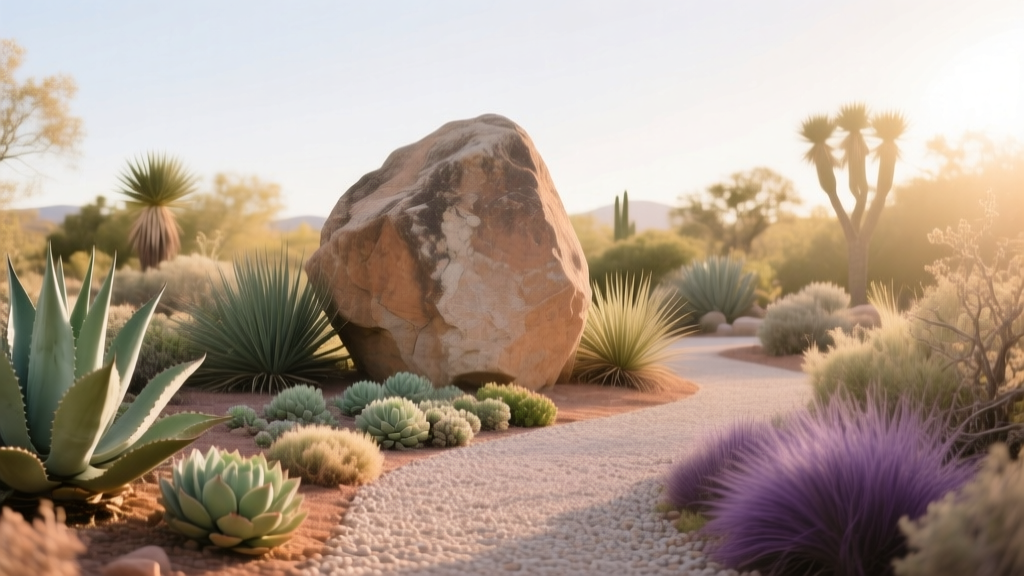
Xeriscape Boulder Placement: 2026 Garden Focal Points
Sarah ChenPublished
The Evolution of Xeriscape Focal Points in 2026
As climate resilience and water conservation continue to dictate landscape architecture trends in 2026, xeriscaping has evolved far beyond its early reputation as a barren, desert-like rock garden. Today, low-water landscaping is about creating lush, dynamic, and ecologically responsible outdoor living spaces. At the heart of this design philosophy is the strategic use of hardscaping to anchor the garden, reduce irrigation needs, and draw the eye. Landscape boulders, when placed with intention, serve as the ultimate xeriscape focal point. They provide immediate visual weight, require absolutely zero water, and create vital microclimates for drought-tolerant flora.
According to EPA WaterSense, incorporating permeable hardscaping and climate-adaptive design elements can reduce outdoor water use by up to 50 percent compared to traditional turf-heavy landscapes. By replacing high-maintenance lawn islands with striking boulder arrangements surrounded by native succulents and ornamental grasses, homeowners are not only slashing their water bills but also drastically reducing weekend maintenance. This guide will walk you through the art and science of boulder placement, ensuring your xeriscape focal point looks as though it has been naturally emerging from the earth for centuries.
Design Principles: Odd Numbers and the Rule of Thirds
The most common mistake homeowners make when installing landscape boulders is treating them like scattered decorations rather than structural elements. In nature, rocks do not appear in perfectly symmetrical pairs or evenly spaced lines. To achieve a naturalistic xeriscape focal point, you must adhere to the rule of odd numbers. Grouping boulders in sets of three, five, or seven creates a sense of organic asymmetry that is inherently more pleasing to the human eye. A massive primary boulder should act as the anchor, flanked by a medium-sized secondary stone and a smaller tertiary rock to lead the eye outward.
Furthermore, the placement of your boulder group should follow the rule of thirds. Rather than centering your focal point in the middle of a garden bed, position the main boulder at one of the intersecting points of an imaginary grid dividing the space into thirds. This off-center placement creates visual tension and allows the surrounding low-water plants to cascade and flow around the stones, mimicking the natural erosion patterns found in arid canyon landscapes and alpine scree slopes.
Sourcing Local Stone for Ecological Harmony
In 2026, the landscaping industry places a heavy emphasis on hyper-local sourcing to reduce the carbon footprint associated with transporting heavy materials. When selecting boulders for your xeriscape, choose stone that is native to your specific geographic region. Not only does this support local quarries and reduce delivery emissions, but it also ensures your garden harmonizes with the surrounding natural geology. A garden in the American Southwest should feature weathered sandstone, limestone, or basalt, while a landscape in the Pacific Northwest might utilize mossy granite or river-washed basalt.
When visiting your local stone yard, look for boulders with varied textures, deep crevices, and natural weathering marks. Avoid stones that have been freshly blasted or feature sharp, unnatural drill marks, as these will immediately betray the artificial nature of your installation. Premium moss rock and heavily weathered fieldstone typically range from $250 to $400 per ton in 2026, depending on regional availability and transport distances. Remember that a single, two-foot diameter granite boulder can easily weigh over 800 pounds, meaning you will likely need to budget an additional $150 to $300 for a compact track loader or mini-excavator rental for the day of installation.
Step-by-Step Installation for Optimal Drainage
A boulder simply dropped on top of the soil will look like an alien artifact and is prone to settling, frost heave, and water pooling. Proper installation is critical, especially in xeriscapes where soil drainage must remain unimpeded. The golden rule of boulder placement is the "one-third rule": at least 20 to 30 percent of the boulder's total mass must be buried below the soil grade. This anchors the stone visually and physically, making it appear as a natural outcropping.
- Step 1: Excavation and Base Preparation. Dig a hole slightly wider and deeper than the base of the boulder. Fill the bottom four inches with crushed angular gravel (such as 3/4-inch minus). This creates a French-drain effect, preventing water from pooling beneath the stone and causing mud boils or frost heave during winter freezes.
- Step 2: Positioning the Stone. Using machinery or a heavy-duty stone dolly, lower the boulder into the pit. Study the stone's "face"—its most interesting, weathered side—and ensure it is angled slightly upward to catch the sun and cast dramatic shadows.
- Step 3: Backfilling and Tamping. Backfill the gaps around the buried portion of the boulder with a mixture of native soil and decomposed granite or pumice. Avoid using rich, moisture-retaining topsoil or peat moss, as this will rot the roots of the xeriscape plants you intend to place nearby. Tamp the soil firmly in two-inch layers to eliminate air pockets.
- Step 4: Top Dressing. Finish the installation by applying a two-inch layer of inorganic mulch, such as crushed gravel or river rock, around the base of the boulder. This suppresses weeds, retains deep soil moisture, and ties the hardscape into the broader xeriscape design.
The Microclimate Effect: Plant Pairings for 2026
Boulders do more than look beautiful; they actively modify the environment immediately surrounding them. The south and west sides of a large boulder will absorb heat during the day and radiate it at night, creating a warm, dry microclimate ideal for heat-loving succulents. Conversely, the north and east sides offer deep shade and slightly higher soil moisture retention, providing a safe haven for delicate, low-water perennials that might otherwise scorch in the afternoon sun. Understanding these microclimates is a core tenet of advanced xeriscaping, as detailed in the comprehensive guidelines provided by Colorado State University Extension.
Below is a curated table of 2026's top low-water plant pairings designed specifically to complement a boulder focal point, categorized by their ideal microclimate placement.
| Plant Common Name | Botanical Name | Water Requirement | Ideal Boulder Placement | Design Function |
|---|---|---|---|---|
| Century Plant | Agave americana | Very Low (Deep, infrequent) | South/West (Full Sun, Heat) | Architectural contrast against rounded stone |
| Coral Yucca | Hesperaloe parviflora | Low (Drought tolerant) | East/South (Morning to Mid Sun) | Vertical height and vibrant red blooms |
| Autumn Moor Grass | Sesleria autumnalis | Low to Moderate | North/East (Partial Shade) | Softens hard stone edges with fine texture |
| Blue Chalksticks | Senecio serpens | Very Low | South (Full Sun, Heat Reflection) | Groundcover spilling over gravel near base |
| Parry's Penstemon | Penstemon parryi | Low (Native arid) | East (Morning Sun, Afternoon Shade) | Attracts pollinators with striking pink spikes |
When planting near your boulders, ensure that the root balls of your succulents and perennials are positioned at least 12 to 18 inches away from the base of the stone. This prevents water from washing directly off the impermeable rock surface and drowning the plant's crown, a common cause of root rot in xeriscape installations.
Illuminating Your Focal Point with Solar Technology
A boulder focal point should not disappear when the sun goes down. In 2026, advancements in high-lumen, warm-temperature solar LED technology have made it easier than ever to highlight landscape features without the need to trench low-voltage wiring through your garden beds. Look for IP67-rated, heavy-duty brass solar uplights with adjustable color temperatures (2700K to 3000K). Position a single uplight at the base of your primary boulder, angling the beam upward to graze the stone's textured surface. This technique, known as "grazing," exaggerates the deep crevices and natural shadows of the rock, turning your xeriscape focal point into a dramatic, glowing sculpture that anchors your outdoor living space well into the night.
Conclusion
Mastering landscape boulder placement is about more than just moving heavy rocks; it is about understanding the intersection of geology, hydrology, and horticulture. By adhering to naturalistic design principles, sourcing local materials, ensuring proper subsurface drainage, and leveraging the unique microclimates your stones create, you can build a breathtaking xeriscape focal point. This approach not only guarantees a stunning, low-maintenance garden for 2026 and beyond but also establishes a resilient, water-wise ecosystem that thrives in harmony with your local environment.

