Lawn Care
Drought Stress Lawn Recovery: 2026 Deep Watering Plan
The 2026 Reality: Water Scarcity and Lawn Survival
As we navigate the environmental realities of 2026, municipal water restrictions and prolonged dry spells have made traditional lawn care obsolete in many regions. Homeowners are increasingly turning to xeriscaping and low-water landscaping principles not just for new installations, but to rescue existing turf. When your lawn is pushed to the brink of desiccation, a haphazard approach to irrigation will only waste water and encourage shallow, vulnerable root systems. Recovering a drought-stressed lawn requires a strategic, xeriscape-aligned deep watering schedule that prioritizes soil moisture retention and root resilience over superficial greenery.
According to the Environmental Protection Agency's WaterSense program, outdoor water use accounts for nearly 30 percent of total household water consumption, a figure that spikes dramatically during summer droughts. By adopting low-water landscaping methodologies, you can cut this usage in half while still nursing your turf back to health.
Identifying True Drought Stress vs. Natural Dormancy
Before deploying your deep watering schedule, it is crucial to determine if your lawn is experiencing drought stress or if it has simply entered natural dormancy. Cool-season grasses like Kentucky bluegrass and tall fescue will naturally go dormant during extreme heat and lack of water, turning brown to protect their crowns. Warm-season grasses like Bermuda and Zoysia do the same during winter or severe summer droughts.
To test the vitality of your turf, perform the 'screwdriver test.' Push a standard six-inch screwdriver into the soil. If it penetrates easily to the hilt, the soil retains deep moisture, and the browning may be disease-related. If the soil is hard and the screwdriver stops at an inch or two, your lawn is severely drought-stressed. Additionally, walk across the lawn; if your footprints remain visible for several minutes (a condition known as 'footprinting'), the grass blades have lost their turgor pressure and are crying out for a deep watering intervention.
The Xeriscape Philosophy: Deep, Infrequent Watering
The cornerstone of xeriscaping is training plants to survive on less water by forcing them to develop deep, extensive root systems. Shallow, daily watering creates a 'lazy' lawn with roots confined to the top inch of topsoil, making it highly susceptible to heat damage and evaporation. A low-water landscaping approach dictates that you water deeply and infrequently.
Deep watering means applying enough moisture to penetrate the soil to a depth of six to eight inches. This encourages roots to chase the moisture downward, anchoring the grass and providing a buffer against surface-level heat. However, applying an inch of water all at once often leads to massive runoff, especially in compacted or clay-heavy soils. This is where the 'Cycle and Soak' method becomes your most valuable tool in 2026.
The 2026 Deep Watering Schedule and the 'Cycle and Soak' Method
The Cycle and Soak method involves breaking your total watering time into shorter intervals, allowing the soil to absorb the moisture between cycles. This eliminates runoff and ensures water reaches the deep root zone.
Here is how to execute a xeriscape-approved recovery schedule for a moderately drought-stressed lawn:
- Step 1: Calculate Total Run Time. Place three or four empty tuna cans in different zones of your lawn. Run your sprinklers for 15 minutes. Measure the water depth in the cans. If you collected 0.25 inches, it will take 60 minutes of total run time to deliver the 1 inch of water needed for deep penetration.
- Step 2: Divide into Cycles. Instead of running the zone for 60 continuous minutes, divide it into three 20-minute cycles.
- Step 3: Set Soak Intervals. Program your irrigation controller to run Cycle 1, wait 45 minutes for the soil to absorb the water (the soak phase), run Cycle 2, wait 45 minutes, and then run Cycle 3.
- Step 4: Frequency. During active drought recovery, perform this deep watering routine twice a week. Once the lawn shows signs of recovery and turgor pressure returns, scale back to once a week or once every ten days, aligning with strict low-water landscaping principles.
Soil Type and Deep Watering Parameters
Your soil composition heavily dictates how you must structure your cycle and soak schedule. The Colorado State University Extension emphasizes that soil infiltration rates vary wildly, meaning a one-size-fits-all approach guarantees water waste.
| Soil Type | Infiltration Rate | Max Run Time Per Cycle | Required Soak Time | Weekly Recovery Target |
|---|---|---|---|---|
| Clay (Heavy) | Very Slow (0.1"/hr) | 10-15 Minutes | 60-90 Minutes | 1 inch (Split over 3-4 cycles) |
| Loam (Balanced) | Moderate (0.3"/hr) | 20-25 Minutes | 45-60 Minutes | 1 inch (Split over 2-3 cycles) |
| Sand (Porous) | Fast (1.0"+/hr) | 30+ Minutes | 30 Minutes | 1.5 inches (Split over 2 days) |
Smart Irrigation Tech for Low-Water Landscaping in 2026
Manual scheduling is prone to human error and ignores real-time microclimate data. In 2026, utilizing a smart irrigation controller is non-negotiable for serious xeriscaping and drought recovery. Modern controllers utilize hyper-local weather data, soil moisture sensors, and evapotranspiration (ET) rates to automatically adjust your deep watering schedule.
When programming your smart controller for drought recovery, ensure you input the correct soil type, slope percentage, and sprinkler head precipitation rate. This allows the algorithm to automatically generate the optimal cycle and soak intervals. Pairing your controller with wireless soil moisture sensors placed at a depth of four inches ensures that you never apply water if the deep root zone is already adequately hydrated, perfectly balancing recovery needs with water conservation. According to the Alliance for Water Efficiency, transitioning to smart irrigation and xeriscape principles can reduce outdoor water use by up to 50 percent while maintaining healthier landscapes.
Mowing Practices During Drought Recovery
When your lawn is recovering from severe drought stress, your mowing habits must align with your deep watering schedule. Never remove more than one-third of the grass blade at a single time. In 2026, xeriscaping experts recommend raising your mower deck to its highest setting, typically between 3.5 and 4 inches for cool-season grasses. Taller grass shades the soil surface, drastically reducing evaporation rates and keeping the deep root zone cooler. Furthermore, leave all clippings on the lawn. These clippings decompose rapidly, returning valuable organic matter and moisture back to the soil ecosystem, acting as a natural, low-water mulch.
Soil Amendments to Maximize Moisture Retention
A deep watering schedule is only half the battle; the soil must be capable of holding onto that moisture. Xeriscaping heavily relies on soil amendment to improve water-holding capacity without increasing irrigation frequency.
- Compost Topdressing: Applying a quarter-inch layer of finely screened compost over your lawn during the fall or early spring introduces organic matter that acts like a sponge. Research shows that increasing soil organic matter by just one percent can allow an acre of soil to hold an additional 20,000 gallons of water.
- Liquid Soil Conditioners and Wetting Agents: Hydrophobic (water-repellent) soil is common in drought-stricken lawns. Applying a biodegradable wetting agent or a product containing humectants helps draw moisture from the air and distributes water evenly through the soil profile, reducing the amount of irrigation needed by up to 30 percent.
- Biochar Integration: An increasingly popular xeriscape amendment in 2026, biochar is a highly porous charcoal-like substance that permanently improves soil structure and water retention. Topdressing with a biochar-compost blend ensures that the water applied during your deep soaking cycles remains available to the roots for longer periods.
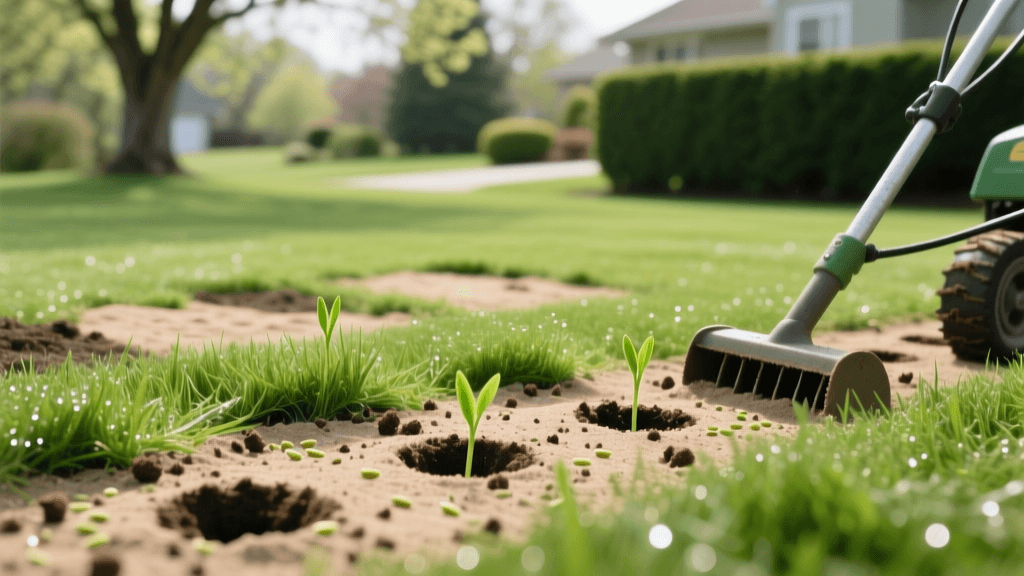
- Aeration: If your screwdriver test revealed heavily compacted soil, core aeration is mandatory. Removing plugs of soil breaks up the thatch layer and creates physical channels for water to reach the deep root zone during your cycle and soak intervals.
When to Pivot: Xeriscape Alternatives to Traditional Turf
Sometimes, despite your best efforts with a deep watering schedule and soil amendments, a severely drought-stressed lawn may not recover, or the water cost may simply be unsustainable. The true spirit of xeriscaping is knowing when to adapt to your environment. If your turf fails to bounce back after three weeks of targeted deep watering, consider transitioning to low-water, drought-tolerant alternatives.
Eco-lawns featuring micro-clover, creeping thyme, or native buffalograss require a fraction of the water needed by traditional Kentucky bluegrass or tall fescue. In 2026, many municipalities offer aggressive turf-replacement rebates, paying homeowners per square foot to remove thirsty lawns and replace them with xeriscape groundcovers and permeable hardscaping. Embracing these low-water landscaping strategies ensures your outdoor space remains resilient, beautiful, and environmentally responsible for decades to come.