Lawn Care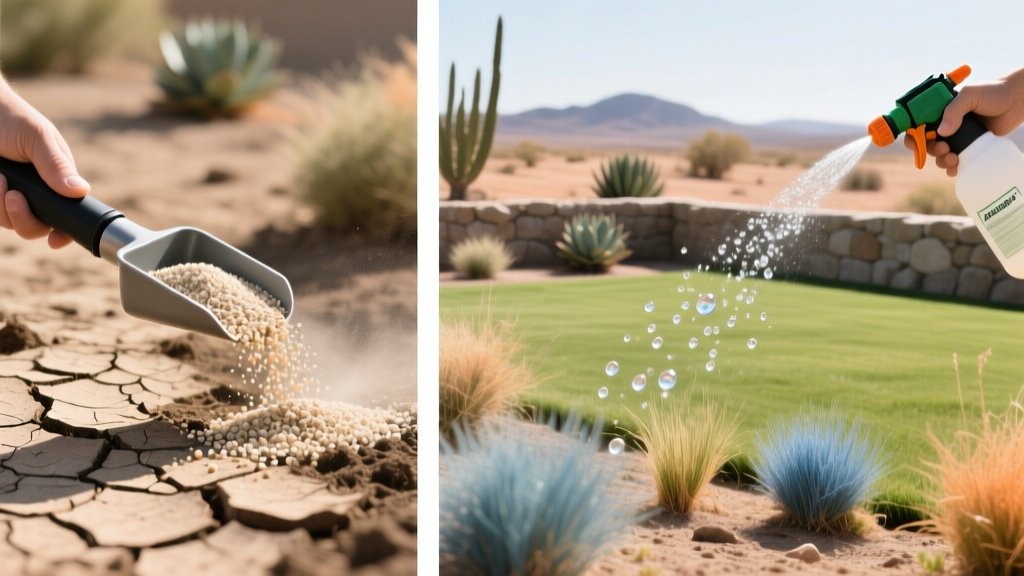
Granular vs Liquid Fertilizer for Xeriscaped Lawns 2026
Sarah ChenPublished
The 2026 Xeriscape Fertilization Challenge
As climate patterns shift and municipal water restrictions become more stringent across the United States in 2026, xeriscaping and low-water landscaping have evolved from regional necessities to mainstream lawn care standards. Homeowners cultivating drought-tolerant turfgrasses—such as Buffalograss, Bermudagrass, Zoysia, and fine fescue blends—face a unique agronomic challenge: how to deliver essential nutrients without relying on the heavy irrigation typically required by traditional fertilization methods. According to the EPA WaterSense program, outdoor water use accounts for nearly a third of all residential water consumption, making low-water landscape management a critical environmental and economic priority. When managing a xeriscaped lawn, the choice between granular and liquid fertilizers is no longer just about convenience; it is a strategic decision that impacts soil salinity, root health, and long-term drought resilience.
The Dilemma of Nutrient Activation in Dry Soils
In a conventional lawn care routine, granular fertilizers are broadcast across the turf and immediately watered in with 0.25 to 0.5 inches of irrigation. This moisture is mandatory to dissolve the nutrient prills, move them into the soil profile, and prevent the salts from burning the grass blades. However, in a strict xeriscape environment, supplemental irrigation is often limited to deep, infrequent soakings—or eliminated entirely during dormancy periods. Applying traditional granular fertilizers to dry soil and leaving them on the surface leads to nutrient volatilization (especially with nitrogen), UV degradation, and severe fertilizer burn when the grass is eventually watered or when morning dew activates the salts on the leaf tissue. Conversely, liquid fertilizers offer immediate foliar uptake but carry their own risks regarding application timing and temperature sensitivity in low-moisture environments.
Granular Fertilizers in Low-Water Landscapes
Granular fertilizers remain a staple for providing baseline macronutrients, but their formulation and application in 2026 require careful selection for xeriscapes. Slow-release, polymer-coated, or organically derived granulars (such as bio-char infused prills or processed poultry manure) are vastly superior to fast-release synthetic salts like urea. Organic granulars rely on soil microbial activity to break down nutrients, which aligns well with the living soil food web promoted in modern xeriscaping.
The primary advantage of high-quality granular fertilizers in low-water lawns is their longevity. A single application of a coated slow-release granular can feed drought-tolerant grasses for up to 12 weeks, reducing the frequency of lawn traffic and equipment use. However, the activation requirement remains a hurdle. To mitigate this, xeriscape professionals recommend applying granular fertilizers just before a forecasted natural rain event or utilizing advanced soil surfactants (wetting agents) that maximize the penetration of minimal dew or light irrigation.
Liquid Fertilizers and Foliar Feeding
Liquid fertilizers have seen massive technological advancements by 2026, particularly in the realm of nano-chelated micronutrients, amino acid complexes, and liquid kelp extracts. For xeriscaped lawns, liquid applications offer a distinct advantage: foliar feeding. Because the nutrients are dissolved in water and sprayed directly onto the grass blades, they can be absorbed through the leaf stomata without requiring any post-application soil irrigation. This completely bypasses the "watering-in" dilemma of granular products.
Furthermore, liquid humic and fulvic acid blends are highly effective in xeriscapes because they improve the soil's cation exchange capacity (CEC) and help retain whatever minimal moisture is present in the soil. The Texas A&M AgriLife Extension emphasizes that improving soil structure and organic matter is paramount in low-water landscapes, and liquid soil conditioners are an efficient way to deliver these compounds without heavy watering. The main drawback of liquid fertilizers is their short residual; they must be applied more frequently, and applying liquid synthetics during peak afternoon heat on drought-stressed grass will cause rapid foliar burn.
Granular vs. Liquid: Head-to-Head Comparison
| Feature | Granular (Slow-Release / Organic) | Liquid (Foliar / Soil Drench) |
|---|---|---|
| Activation Water Needs | Moderate (Requires 0.25" irrigation or rain) | None (if applied as foliar feed) |
| Burn Risk in Drought | High if left on surface; Low if watered in | High if applied in mid-day heat |
| Longevity | 8 to 12 weeks | 2 to 4 weeks |
| Application Frequency | 2 to 3 times per year | Monthly during growing season |
| Soil Salinity Impact | Low (Organic) / High (Synthetic) | Low (Amino/Kelp) / High (Synthetic) |
| Best For Grass Types | Buffalograss, Dormant Zoysia | Bermudagrass, Active Fine Fescue |
The Hidden Threat: Soil Salinity and Salt Buildup
One of the most critical aspects of xeriscape fertilization that homeowners overlook is soil salinity. In high-rainfall regions, natural precipitation leaches excess fertilizer salts deep below the root zone. In low-water landscapes, these salts accumulate in the topsoil, creating a toxic environment that inhibits root growth and paradoxically causes "physiological drought"—where the grass cannot absorb water even if it is present. Fast-release granular and synthetic liquid fertilizers are the primary culprits.
To combat this in 2026, xeriscape lawn care dictates a shift toward low-salt-index fertilizers. Liquid amino-acid fertilizers and organic granular meals possess a near-zero salt index, making them the safest choices for maintaining soil health in water-restricted zones. The Colorado State University Extension notes that monitoring soil health and avoiding excessive chemical inputs is foundational to successful xeriscaping, as native and adaptive grasses generally require far less nitrogen than traditional Kentucky Bluegrass or Ryegrass lawns.
Integrating Soil Wetting Agents (Surfactants)
When comparing granular and liquid applications in low-water environments, the efficacy of both is dramatically enhanced by the use of soil wetting agents. In 2026, advanced non-ionic surfactants and block-copolymer wetting agents are considered essential companions to xeriscape fertilization. Dry, hydrophobic soils common in low-water landscapes often repel moisture, causing liquid fertilizers to run off or granular activation water to pool and evaporate.
By tank-mixing liquid fertilizers with a high-quality surfactant, homeowners ensure uniform coverage and deep stomatal penetration. If using granular products, a prior application of a soil penetrant allows even the lightest morning dew to carry dissolved nutrients into the root zone. This synergy reduces the overall volume of water needed for fertilization to near zero, perfectly aligning with strict municipal xeriscape ordinances.
The 2026 Xeriscape Fertilization Schedule
To maximize drought tolerance without wasting water, follow this low-water fertilization schedule tailored for adaptive grasses:
- Early Spring (Soil Temp 55°F): Apply a liquid kelp and humic acid blend. This stimulates early root growth and improves soil moisture retention without requiring heavy watering. Apply in the early morning when stomata are open.
- Late Spring (Pre-Summer Heat): Broadcast a low-nitrogen, organic granular fertilizer (such as a bio-char or feather meal blend). Time this application 24 hours before a forecasted spring rainstorm to naturally activate the prills without using your irrigation system.
- Mid-Summer (Peak Drought): Avoid all synthetic nitrogen. If the lawn shows signs of severe stress, apply a liquid amino-acid stress relief product at sunset to help the grass regulate osmotic pressure and retain cellular water.
- Early Fall (Recovery): Apply a liquid soil conditioner with fulvic acid and a light dose of organic liquid nitrogen to promote root carbohydrate storage for winter dormancy.
Conclusion
The debate between granular and liquid fertilizers in 2026 is not about which is universally better, but rather which is better suited to the unique constraints of your xeriscape. Granular organics provide a slow, steady baseline of nutrients but require strategic timing around natural rainfall. Liquids offer unparalleled precision and zero-water foliar feeding but demand frequent, carefully timed applications to avoid heat stress. By understanding the mechanics of low-water soil chemistry, utilizing modern wetting agents, and prioritizing low-salt-index products, you can maintain a vibrant, deeply rooted, and drought-resilient lawn that thrives within the strictest water conservation guidelines.