Tree Care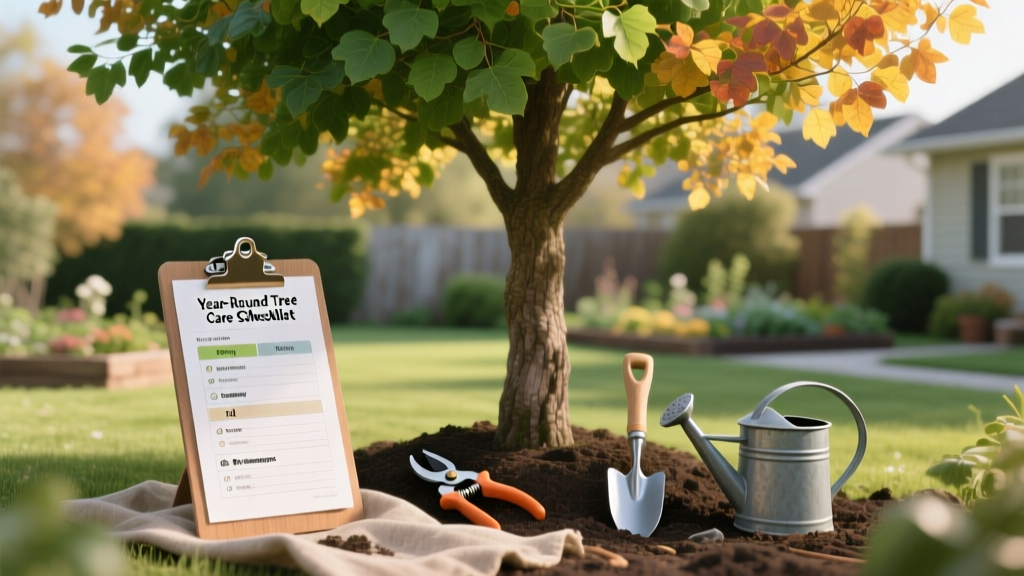
The Ultimate Year-Round Tree Care Schedule & Checklist
James MillerPublished
The Importance of a Proactive Tree Care Schedule
Trees are the structural backbone of your landscape, providing shade, increasing property value, and improving local air quality. However, unlike your weekly lawn mowing routine, tree care requires a strategic, seasonal approach. Neglecting your trees for even a single season can lead to irreversible structural damage, severe pest infestations, or fatal fungal diseases. A proactive, year-round tree care schedule ensures that your canopy remains vigorous, structurally sound, and resilient against extreme weather.
Whether you are managing mature shade trees or establishing newly planted saplings, timing is everything. Pruning at the wrong time of year can invite pathogens like oak wilt, while improper summer watering can lead to shallow root systems that topple during storms. This comprehensive checklist breaks down exactly what you need to do, when you need to do it, and the specific products and measurements required for professional-level tree maintenance at home.
Spring Tree Care Checklist: Inspection and Preparation
Spring is the season of awakening. As sap begins to flow and buds swell, your primary focus should be on assessing winter damage and preparing the soil for the growing season.
- Visual Inspection: Walk the perimeter of your trees. Look for heaving soil, cracked bark, or broken limbs caused by winter snow loads. Remove any hanging or broken branches (hangers) immediately to prevent them from falling on your home or lawn.
- Soil Testing and Fertilization: Before applying any fertilizer, conduct a soil test. If your soil is deficient, apply a slow-release, granular tree fertilizer with an NPK ratio of 10-10-10 or 12-6-6. Apply at a rate of 1 to 2 pounds of actual nitrogen per 1,000 square feet of the tree's drip line. Cost: $25-$40 for a professional soil test kit and $30 for a 40lb bag of slow-release tree fertilizer.
- Proper Mulching: Refresh your mulch rings to retain moisture and suppress weeds. Follow the 3-3-3 rule recommended by The Morton Arboretum: apply a 3-inch layer of organic hardwood mulch, in a 3-foot radius around the tree, keeping it 3 inches away from the trunk flare. Never 'volcano mulch' (piling mulch against the trunk), as this causes bark rot and encourages girdling roots.
- Spring Pruning: Limit spring pruning to the removal of dead, diseased, or damaged wood. Avoid heavy pruning of spring-flowering trees (like lilacs or dogwoods) until after they bloom, or you will sacrifice the season's flowers.
Summer Tree Care Checklist: Hydration and Pest Monitoring
Summer stresses trees through high transpiration rates and potential drought. Your schedule must shift toward deep hydration and vigilant pest monitoring.
- Deep Watering Protocol: Trees require deep, infrequent watering rather than shallow daily sprinkling. A general rule is to provide 10 gallons of water per inch of trunk diameter (caliper) measured at knee height. For a newly planted tree with a 2-inch caliper, apply 20 gallons per week during dry spells. Use a slow-release tree watering bag (like the Treegator, costing around $25-$35) or a soaker hose left on a low trickle for 2 to 3 hours to ensure water penetrates 12 inches into the soil.
- Pest and Disease Scouting: Inspect the canopy and trunk bi-weekly. Look for D-shaped exit holes and S-shaped larval galleries indicative of the Emerald Ash Borer (EAB). Check for defoliation from Japanese Beetles or tent caterpillars. If systemic treatment is required for borers, apply an imidacloprid-based soil drench (e.g., Bayer Advanced Tree & Shrub Protect and Feed, approx. $20-$40) in early summer, strictly following the label's dosage based on trunk circumference.
- Storm Preparation: Summer brings severe thunderstorms. Inspect your mature trees for 'codominant stems' (two main trunks of equal size forming a weak 'V' crotch). Hire an ISA Certified Arborist ($75-$150 for a consultation) to install dynamic cables or brace rods to prevent splitting during high winds.
Fall Tree Care Checklist: Planting and Winterization
Fall is arguably the most critical season for tree care. The soil is still warm, which encourages root growth, while the cooler air reduces canopy stress.
- Fall Planting: Autumn is the optimal time to plant new trees. Dig a hole twice as wide as the root ball but no deeper. Ensure the 'root flare' (where the trunk widens at the base) is fully exposed and sits 1 to 2 inches above grade. Backfill with native soil and water thoroughly to eliminate air pockets.
- Winter Hydration: Evergreens and newly planted deciduous trees lose moisture through their needles and bark during winter winds. According to the Colorado State University Extension, you must water trees deeply right up until the ground freezes. If the fall is dry, apply 10-15 gallons of water per tree every two weeks until the soil temperature drops below 40°F.
- Anti-Desiccant Application: For broadleaf evergreens (like rhododendrons or hollies) and newly transplanted conifers, spray an anti-desiccant like Wilt Pruf ($15-$25 per bottle) in late November. This creates a protective polymer coating over the leaves, reducing winter moisture loss.
- Sanitation Cleanup: Rake and dispose of fallen leaves from trees prone to fungal diseases, such as apple scab on crabapples or anthracnose on sycamores. Do not compost these leaves; bag them to break the disease cycle for the following spring.
Winter Tree Care Checklist: Dormant Pruning and Protection
With the leaves gone and the trees dormant, winter offers the best visibility for structural pruning and the lowest risk for spreading airborne pathogens.
- Dormant Pruning: Winter is the ideal time for major structural pruning. The University of Minnesota Extension highly recommends dormant pruning for oak trees specifically, as the beetles that spread the fatal oak wilt fungus are inactive in freezing temperatures. Use sharp, sterilized bypass pruners and pole saws to remove crossing branches, water sprouts, and inward-growing limbs. Cost for professional dormant pruning on a mature tree ranges from $300 to $800 depending on size and access.
- Trunk Protection: Young trees with thin bark (like maples, ash, and fruit trees) are susceptible to 'sunscald'—a condition where winter sun warms the bark, activating cells that freeze and die at night. Wrap the trunks of young trees with white, reflective tree guard wrap ($10-$15 per roll) starting from the base and overlapping up to the first scaffold branch. Remove the wrap in early spring to prevent insect harboring.
- Rodent Deterrence: Mice and voles will chew through the tender bark of young trees under the snow line. Install a cylinder of 1/4-inch hardware cloth around the base of the tree, burying it 2 inches into the soil and extending it 18 inches above grade to protect against snow cover.
Seasonal Tree Care Quick Reference Chart
| Season | Primary Focus | Watering Needs | Pruning Rules | Pest/Disease Watch |
|---|---|---|---|---|
| Spring | Inspection, Mulching, Soil Prep | Supplemental if dry; 1 inch/week | Remove dead wood only; wait on spring bloomers | Fungal spores, aphids, cankers |
| Summer | Deep Hydration, Pest Control | 10 gallons per inch of caliper weekly | Avoid heavy pruning; remove storm damage only | Emerald Ash Borer, Japanese Beetles |
| Fall | Planting, Winterization, Cleanup | Deep soak every 2 weeks until freeze | Minimal pruning; focus on sanitation | Apple scab, anthracnose (leaf cleanup) |
| Winter | Dormant Pruning, Trunk Protection | N/A (dormant); rely on fall moisture | Ideal for structural cuts and Oak pruning | Rodent bark damage, sunscald |
Conclusion: Consistency is the Key to Canopy Health
Maintaining a healthy landscape requires looking beyond the grass and focusing upward. By following this year-round tree care schedule, you transition from reactive emergency tree work to proactive health management. Investing a few hours each season in proper mulching, targeted deep watering, and strategic dormant pruning will save you thousands of dollars in emergency tree removals and chemical treatments over the lifespan of your trees. Mark your calendar, gather your tools, and give your trees the scheduled care they deserve.