Lawn Care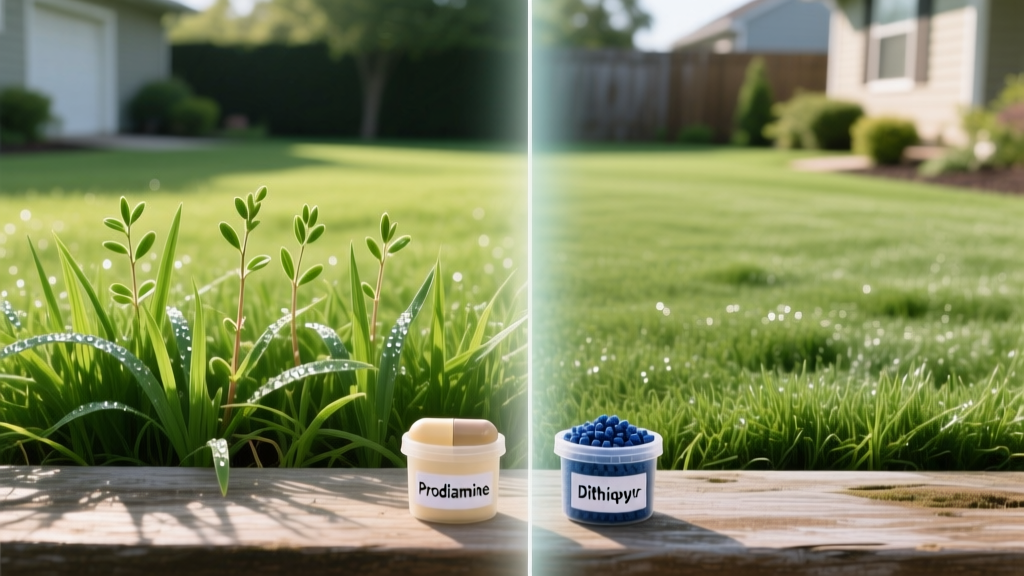
Prodiamine vs Dithiopyr: Which Pre-Emergent Herbicide Is Best?
Robert HayesPublished
The Battle of the Pre-Emergents: Prodiamine vs. Dithiopyr
When spring approaches, lawn care enthusiasts and professionals alike turn their attention to one of the most critical steps in seasonal turf management: pre-emergent herbicide application. If you are battling annual grassy weeds like crabgrass, goosegrass, or poa annua, establishing a chemical barrier in the soil is non-negotiable. However, the market is dominated by two heavyweights: Prodiamine and Dithiopyr. Both are exceptionally effective, but they operate with slightly different chemistries, application windows, and secondary benefits. Choosing between them requires a deep understanding of your lawn's specific needs, your budget, and your application timeline.
According to turfgrass researchers and extension programs, such as those at North Carolina State University, understanding the active ingredient and its behavior in the soil profile is the key to achieving a weed-free lawn. In this comprehensive guide, we will break down Prodiamine (commonly known by the brand name Barricade) and Dithiopyr (commonly known as Dimension) to help you decide which pre-emergent herbicide is best for your turf.
Understanding How Pre-Emergents Work
Before comparing the two products, it is essential to dispel a common myth: pre-emergent herbicides do not stop weed seeds from germinating. Instead, they inhibit cell division in the developing root system of the young seedling. When a weed seed germinates and sends its first root (the radicle) into the soil, it encounters the chemical barrier. The root tip is unable to divide and grow, effectively starving the seedling before it can ever push its leaves through the soil surface to photosynthesize.
Because this barrier must be in place before the roots begin to develop, timing is everything. The University of Minnesota Extension emphasizes that applying pre-emergents too early can result in the chemical barrier breaking down before the main weed flush occurs, while applying too late allows weeds to establish roots past the barrier zone.
Prodiamine (Barricade) Profile
Prodiamine is a dinitroaniline herbicide that has been a staple in the turf industry for decades. It is most famously sold under the brand name Barricade, though generic versions like Prodiamine 65 WDG (Water Dispersible Granule) are widely available and highly cost-effective.
Pros of Prodiamine
- Exceptional Residual: Prodiamine binds very tightly to soil organic matter and thatch. When applied at the correct rate, it can provide a continuous chemical barrier for 4 to 6 months, easily covering the entire spring and summer crabgrass germination window with a single application.
- Cost-Effective: Granular formulations like Prodiamine 65 WDG offer incredible coverage per dollar, making it the go-to choice for large properties and commercial lawn care operators.
- Low Odor and Easy Handling: The WDG formulation mixes easily in a backpack sprayer and has virtually no odor compared to liquid emulsifiable concentrates.
Cons of Prodiamine
- No Post-Emergent Activity: Prodiamine is strictly a pre-emergent. If a crabgrass seed has already germinated and established a root system, Prodiamine will not kill it.
- Concrete Staining: One of the most notorious drawbacks of Prodiamine is its tendency to leave a stubborn yellow stain on concrete driveways, sidewalks, and curbs if not immediately swept or washed off after application.
Dithiopyr (Dimension) Profile
Dithiopyr belongs to the pyridine chemical family and is most commonly sold under the brand name Dimension 2EW (Emulsifiable in Water). It is a premium product that offers unique benefits that Prodiamine simply cannot match.
Pros of Dithiopyr
- Early Post-Emergent Activity: This is Dithiopyr's superpower. Unlike Prodiamine, Dimension has early post-emergent activity against crabgrass. If you apply it slightly late, it can still kill young crabgrass seedlings up to the 1-tiller stage (when the weed is just a few weeks old and has not yet branched out).
- Root Pruning Mechanism: Dithiopyr works by pruning the roots of susceptible weeds, which provides a slightly different mode of action that can be useful in resistance management.
- No Concrete Staining: Dimension 2EW is clear and will not stain concrete or hardscapes, making it ideal for urban lawns with extensive driveways and walkways.
Cons of Dithiopyr
- Shorter Residual: Dithiopyr breaks down faster in the soil than Prodiamine. To get full-season control, you often need to apply it at a higher rate or plan on a split-application strategy.
- Higher Cost: Dimension is significantly more expensive per 1,000 square feet of coverage compared to generic Prodiamine WDG.
Head-to-Head Comparison Chart
| Feature | Prodiamine (Barricade / 65 WDG) | Dithiopyr (Dimension 2EW) |
|---|---|---|
| Chemical Family | Dinitroaniline | Pyridine |
| Primary Target Weeds | Crabgrass, Goosegrass, Poa Annua | Crabgrass, Goosegrass, Poa Annua |
| Post-Emergent Activity | None | Yes (Crabgrass up to 1-tiller stage) |
| Residual Length | 4 to 6 months | 2 to 4 months |
| Concrete Staining | Yes (Yellow stain) | No |
| Relative Cost | Low ($) | High ($$$) |
| Formulation Type | Water Dispersible Granule (WDG) | Emulsifiable in Water (EW) |
Application Timing and Soil Temperature
The efficacy of both Prodiamine and Dithiopyr hinges entirely on application timing. The old adage of 'applying pre-emergent when the forsythia bushes bloom' is largely considered a myth by modern turf scientists. Forsythia bloom times are dictated by air temperature and sunlight, whereas weed seed germination is dictated by soil temperature and moisture.
For cool-season and warm-season lawns, the target soil temperature for crabgrass germination is consistently between 50°F and 55°F at a 2-inch depth for three consecutive days. You should aim to apply your pre-emergent when soil temperatures reach 50°F, ensuring the barrier is established before the 55°F threshold triggers the germination flush.
Because Dithiopyr offers that early post-emergent safety net, it is the superior choice for homeowners who tend to procrastinate or who experience an unexpectedly early, warm spring that triggers germination before the scheduled application day. Prodiamine requires stricter adherence to the calendar and soil temperature tracking.
Calibration and Application Techniques
Whether you choose Prodiamine or Dithiopyr, uneven application will result in 'breakthrough' weeds where the chemical barrier is too thin. To ensure accurate coverage, you must calibrate your backpack or pump sprayer.
- Measure a Test Area: Mark off a 20x50 foot area in your driveway or lawn (exactly 1,000 square feet).
- Water Test: Fill your sprayer with plain water and spray the 1,000 square foot area at your normal walking pace and spraying pressure.
- Measure Output: Refill the sprayer to the top using a measuring cup to see exactly how many ounces of water it took to cover 1,000 square feet. If it took 2 gallons (256 oz) of water to cover the area, then 256 oz is your carrier volume per 1,000 sq ft.
- Mix the Herbicide: If the label calls for 0.5 oz of product per 1,000 sq ft, you will mix 0.5 oz of herbicide into every 256 oz (2 gallons) of water in your tank.
When spraying, use a flat-fan nozzle and maintain a consistent 18 to 24-inch height above the turf. Walk at a steady pace, overlapping each pass by about 30% to prevent streaking and missed strips.
The Crucial Step: Watering In
The Environmental Protection Agency (EPA) and all major herbicide manufacturers stress the importance of 'watering in' pre-emergent herbicides. Both Prodiamine and Dithiopyr sit on the soil surface and thatch layer after application. They must be moved down into the top 1 to 2 inches of soil to create the interception zone for germinating weed roots.
You must apply 0.25 to 0.5 inches of irrigation or rely on a steady rainfall within 7 to 14 days of application. If the product sits on the surface under direct UV sunlight for weeks without being watered in, the active ingredient will photodegrade, rendering your expensive application completely useless.
Cost, Coverage, and Value Analysis
When budgeting for the season, the cost differences between these two chemicals are stark. Let us look at the math for an average 5,000 square foot suburban lawn.
- Prodiamine 65 WDG: A standard 5-pound bottle costs approximately $100. The application rate for a 4-month residual is roughly 0.5 to 0.75 ounces per 1,000 square feet. A 5-pound bottle (80 ounces) will treat over 100,000 square feet. For a 5,000 sq ft lawn, your cost per application is roughly $3.50 to $5.00.
- Dimension 2EW: A standard 2.5-gallon jug costs approximately $150 to $180. The application rate for early post-emergent control and a 3-month residual is about 0.5 to 0.75 ounces per 1,000 square feet. A 2.5-gallon jug (320 ounces) will treat roughly 40,000 to 60,000 square feet. For a 5,000 sq ft lawn, your cost per application is roughly $12.00 to $18.00.
While Prodiamine is the clear winner for budget-conscious consumers, Dimension's ability to rescue a late application can save you from having to purchase and apply expensive post-emergent chemicals like Quinclorac later in the summer.
The Overseeding Conflict
It is vital to remember that pre-emergent herbicides do not discriminate between weed seeds and desirable turfgrass seeds. Both Prodiamine and Dithiopyr will severely inhibit the germination of fescue, bluegrass, and ryegrass. If you plan to overseed your lawn in the spring, you cannot use either of these products. You must wait at least 60 days after application to seed, or preferably, save your overseeding for the fall and use a different strategy like Siduron (Tupersan) if spring seeding is absolutely mandatory.
The Verdict: Which Should You Choose?
Choose Prodiamine if: You have a large property, you are on a strict budget, you are highly disciplined about applying early based on soil temperatures, and you do not mind taking care to sweep your driveway immediately after spraying to prevent staining.
Choose Dithiopyr if: You have a smaller urban lawn with lots of concrete hardscaping, you tend to apply your spring treatments a few weeks late, or you want the peace of mind that comes with early post-emergent crabgrass control to catch any late-germinating stragglers.
Ultimately, both products are phenomenal tools for lawn care. By understanding your local climate, your soil temperatures, and your own scheduling habits, you can select the perfect pre-emergent to keep your turf thick, green, and entirely weed-free this season.