Lawn Care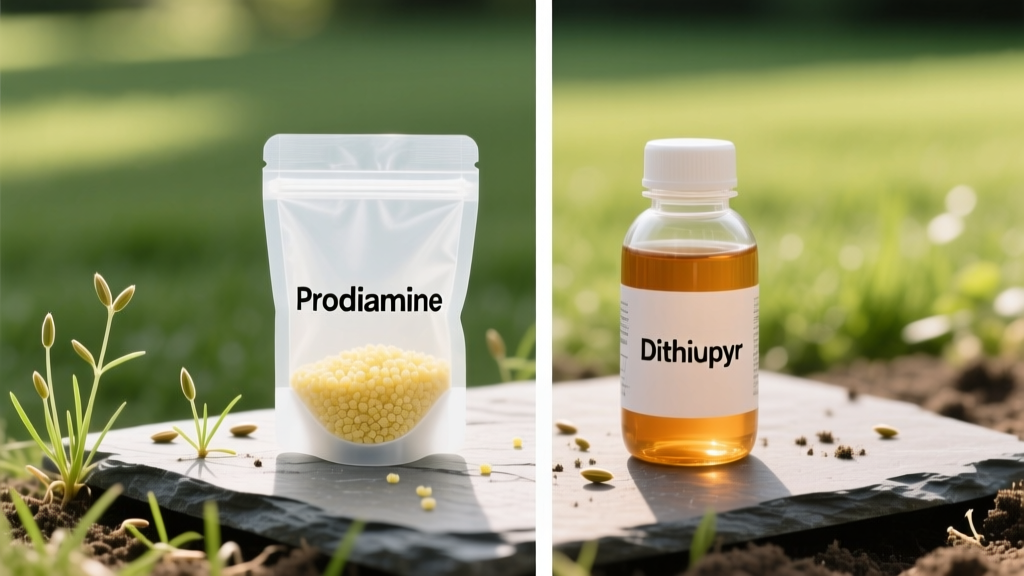
Prodiamine vs Dithiopyr: Which Pre-Emergent is Best?
Anna KowalskiPublished
The Battle Against Annual Grassy Weeds
Every spring, homeowners and lawn care professionals face the same formidable enemy: annual grassy weeds like crabgrass, goosegrass, and foxtail. Once these weeds establish themselves in your turf, they are notoriously difficult to eradicate without damaging the surrounding desirable grass. This is where pre-emergent herbicides become the cornerstone of any effective lawn care program. By creating an invisible chemical barrier at the soil surface, pre-emergents stop weed seeds from successfully germinating and taking root.
However, not all pre-emergent herbicides are created equal. In the professional turf management industry, the debate almost always boils down to two powerhouse active ingredients: Prodiamine (commonly known by the brand name Barricade) and Dithiopyr (commonly known by the brand name Dimension). Both are highly effective, but they operate with slightly different mechanisms, longevity profiles, and application windows. According to the Environmental Protection Agency (EPA), selecting the right pest control product requires understanding both the target pest's life cycle and the chemical's specific environmental behavior. In this comprehensive guide, we will break down Prodiamine vs. Dithiopyr to help you decide which pre-emergent is best for your specific lawn care needs.
Prodiamine (Barricade): The Long-Lasting Barrier
Prodiamine is a dinitroaniline herbicide that has been a staple in the turfgrass industry for decades. It works by inhibiting cell division in the root tips of germinating weed seeds. When a weed seed sprouts and its emerging root comes into contact with the Prodiamine barrier in the soil, root development ceases, and the seedling quickly dies.
Pros of Prodiamine
- Exceptional Longevity: Prodiamine is renowned for its long residual control. When applied at the maximum labeled rate, it can provide up to 6 months of continuous crabgrass prevention, often requiring only a single spring application to last through the entire growing season.
- Cost-Effective: On a per-acre or per-1,000-square-foot basis, Prodiamine is generally more affordable than Dithiopyr, making it a favorite for large properties and budget-conscious homeowners.
- Low Solubility: Because it binds tightly to soil organic matter and has low water solubility, Prodiamine is less likely to leach through the soil profile during heavy spring rains, keeping the barrier exactly where it needs to be.
Cons of Prodiamine
- Strict Application Window: Prodiamine is strictly a pre-emergent. If crabgrass has already germinated and emerged from the soil, Prodiamine will not kill it. You must apply it before soil temperatures consistently reach the germination threshold.
- Overseeding Restrictions: Prodiamine has a long residual that prevents not only weeds but also desirable grass seeds from germinating. You typically cannot overseed a lawn treated with Prodiamine for 4 to 6 months after application.
Dithiopyr (Dimension): The Flexible Forgiver
Dithiopyr is a pyridine herbicide that also targets root development, but it possesses a unique secondary trait that sets it apart from almost all other pre-emergents: early post-emergent control. While it stops seeds from germinating, Dithiopyr can also kill young crabgrass seedlings that have already sprouted, provided they are in the early stages of growth.
Pros of Dithiopyr
- Early Post-Emergent Control: Dithiopyr can control crabgrass up to the 1-tiller stage (when the young weed has just one secondary shoot). This 'forgiveness factor' is invaluable for homeowners who miss the strict early-spring application window.
- Shorter Overseeding Restrictions: Because it breaks down slightly faster in the soil and environment, you can typically overseed a lawn treated with Dithiopyr much sooner than one treated with Prodiamine—often within 6 to 12 weeks, depending on the application rate.
- Broad Weed Spectrum: Dithiopyr is highly effective against a wide variety of annual grasses and certain broadleaf weeds, including chickweed and spurge, when applied early.
Cons of Dithiopyr
- Shorter Residual: Dithiopyr generally provides 3 to 4 months of control. In regions with long, hot summers, a single spring application may break down before the late-summer flush of weeds, necessitating a second application.
- Higher Cost: Dimension is typically more expensive per application than Barricade, which can be a limiting factor for very large properties.
Head-to-Head Comparison Chart
To visualize the differences, review the comparison table below. Data aligns with recommendations from the University of Minnesota Extension for cool-season and warm-season turf management.
| Feature | Prodiamine (Barricade) | Dithiopyr (Dimension) |
|---|---|---|
| Active Ingredient Class | Dinitroaniline | Pyridine |
| Primary Mode of Action | Root inhibitor (Pre-emergent only) | Root inhibitor (Pre + Early Post-emergent) |
| Longevity of Control | 4 to 6 months | 3 to 4 months |
| Post-Emergent Capability | None | Up to 1-tiller crabgrass |
| Approximate Cost per 1k sq ft | $0.08 - $0.12 | $0.15 - $0.22 |
| Overseeding Wait Time | 4 to 6 months | 6 to 12 weeks |
| Best Application Window | Early Spring (Soil temps 50-55°F) | Early to Mid-Spring (Soil temps 50-60°F) |
Application Timing and Soil Temperatures
The single most critical factor in pre-emergent success is timing. Many amateur gardeners rely on visual cues, such as the blooming of forsythia bushes, to determine when to apply crabgrass preventer. However, turfgrass scientists warn that phenological indicators can be unreliable due to microclimates and varying spring weather patterns.
Instead, rely on soil temperature. Crabgrass begins to germinate when the soil temperature at a 2-inch depth consistently reaches 50°F to 55°F for several consecutive days. Research from the Purdue University Turfgrass Program indicates that applying your pre-emergent just before this threshold is reached ensures the chemical barrier is fully established and watered in before the first flush of weed seeds sprouts.
Pro Tip: Invest in a simple soil thermometer. Check the temperature in the morning in a shaded area of your lawn at a 2-inch depth to get the most accurate reading for germination thresholds.
Liquid vs. Granular Formulations
Both Prodiamine and Dithiopyr are available in granular and liquid formulations, but they perform differently depending on how you apply them.
Granular Pre-Emergents
Granular products are coated onto a carrier, such as fertilizer or limestone. They are incredibly easy to apply using a standard rotary or drop spreader. However, granular pre-emergents must be watered in with at least 0.5 inches of irrigation or rainfall within 7 to 14 days to activate the chemical and wash it off the carrier granules into the soil surface. If left on the surface too long, UV degradation can reduce efficacy.
Liquid Pre-Emergents
Liquid formulations, such as Prodiamine 65 WDG (Water Dispersible Granule) or Dimension 2EW (Emulsifiable Wettable), are mixed with water and sprayed using a backpack or tow-behind sprayer. Liquids offer superior coverage and uniformity compared to granulars. Because the active ingredient is already suspended in water, it penetrates the thatch layer and reaches the soil surface much faster, reducing the strict watering-in window.
Split Application Strategies for Maximum Control
While a single heavy application of Prodiamine can last all season, modern turf management heavily favors the split application strategy. Instead of applying the full yearly rate of pre-emergent in one go, you divide the total rate into two separate applications spaced 6 to 8 weeks apart.
For example, if the maximum labeled rate for Prodiamine is 2.3 lbs of active ingredient per acre, you would apply 1.15 lbs in early April, and the remaining 1.15 lbs in early June. This strategy provides a thicker, more consistent chemical barrier and ensures that the residual control extends deep into the late summer months when late-season weeds like goosegrass and spurge attempt to germinate. Dithiopyr is also an excellent candidate for split applications, especially if you are trying to stretch its early post-emergent capabilities into the early summer.
Environmental and Safety Best Practices
When handling any herbicide, safety and environmental stewardship must be your top priorities. Both Prodiamine and Dithiopyr are highly toxic to aquatic invertebrates and fish. Therefore, you must never apply these products near bodies of water, storm drains, or areas where surface runoff is likely to occur.
Always wear appropriate Personal Protective Equipment (PPE) as dictated by the product label, including long sleeves, long pants, chemical-resistant gloves, and protective eyewear. After application, sweep any granular product that lands on driveways or sidewalks back onto the lawn to prevent it from washing into municipal storm drains. By following the label instructions precisely, you ensure a thick, healthy lawn while protecting local waterways and ecosystems.
Conclusion: Which Should You Choose?
The choice between Prodiamine and Dithiopyr ultimately depends on your specific lawn care goals, budget, and schedule. If you are highly disciplined with your early-spring timing, have a large property, and want a cost-effective, set-it-and-forget-it solution, Prodiamine is the undisputed champion. Its long residual and low cost make it the workhorse of the industry.
On the other hand, if you tend to procrastinate in the spring, missed the early germination window, or plan to overseed your lawn in the late summer or early fall, Dithiopyr is the superior choice. Its ability to kill young crabgrass seedlings and its shorter reseeding interval offer unparalleled flexibility for dynamic lawn care routines. Whichever you choose, consistent application, proper soil temperature monitoring, and adequate watering will guarantee a weed-free lawn all season long.