Lawn Care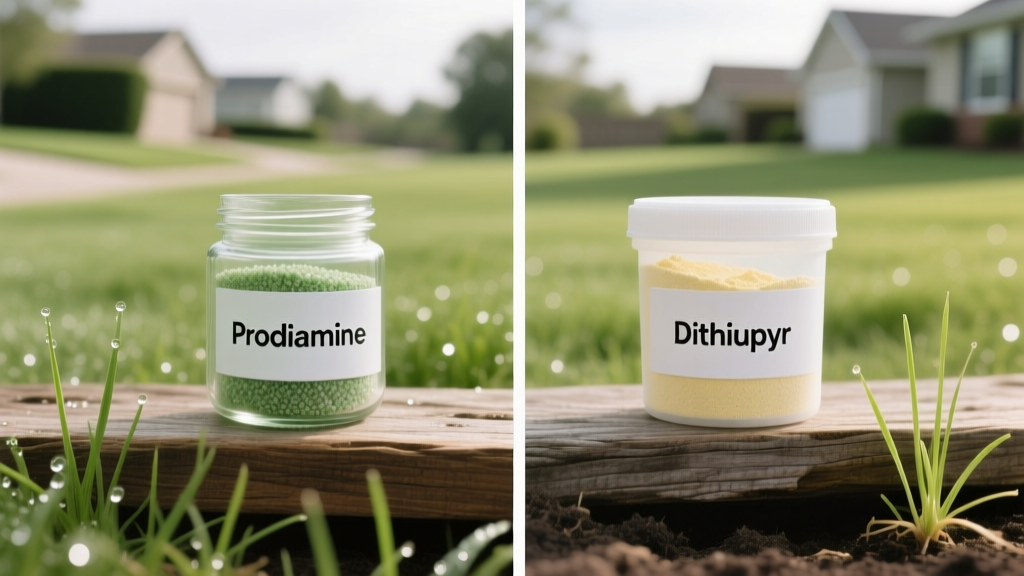
Prodiamine vs Dithiopyr: Best Pre-Emergent Herbicide for Lawns
Lisa ThompsonPublished
The Battle of the Pre-Emergent Herbicides
When it comes to maintaining a pristine, weed-free lawn, pre-emergent herbicides are your first and most critical line of defense. Rather than killing weeds after they sprout and damage your turf's aesthetics, pre-emergents create a chemical barrier in the top layer of soil that prevents weed seeds—most notably crabgrass—from successfully germinating and establishing roots. For professional turf managers and dedicated lawn care enthusiasts, the debate almost always narrows down to two powerhouse active ingredients: Prodiamine and Dithiopyr.
Both chemicals are exceptionally effective at halting annual grassy weeds and many broadleaf weeds before they start. However, they operate with slightly different modes of action, offer different application windows, and impact your lawn care budget in unique ways. According to turfgrass experts at Penn State Extension, understanding the specific behavior of these herbicides in the soil profile is the key to a season-long, weed-free lawn. In this comprehensive guide, we will break down Prodiamine (commonly known by the brand name Barricade) versus Dithiopyr (widely known as Dimension) to help you decide which product is the undisputed champion for your specific lawn care routine.
Prodiamine 65 WDG (Barricade): The Long-Lasting Barrier
Prodiamine is a highly popular pre-emergent herbicide belonging to the dinitroaniline chemical family. It is most commonly sold to professionals and advanced DIYers as a Water Dispersible Granule (WDG), with a 65% active ingredient concentration. When applied to the lawn and watered in, Prodiamine binds tightly to soil particles and organic matter, creating a highly stable vapor barrier.
How Prodiamine Works
When a weed seed germinates and its emerging root (radicle) or shoot comes into contact with the Prodiamine barrier, the chemical inhibits cell division. The seedling essentially starves and dies before it ever breaches the soil surface. Because it binds so tightly to the soil, Prodiamine is highly resistant to breaking down from heavy rainfall or microbial activity, giving it an incredible longevity of up to six months in the soil profile.
Pros and Cons of Prodiamine
- Pros: Exceptional longevity (often requiring only one or two applications per year), highly cost-effective per square foot, and does not stunt the roots of mature, established turfgrass.
- Cons: Zero post-emergent activity. If a weed seed has already germinated and established a root system before you apply Prodiamine, it will not kill it. Furthermore, its long residual means you must wait at least four months before overseeding your lawn with new grass seed.
Dithiopyr 2 EW (Dimension): The Flexible Fighter
Dithiopyr, belonging to the pyridine chemical family, is most frequently sold as an Emulsifiable in Water (EW) liquid formulation, typically at a 24% active ingredient concentration. While it shares the primary goal of preventing weed seed germination, Dithiopyr offers a unique secondary benefit that Prodiamine completely lacks: early post-emergent activity.
How Dithiopyr Works
Like Prodiamine, Dithiopyr inhibits root development in germinating seeds. However, research highlighted by Michigan State University Extension notes that Dithiopyr is unique because it can actually kill young crabgrass seedlings that have already germinated but have not yet reached the tillering stage (typically up to the one- or two-leaf stage). This makes it a slightly more forgiving product if you miss your early spring application window by a week or two.
Pros and Cons of Dithiopyr
- Pros: Early post-emergent crabgrass control, excellent broadleaf weed pre-emergent control (including chickweed and henbit), and a slightly shorter residual that allows for earlier fall overseeding compared to Prodiamine.
- Cons: Shorter overall longevity in the soil (typically 3 to 4 months), meaning it almost always requires a second application in late spring to carry the lawn through the heat of summer. It is also generally more expensive per square foot and can cause mild root pruning to newly established turf if applied too heavily.
Head-to-Head Comparison Chart
| Feature | Prodiamine 65 WDG (Barricade) | Dithiopyr 2 EW (Dimension) |
|---|---|---|
| Active Ingredient Class | Dinitroaniline | Pyridine |
| Formulation | Water Dispersible Granule (WDG) | Emulsifiable in Water (EW) Liquid |
| Pre-Emergent Control | Excellent (Crabgrass, Poa Annua) | Excellent (Crabgrass, Poa Annua) |
| Post-Emergent Activity | None | Yes (Early post-emergent up to tillering) |
| Soil Longevity | 4 to 6 Months | 3 to 4 Months |
| Overseeding Wait Time | Minimum 4 Months | Minimum 3 Months |
| Avg. Cost per 1,000 sq. ft. | $0.05 - $0.10 | $0.15 - $0.25 |
Application Timing and Soil Temperatures
The most common mistake homeowners make with pre-emergents is applying them based on the calendar or the blooming of forsythia bushes, rather than actual soil temperatures. Crabgrass germinates when the soil temperature at a two-inch depth reaches 50°F to 55°F for three to five consecutive days.
Prodiamine Timing: Because Prodiamine has zero post-emergent activity, the barrier must be established before the soil hits that 50°F threshold. Applying it in early spring, just as the soil begins to warm, is critical. If you apply it too early (e.g., late winter), microbial breakdown and heavy spring rains might degrade the barrier before the peak summer germination flush. If you apply it too late, crabgrass will slip right through the barrier.
Dithiopyr Timing: Dithiopyr offers a wider application window. Because of its early post-emergent capabilities, you can apply Dithiopyr slightly later in the spring, even if the soil has just crossed the 55°F mark and the very first crabgrass seeds are sprouting. The chemical will kill those young seedlings while simultaneously establishing a barrier for the rest of the season.
The Strategy of Split Applications
Whether you choose Prodiamine or Dithiopyr, turfgrass scientists universally recommend a "split application" strategy rather than dropping the maximum annual rate all at once. By splitting your total annual dose into two applications spaced 6 to 8 weeks apart, you ensure a thicker, more consistent chemical barrier that is less likely to be compromised by heavy rains or soil disturbances.
For Prodiamine, a common split application involves applying 0.5 ounces per 1,000 square feet in early spring, followed by another 0.5 ounces in late spring. This provides season-long control without exceeding the maximum annual label rate, which is crucial for preventing soil toxicity and root stunting.
For Dithiopyr, split applications are almost mandatory due to its shorter residual. An application of 0.75 ounces per 1,000 square feet in early spring, followed by a second application of 0.75 ounces roughly 60 days later, will carry your lawn safely through the dog days of August.
Cost and Coverage Analysis
When evaluating lawn care products, looking at the upfront cost of the jug is misleading; you must calculate the cost per 1,000 square feet. Prodiamine is the undisputed king of budget-friendly weed prevention. A single 5-pound jug of generic Prodiamine 65 WDG typically costs between $130 and $160. Because the application rate is so low (often just 0.5 oz per 1,000 sq. ft.), that single jug can treat over 150,000 square feet for a single application. This brings the cost down to mere pennies per 1,000 square feet.
Dithiopyr, on the other hand, is significantly more expensive. A 2.5-gallon jug of Dimension 2 EW can cost upwards of $200 to $250, and because it is a liquid with a higher volume application rate, it covers far less area. For a standard 5,000 square foot suburban lawn, Prodiamine will cost you roughly $5 to $10 for the entire year's pre-emergent defense, whereas Dithiopyr might cost $20 to $30 for the same coverage.
Overseeding Considerations
If you plan to overseed your lawn with cool-season grasses like Tall Fescue or Kentucky Bluegrass in the early fall, your choice of pre-emergent will dictate your schedule. Pre-emergents do not differentiate between weed seeds and expensive turfgrass seeds; they will inhibit the germination of both.
Prodiamine's long residual means you generally need to wait at least 4 months (and sometimes up to 5 months, depending on the application rate) after your last application before you can safely drop grass seed. If you apply a heavy dose of Prodiamine in May, you may find yourself unable to overseed in early September. Dithiopyr breaks down faster, usually requiring a 3-month wait time, offering a bit more flexibility for late-summer lawn renovations.
Final Verdict: Which Should You Choose?
The choice between Prodiamine and Dithiopyr ultimately comes down to your specific lawn care habits, budget, and seasonal goals.
Choose Prodiamine if: You are on a budget, you manage a large property, you are highly disciplined about early spring application timing, and you do not plan on doing extensive fall overseeding. It is the ultimate "set it and forget it" workhorse for season-long crabgrass prevention.
Choose Dithiopyr if: You struggle with application timing and need the safety net of early post-emergent crabgrass control, you are battling specific broadleaf weeds that germinate early, or you need a slightly shorter residual window to accommodate an early fall overseeding schedule. While it costs more, the flexibility and broad-spectrum control make it a favorite among high-end lawn care professionals.
By understanding the unique strengths of both chemicals, you can tailor your weed control program to your lawn's exact needs, ensuring a thick, green, and weed-free turf from spring thaw to autumn frost.