Tree Care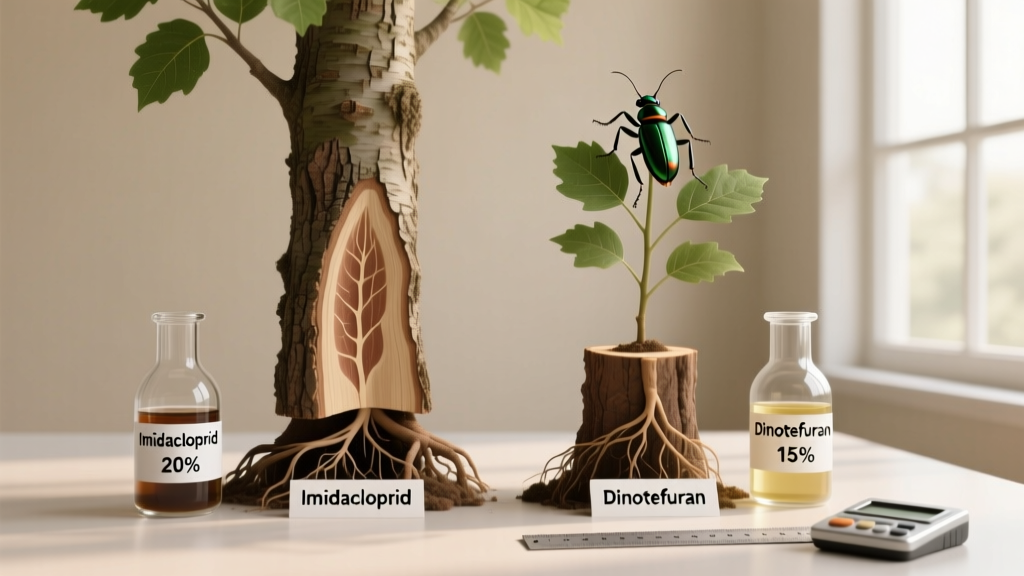
Imidacloprid vs Dinotefuran: Best EAB Tree Treatment
James MillerPublished
The Battle Against the Emerald Ash Borer
The Emerald Ash Borer (EAB), scientifically known as Agrilus planipennis, is an invasive wood-boring beetle that has decimated tens of millions of ash trees across North America. If you have ash trees on your property, proactive chemical treatment is not merely an option; it is an absolute necessity for their survival. When it comes to saving your trees, the two most prominent systemic insecticides on the market are Imidacloprid and Dinotefuran. Both belong to the neonicotinoid class of chemicals, but they behave very differently once introduced to the tree's vascular system. In this comprehensive guide, we will compare Imidacloprid vs Dinotefuran to help you decide which product is best for your specific tree care needs, budget, and environmental conditions.
Understanding the Threat and the Need for Systemics
Before diving into the chemical comparison, it is crucial to understand the enemy. EAB larvae feed on the inner bark (phloem and outer xylem) of ash trees, creating S-shaped galleries that disrupt the tree's ability to transport water and nutrients. According to the University of Minnesota Extension, an untreated ash tree will typically die within two to four years of initial infestation. Because the damage occurs deep beneath the bark, topical contact sprays are entirely ineffective. You must use systemic insecticides that are absorbed by the roots or trunk and translocated throughout the canopy where the larvae and adult beetles feed.
Identifying EAB Damage
To determine which treatment you need, you must first assess the tree's current health. Look for the following symptoms:
- D-Shaped Exit Holes: Adult beetles leave distinct, 1/8-inch D-shaped holes in the bark when emerging in late spring.
- Canopy Dieback: Thinning and dying leaves usually start at the very top of the canopy and work their way down.
- Epicormic Sprouting: The tree may produce aggressive, new shoots along the base of the trunk or on lower branches as it attempts to compensate for canopy loss.
- Woodpecker Damage: Increased woodpecker activity and 'flecking' (stripping of the outer bark) indicate larvae are present beneath the surface.
Imidacloprid: The Industry Standard for Preventive Care
Imidacloprid has been the go-to chemical for EAB management for over a decade. It is widely available to homeowners in the form of soil drenches and granular applications, as well as to licensed professionals via direct trunk injection. When applied as a soil drench, the chemical is absorbed by the fine feeder roots and moves upward through the xylem to the leaves and branches.
Pros and Cons of Imidacloprid
Pros:
- Highly cost-effective, especially for smaller to medium-sized trees.
- Widely available at local garden centers and online retailers.
- Provides long residual control, protecting the tree for up to 12 months per application.
Cons:
- Slow uptake speed; it can take 4 to 8 weeks for the chemical to reach the upper canopy in lethal concentrations.
- Limited efficacy on very large trees (over 20 inches in diameter) when applied as a soil drench, as the root system is too massive to deliver the chemical fast enough.
- Highly toxic to aquatic invertebrates and must be kept away from storm drains and water bodies.
Dinotefuran: The Fast-Acting Rescue Alternative
Dinotefuran is a newer-generation neonicotinoid that boasts a significantly higher water solubility than Imidacloprid. This unique chemical property allows it to move through the tree's vascular system at a much faster rate. The Emerald Ash Borer Information Network highlights Dinotefuran as a critical tool for 'rescue' treatments on trees that are already showing significant signs of decline but still have a viable canopy.
The Basal Trunk Spray Advantage
One of the most significant advantages of Dinotefuran is its ability to be applied as a basal trunk spray. This involves spraying the chemical directly onto the lower trunk bark (usually the bottom 4 to 5 feet), where it penetrates the outer layers and enters the vascular system without needing soil contact. This is a massive advantage for trees growing near water bodies, paved surfaces, or in heavily compacted urban soils where root uptake of soil drenches is notoriously poor.
Pros and Cons of Dinotefuran
Pros:
- Rapid uptake speed; reaches the canopy in 1 to 3 weeks, making it ideal for stressed trees.
- Can be applied via basal bark spray, bypassing soil compaction and runoff issues.
- Effective on much larger trees that Imidacloprid soil drenches cannot adequately protect.
Cons:
- Significantly more expensive per ounce than generic Imidacloprid products.
- Basal bark sprays often require a specialized penetrating adjuvant (a surfactant) to ensure the chemical crosses the bark barrier.
- Less commonly found in standard retail garden centers; often requires purchasing from professional landscaping suppliers.
Head-to-Head Comparison Chart
| Feature | Imidacloprid | Dinotefuran |
|---|---|---|
| Water Solubility | Moderate | Very High |
| Uptake Speed | 4 to 8 weeks | 1 to 3 weeks |
| Max Efficacy DBH (Soil) | ~20 inches | Larger trees (via trunk spray) |
| Primary Application | Soil Drench / Injection | Basal Trunk Spray / Soil Drench |
| Rescue Treatment Viability | Low (Best if <30% dieback) | High (Viable up to 50% dieback) |
| Residual Control | 12 months | 12 months |
| Relative Cost | $ (Budget-Friendly) | $$$ (Premium) |
Tree Size and DBH Limits: Why They Matter
When choosing between these two products, the size of your tree is the most critical deciding factor. Arborists measure tree size using Diameter at Breast Height (DBH), which is the diameter of the trunk measured at 4.5 feet above the ground. To find your tree's DBH, measure the circumference of the trunk at chest height and divide that number by 3.14 (Pi).
As noted by Purdue University Extension, soil-applied Imidacloprid is generally not recommended for trees exceeding 20 inches in DBH. The sheer volume of wood and the vast root network dilute the chemical, meaning the upper canopy never receives a lethal dose for the EAB larvae. If your tree is larger than 20 inches DBH, you must either hire a professional for trunk injections or switch to a Dinotefuran basal bark spray, which can effectively treat much larger specimens.
Environmental and Pollinator Concerns
Because both Imidacloprid and Dinotefuran are neonicotinoids, they carry inherent risks to non-target insects, particularly bees and other pollinators. Ash trees are wind-pollinated and do not rely heavily on insect pollinators, which reduces the direct risk to bees foraging on the flowers. However, you must never apply these systemic treatments while the tree is in bloom or if the tree is heavily infested with aphids or scale insects that produce honeydew, which bees may consume.
Furthermore, when using soil drenches, always remove any flowering weeds or clover from the application area before drenching the soil. If pollinators are a primary concern, or if your tree is located immediately adjacent to a pond or stream, professional trunk injection (which uses specialized Imidacloprid or Emamectin benzoate formulations) is the safest route, as it completely eliminates soil runoff and non-target exposure.
Step-by-Step Application Best Practices
Applying an Imidacloprid Soil Drench
- Measure and Calculate: Determine your tree's DBH and read the specific product label for the exact mixing ratio (often measured in ounces per inch of DBH).
- Prepare the Area: Clear mulch, rocks, and flowering weeds from a 2-foot radius around the base of the trunk.
- Mix and Apply: Mix the concentrate with water in a watering can. Pour the mixture evenly in a circular band around the drip line or directly around the root flare, depending on the label instructions.
- Water it In: Lightly irrigate the area with an additional 1 to 2 gallons of plain water to help push the chemical into the root zone. Do not overwater to the point of runoff.
Applying a Dinotefuran Basal Trunk Spray
- Prepare the Bark: If the trunk is heavily covered in thick moss or loose, peeling bark, gently brush it away to expose the tighter inner bark layers.
- Mix with Adjuvant: Mix the Dinotefuran product with water and the manufacturer-recommended penetrating surfactant. The surfactant is mandatory for bark penetration.
- Spray the Trunk: Using a low-pressure pump sprayer, apply the mixture to the bottom 4 to 5 feet of the trunk. Spray until the bark is thoroughly wet and just beginning to drip, ensuring 360-degree coverage.
- Allow to Dry: Keep pets and children away from the trunk until the liquid has completely dried into the bark.
When to Treat: Timing is Everything
For both chemicals, timing is critical. Systemic treatments should be applied in the spring, typically between mid-April and late May, just as the ash trees are beginning to push new leaf growth and the soil is consistently moist. The upward flow of sap during the spring flush is what carries the insecticide into the canopy. If you apply a soil drench in the middle of a summer drought, the tree's roots will not absorb the chemical, and your treatment will fail. Always water your trees deeply a few days before applying any soil-based systemic insecticide.
Final Verdict: Which Should You Choose?
If you have smaller ash trees (under 20 inches DBH) that are currently healthy or showing minimal signs of stress, Imidacloprid soil drenches are the most economical and practical choice for annual preventive maintenance. However, if you are dealing with a massive, mature ash tree, a tree surrounded by concrete, or a tree that is already showing moderate canopy dieback and requires immediate 'rescue' intervention, Dinotefuran is the superior, fast-acting solution. Remember that if a tree has lost more than 50% of its canopy, the vascular system is too damaged to transport any chemical, and the tree should be safely removed by a certified arborist to prevent it from becoming a hazard.