Tree Care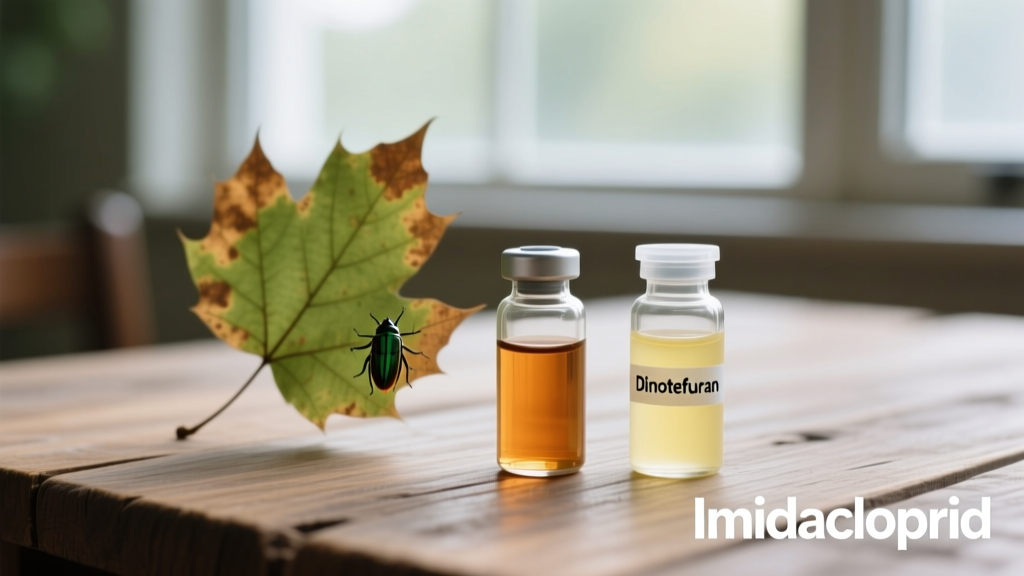
Imidacloprid vs Dinotefuran: Best EAB Tree Treatment
James MillerPublished
The Emerald Ash Borer Crisis
The Emerald Ash Borer (EAB) is an invasive beetle that has killed hundreds of millions of ash trees across North America. When EAB larvae feed on the inner bark of ash trees, they disrupt the tree's ability to transport water and nutrients, inevitably leading to canopy dieback and death. According to the USDA Animal and Plant Health Inspection Service (APHIS), EAB has spread to over 35 states, making proactive tree care and chemical intervention essential for homeowners who wish to preserve their mature ash trees.
While tree removal is sometimes necessary, high-value ash trees can be saved using systemic insecticides. The two most common and effective active ingredients available for homeowner and professional use are Imidacloprid and Dinotefuran. But how do you choose between them? This guide breaks down the science, application methods, costs, and effectiveness of Product A (Imidacloprid) versus Product B (Dinotefuran) to help you make an informed tree care decision.
Imidacloprid vs. Dinotefuran: Head-to-Head Comparison
| Feature | Product A: Imidacloprid | Product B: Dinotefuran |
|---|---|---|
| Common Brand Names | BioAdvanced 12 Month, Fertilome Tree & Shrub | Safari 20SG, Zylam, Transtect |
| Primary Application | Soil Drench / Soil Injection | Basal Trunk Spray / Soil Drench |
| Xylem Mobility | Moderate (Slow uptake) | High (Rapid uptake) |
| Best Tree Size | Small to Medium (Under 22" DBH) | Medium to Large (Over 22" DBH) |
| Time to Translocate | 4 to 8 weeks | 1 to 3 weeks |
| Relative Cost | Low to Moderate | Moderate to High |
Product A: Imidacloprid (Soil Drench)
Imidacloprid is a neonicotinoid insecticide that has been a staple in tree care for decades. It works by interfering with the nervous system of the EAB larvae as they feed on the treated vascular tissue of the ash tree. For homeowners, it is most commonly sold as a liquid concentrate designed to be mixed with water and poured around the base of the tree.
Application and Timing
Imidacloprid must be applied as a soil drench in the early spring, typically between mid-April and mid-May, just before the adult beetles emerge and lay eggs. Because it takes 4 to 8 weeks for the chemical to be absorbed by the roots and translocated to the upper canopy, timing is critical.
- Measurement: Measure the circumference of the trunk at 4.5 feet above the ground (breast height). The standard application rate is typically 1 ounce of product per inch of trunk circumference.
- Mixing: Mix the required ounces with 1 gallon of water for every 10 inches of circumference.
- Application: Remove any mulch or dead leaves from the base of the trunk. Pour the mixture in a circular band around the drip line or directly adjacent to the trunk, ensuring the soil is moist but not waterlogged.
Pros and Cons
The primary advantage of Imidacloprid is its cost-effectiveness and widespread availability at local garden centers. However, its moderate water solubility means it moves slowly through the tree's xylem. According to research highlighted by the Penn State Extension, Imidacloprid is generally not recommended for ash trees with a Diameter at Breast Height (DBH) greater than 22 inches, as the chemical cannot reach the upper canopy in lethal concentrations fast enough to protect massive trees.
Product B: Dinotefuran (Basal Trunk Spray)
Dinotefuran is a newer generation neonicotinoid that boasts a significantly higher water solubility than Imidacloprid. This chemical property allows it to move rapidly upward through the tree's xylem, making it a highly effective rescue treatment for larger ash trees or trees that are already showing early signs of EAB stress.
Application and Timing
While Dinotefuran can be applied as a soil drench, its most popular and effective homeowner application method is the basal trunk spray. This involves spraying the lower 5 to 6 feet of the trunk directly, allowing the chemical to penetrate the bark and enter the vascular system.
- Timing: Apply in the spring to early summer when the tree is actively transpiring and pulling water (and the insecticide) up into the canopy.
- Mixing: Dinotefuran requires the use of a specialized penetrating surfactant (organosilicone) to help the chemical bypass the rough outer bark of mature ash trees.
- Application: Using a pump sprayer, apply the mixture to the lower trunk until the bark is thoroughly wet and just begins to run off. Wear appropriate Personal Protective Equipment (PPE), including long sleeves, chemical-resistant gloves, and eye protection.
Pros and Cons
Dinotefuran's rapid uptake (often within 1 to 3 weeks) makes it superior for large trees or late-spring applications where Imidacloprid would fail to reach the canopy in time. The basal spray method also avoids introducing chemicals directly into the soil, which is beneficial if your ash tree is located near a vegetable garden or a sensitive water feature. The main drawback is the higher upfront cost and the necessity of purchasing a compatible surfactant.
Cost Analysis for a 15-Inch DBH Tree
To understand the financial commitment, let us compare the cost of treating a healthy ash tree with a 15-inch DBH (approximately 47 inches in circumference).
- Imidacloprid Soil Drench: Requires roughly 47 ounces of concentrate. A standard 32-ounce bottle of BioAdvanced costs about $25, meaning you will need two bottles per year. Estimated Annual Cost: $50.00
- Dinotefuran Basal Spray: Requires a precise mixture of Safari 20SG and a surfactant. A small 6-ounce bottle of Safari costs around $65 and is highly concentrated, often enough to treat several 15-inch trees. Factoring in the $15 surfactant, the initial investment is higher, but the cost per tree drops significantly. Estimated Annual Cost: $25.00 (after initial purchase of supplies)
While Imidacloprid is cheaper to buy off the shelf, Dinotefuran's high concentration can actually make it more economical over a multi-year treatment plan for properties with multiple ash trees.
Environmental and Pollinator Considerations
Both Imidacloprid and Dinotefuran are neonicotinoids, a class of chemicals that has faced scrutiny due to its potential impact on non-target pollinators, particularly bees. Ash trees are wind-pollinated, which significantly reduces the risk of bees directly contacting the insecticide on the flowers. However, systemic insecticides can occasionally be present in honeydew secreted by aphids or in guttation droplets on leaves.
To minimize environmental impact, the Emerald Ash Borer Information Network recommends applying soil drenches only when the soil is not waterlogged and ensuring that no flowering weeds (like dandelions or clover) are present in the treatment zone. If flowering weeds are present, mow them down immediately before applying the soil drench to prevent foraging bees from coming into contact with the chemical residue.
The 50% Canopy Rule: When to Stop Treating
No insecticide can resurrect dead wood. Before investing in either Product A or Product B, you must assess the current health of your ash tree. Arborists universally follow the '50% Canopy Rule' when deciding whether to treat or remove an EAB-infested tree.
Expert Guideline: If an ash tree has lost more than 50% of its leaf canopy due to Emerald Ash Borer feeding, the vascular system is too severely damaged to effectively translocate systemic insecticides. At this stage, chemical treatment will fail, and the tree should be safely removed by a certified arborist to prevent it from becoming a hazardous falling risk.
Final Verdict: Which Should You Choose?
The choice between Imidacloprid and Dinotefuran ultimately comes down to the size of your tree and the timing of your application.
- Choose Imidacloprid (Product A) if you have small to medium-sized ash trees (under 22 inches DBH), you are applying the treatment in early spring, and you prefer a simple soil drench application using readily available hardware store products.
- Choose Dinotefuran (Product B) if you are protecting large, mature ash trees (over 22 inches DBH), you missed the early spring window and need a chemical that translocates rapidly, or you want to avoid soil applications near sensitive garden beds by utilizing a basal trunk spray.
Consistent, annual treatment is the only way to protect your ash trees from the Emerald Ash Borer. By selecting the right systemic insecticide for your specific tree size and property layout, you can preserve your landscape's canopy and maintain your property value for decades to come.