Tree Care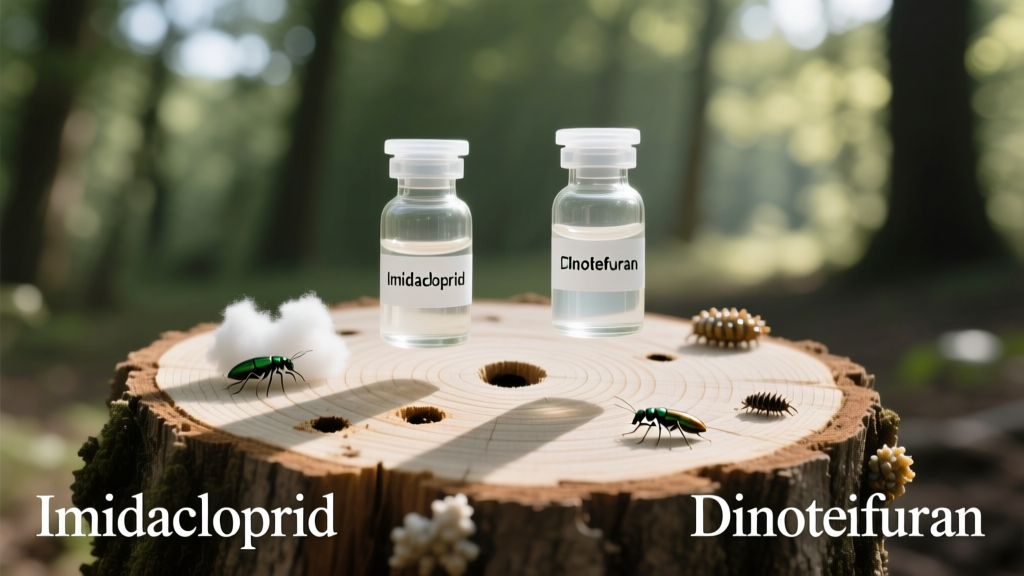
Imidacloprid vs Dinotefuran: Best Systemic Tree Insecticide
Sarah ChenPublished
Introduction to Systemic Tree Insecticides
When managing destructive tree pests like the Emerald Ash Borer (EAB), Hemlock Woolly Adelgid (HWA), or severe scale infestations, homeowners and arborists frequently turn to systemic insecticides. Unlike contact sprays that only kill pests on the surface, systemic treatments are absorbed by the tree's roots or trunk and distributed throughout the vascular system. When sap-sucking or wood-boring insects feed on the tree, they ingest the insecticide and perish. The two most prominent active ingredients in this space are Imidacloprid and Dinotefuran. In this comprehensive guide, we will compare the leading products in each category: Bayer Advanced 12 Month Tree and Shrub Protect and Feed (Imidacloprid) versus Safari 20SG Systemic Insecticide (Dinotefuran).
Product A: Imidacloprid (Bayer Advanced Tree and Shrub)
Imidacloprid is the oldest and most widely used neonicotinoid insecticide in the world. For residential tree care, it is most commonly found in the Bayer Advanced 12 Month Tree and Shrub Protect and Feed line. This product is typically applied as a soil drench around the base of the tree. Once applied, the tree's root system absorbs the chemical, slowly translocating it upward through the xylem into the canopy.
The primary advantage of Imidacloprid is its cost-effectiveness and long residual activity. A single application can protect a tree for up to twelve months. Furthermore, the Bayer formulation often includes a slow-release fertilizer component, providing a nutritional boost to the tree while it fights off pests.
However, Imidacloprid is notoriously slow-acting. It can take anywhere from four to eight weeks for the chemical to reach the upper canopy in a mature tree. If a tree is already under severe attack from a fast-moving pest like the Emerald Ash Borer, this delay can be fatal. Additionally, Imidacloprid is highly water-soluble, which raises concerns about groundwater leaching in areas with sandy soils or high water tables.
Product B: Dinotefuran (Safari 20SG Systemic Insecticide)
Dinotefuran is a newer generation neonicotinoid that has revolutionized professional and advanced residential tree care. The most recognized formulation is Safari 20SG. Unlike Imidacloprid, Dinotefuran is highly systemic and can be applied as a soil drench, a basal trunk spray, or even a foliar spray.
The standout feature of Dinotefuran is its rapid uptake and exceptional xylem mobility. When applied as a basal bark spray, Safari 20SG can reach the upper canopy of a large tree in a matter of days, rather than weeks. This makes it an invaluable rescue treatment for trees that are actively declining from severe pest pressure. It is also highly effective against pests that Imidacloprid struggles with, such as certain scale insects and the Hemlock Woolly Adelgid.
The main drawback of Safari 20SG is its price point and shorter residual lifespan. While a small six-ounce bottle can cost over a hundred dollars, it is highly concentrated. However, because it breaks down faster in the environment and within the tree tissue, it often requires annual or even bi-annual applications to maintain continuous protection against aggressive borers.
Head-to-Head Comparison Chart
| Feature | Imidacloprid (Bayer Advanced) | Dinotefuran (Safari 20SG) |
|---|---|---|
| Active Ingredient | Imidacloprid | Dinotefuran |
| Primary Application | Soil Drench | Basal Spray, Soil Drench |
| Uptake Speed | Slow (4 to 8 weeks) | Fast (1 to 3 days) |
| Residual Control | Up to 12 Months | 3 to 6 Months |
| Cost Efficiency | High (Low cost per tree) | Moderate (Higher upfront cost) |
| Best Use Case | Preventative maintenance | Rescue treatments, HWA, Scale |
Efficacy Against Common Tree Pests
Emerald Ash Borer (EAB)
The Emerald Ash Borer is an invasive beetle responsible for killing hundreds of millions of ash trees across North America. According to the Emerald Ash Borer Information Network, systemic insecticides are the only viable defense for high-value landscape ash trees. Both Imidacloprid and Dinotefuran are effective, but they serve different strategic purposes. Imidacloprid is best used as a preventative measure on healthy trees or those with very minor canopy dieback (less than twenty percent). Dinotefuran, due to its rapid translocation, is the preferred choice for rescue treatments on trees showing moderate decline (twenty to fifty percent canopy dieback). For trees with more than fifty percent dieback, neither product will save the tree, and removal is recommended by the USDA APHIS.
Arborist Best Practice: Never treat an ash tree with systemic insecticides if canopy dieback exceeds fifty percent. The vascular system is too damaged to transport the chemical, and the tree will not recover.
Hemlock Woolly Adelgid and Scale Insects
While Imidacloprid provides excellent control for many sap-sucking insects, it has shown variable efficacy against the Hemlock Woolly Adelgid (HWA) and certain armored scale insects. Dinotefuran, on the other hand, is exceptionally lethal to HWA and soft scales. Arborists often use a rotational strategy, applying Dinotefuran for a rapid knockdown of a severe HWA infestation, followed by Imidacloprid in subsequent years for long-term, cost-effective maintenance.
Application Methods and Timing
Soil Drenching
Both products can be applied as a soil drench, which involves mixing the chemical with water and pouring it around the root flare. For Imidacloprid, the standard rate is typically one ounce of product per one inch of trunk circumference at breast height (DBH). For Dinotefuran soil drenches, the rate varies by product concentration but is generally much lower by weight due to its high solubility. Soil drenches must be applied in early spring or early fall when trees are actively transpiring and pulling water from the soil. Applying during summer droughts or winter dormancy will result in poor uptake.
Basal Trunk Spraying
This method is exclusive to Dinotefuran (Safari 20SG) and is a game-changer for tree care professionals. By mixing Safari with a penetrating adjuvant and spraying the lower eighteen inches of the trunk, the chemical penetrates the bark and enters the vascular system directly. This bypasses the soil entirely, eliminating concerns about soil leaching, clay binding, or slow root uptake. Basal spraying can be done almost any time the tree is actively growing and the bark is not frozen or saturated with rain.
Environmental and Pollinator Considerations
Both Imidacloprid and Dinotefuran belong to the neonicotinoid class of chemicals, which has faced intense scrutiny regarding its impact on pollinators. The USDA Forest Service Forest Health Protection program emphasizes that while these chemicals are highly toxic to bees, the risk is significantly mitigated when applied as a soil drench or basal spray to non-flowering trees or trees that do not attract pollinators (like ash or oak). However, if you are treating a linden, basswood, or other highly attractive flowering tree, you must exercise extreme caution. To minimize risk, never apply soil drenches to waterlogged soils, and avoid treating trees that are already in bloom. Dinotefuran is slightly less persistent in the soil than Imidacloprid, which some environmental advocates prefer, though both require strict adherence to label instructions to protect local ecosystems.
Final Verdict: Which Should You Choose?
Choosing between Imidacloprid and Dinotefuran ultimately depends on the health of your tree, the specific pest you are targeting, and your budget.
- Choose Imidacloprid (Bayer Advanced) if you are implementing a preventative care schedule for healthy trees, dealing with standard aphid or borer pressure, and want a cost-effective, once-a-year solution that also provides fertilizer.
- Choose Dinotefuran (Safari 20SG) if you are executing a rescue treatment on a rapidly declining tree, targeting stubborn pests like Hemlock Woolly Adelgid, or need a fast-acting basal spray that bypasses poor soil conditions.
By understanding the unique strengths and limitations of both systemic insecticides, you can make an informed decision that will preserve the health, beauty, and structural integrity of your landscape trees for decades to come.