Pest Control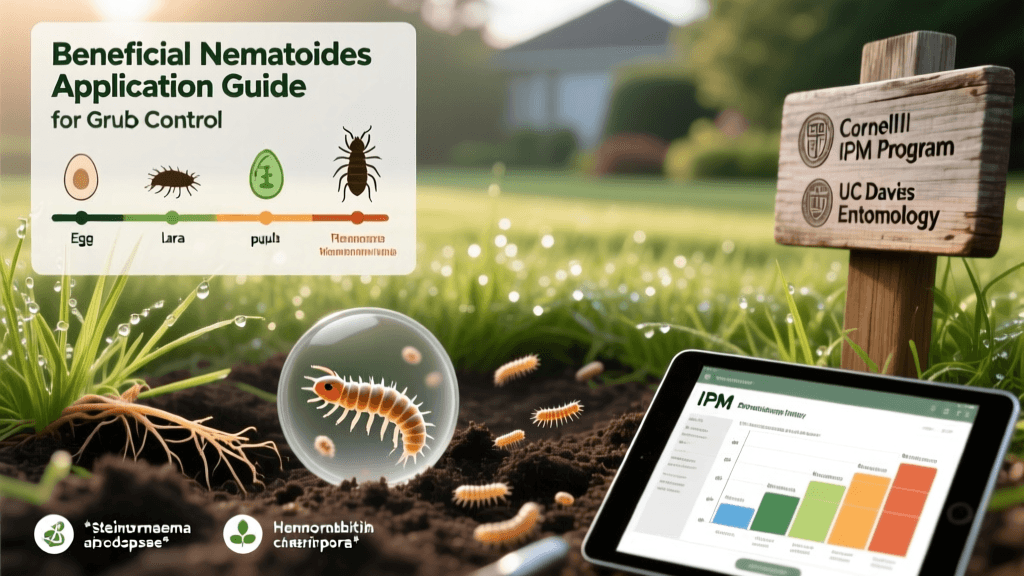
Beneficial Nematodes Application Guide For Grub Control
Understanding the Grub Lifecycle for Targeted Control
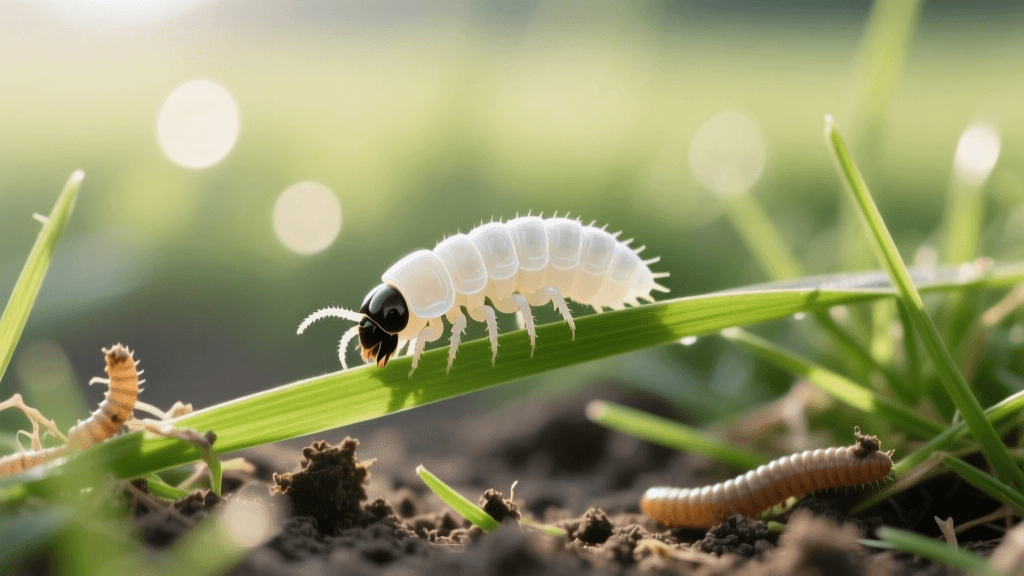
White grubs—the larval stage of scarab beetles including Japanese beetles (Popillia japonica), June beetles (Phyllophaga spp.), and European chafers (Amphimallon majalis)—go through complete metamorphosis: egg, larva, pupa, and adult. Eggs are laid in soil between late June and early August in most temperate regions, usually peaking 10–14 days after adults start flying. Larvae hatch in 2–3 weeks and feed on grass roots from late summer into fall. They spend winter 4–8 inches down in USDA Hardiness Zones 5–7, then move up to feed again in early spring before pupating in late May or early June at 1–3 inches deep. Adults emerge 3–4 weeks later, finishing a one-year cycle across much of the U.S. (Cornell University Cooperative Extension, 2022).
Why Beneficial Nematodes Fit Well in IPM
Beneficial nematodes are microscopic roundworms that infect soil-dwelling insect larvae. Unlike broad-spectrum chemical insecticides, they don’t harm mammals, birds, earthworms, or pollinators. They support Integrated Pest Management (IPM) as promoted by land-grant universities and extension services—focusing on prevention, monitoring, and acting only when pest numbers cross a threshold. The University of Massachusetts Amherst’s Turf Program includes nematode applications in its regional IPM protocols for residential lawns, with soil moisture testing before use and scheduled irrigation afterward to help them work better.
Key Species and Their Host Specificity
The two most widely used species for grub control are Heterorhabditis bacteriophora and Steinernema carpocapsae. Both infect grubs, but they behave differently in the soil:
- H. bacteriophora moves around actively in moist, warm soils (best between 60–90°F); it enters grubs through natural openings and releases symbiotic Photorhabdus bacteria that kill the host within 48 hours.
- S. carpocapsae stays near the surface and waits to ambush moving larvae; it works well against young grubs in spring but less so against older ones that have moved deeper for winter.
When and How to Apply
Timing matters. You want to apply when grubs are vulnerable and soil conditions support nematode movement. In the northeastern U.S., mid-August to mid-September is usually best for targeting third-instar grubs—soil temperatures should stay above 60°F at a 2-inch depth, and moisture should be over 15% by weight. A study across 12 sites in Ohio and Pennsylvania found that applications before August 15 gave just 42% grub mortality, while those between August 20 and September 10 reached 78–89% control (Ohio State University Extension, 2021). Soil pH should sit between 5.5 and 7.5, and you’ll get better results applying at dawn, dusk, or under cloudy skies to limit UV exposure.
Irrigation Requirements Before and After Application
Water the area first. Apply 0.25–0.5 inches of water 24 hours before treatment so the soil is moist and grubs are closer to the surface. Right after applying nematodes, add another 0.25 inches to help them wash down into the root zone. Then water lightly (0.1 inch) each day for three days to keep the top layer damp—nematodes dry out fast if the soil surface gets hot or exposed to sun.
Product Selection and Active Ingredients
Commercial nematode products contain live, infective juvenile nematodes mixed into inert carriers like clay or gel. Labels must list the species, concentration (e.g., 1 billion H. bacteriophora per acre), and expiration date. Reputable suppliers include BioLogic (Ithaca, NY), Arbico Organics (Tucson, AZ), and Gardens Alive! (Lawrenceburg, IN). All need refrigerated shipping and storage at 39–50°F; viability drops about 20% each week past the labeled shelf life. Don’t mix them with fungicides or copper-based bactericides—they cut nematode survival by up to 90% in lab tests.
Application Equipment and Calibration
Use low-pressure sprayers (<50 psi) with mesh screens no finer than 50 mesh to avoid clogging or damaging the nematodes. Hose-end applicators set to deliver 1 gallon per 250 sq ft work fine for small lawns. For larger areas, backpack sprayers with adjustable nozzles set to a coarse droplet size (200–400 µm) spread them more evenly. Stir the tank constantly during application—nematodes settle quickly because they’re heavier than the carrier solution.
Measuring Success and Monitoring Post-Treatment
Check results 14–21 days after applying. Dig ten 6-inch × 6-inch × 3-inch soil samples per 1,000 sq ft and sort through them by hand for live versus dead grubs. A good result means fewer than 5 grubs per square foot—the economic threshold Rutgers University’s Department of Entomology uses for healthy turfgrass. If counts are higher, consider reapplying—but only if soil temperature stays above 60°F and moisture is sufficient. Wait at least 10 days between applications; nematodes need time to reproduce inside hosts and move around.
Grub damage shows up as uneven brown patches that pull up easily due to damaged roots. To tell it apart from drought stress, try the “tug test”: gently pull on affected turf. If it lifts like carpet, grubs are likely the cause. Drought-stressed turf stays anchored even when it turns brown.
University of Vermont Extension suggests pairing nematodes with simple lawn care habits: mowing at 3–3.5 inches helps roots grow deeper and tolerate some grub feeding, while skipping extra nitrogen fertilizer in June makes the lawn less attractive to egg-laying beetles.
Field trials in suburban Chicago found that plots treated with H. bacteriophora at 250 million/acre in early September had 84% fewer grubs than untreated plots, where densities averaged 22 per square foot (Purdue University Department of Entomology, 2020).
Nematodes don’t work on pupae or adults. So using them alongside pheromone traps to track adult beetles—or spot-spraying only when trap counts go above 5 beetles per week—adds another layer of control, consistent with Cornell’s IPM approach.
Soil texture affects how far and fast nematodes move: in sandy loam, they travel about 1 inch per day; in heavy clay, that slows to 0.25 inch/day. Adjust how much solution you apply—clay soils may need 20% more volume to reach 2 inches deep.
Write down the application date, soil temperature at 2 inches (measured with a certified probe), relative humidity, and weather right after spraying. This helps with future decisions and meets record-keeping rules for organic land care certification in places like Portland, OR and Madison, WI.
When stored at 39°F, viable nematodes hold at least 90% of their infectivity for up to 4 weeks after shipment. If you thaw frozen product (never in a microwave), check motility under 40× magnification: at least 70% of juveniles should show strong, wavy movement.
“Nematodes are not a ‘set-and-forget’ solution. Their success hinges on precise environmental synchronization—not just product quality.” — Dr. Sarah Karp, Senior Extension Entomologist, University of Massachusetts Amherst
Comparative Efficacy Data Across Soil Types and Regions
A multi-year trial run by the Northeastern IPM Center tested nematode performance across six soil types and four climate zones. Key findings included:
- In loamy sand, H. bacteriophora achieved 86% control at 20°C soil temp; in silty clay, the same treatment dropped to 61%.
- When soil moisture fell below 12%, grub mortality stayed under 30%—even with perfect timing.
- At 55°F, infection rates were 55% lower than at 75°F.
- Applying nematodes twice, seven days apart, raised total mortality by only 4%—suggesting little benefit without fixing underlying conditions.
- Fields with more than 25 earthworms per square foot showed 12% longer nematode activity, probably because earthworms improve soil structure and hold moisture.
| Region | Avg. Optimal Application Window | Soil Temp Range (2-in depth) | Recommended Nematode Rate (per 1,000 sq ft) |
|---|---|---|---|
| Pacific Northwest (e.g., Seattle, WA) | Mid-August to Early September | 62–74°F | 15 million H. bacteriophora |
| Mid-Atlantic (e.g., Philadelphia, PA) | August 10–30 | 65–78°F | 20 million H. bacteriophora |
| Upper Midwest (e.g., Minneapolis, MN) | Early to Mid-August | 60–72°F | 25 million H. bacteriophora |