Tree Care
Best Fast Growing Trees For Privacy
Fast-Growing Trees That Deliver Real Privacy
A well-chosen privacy screen blocks a neighbor's view, cuts down on wind, muffles road noise, and adds habitat and structure to your yard. The trick is picking trees that grow quickly enough to make a difference in a few years—but won’t get out of hand or weaken over time. Growth rate alone isn’t enough. Think about how far the roots spread, how wide the canopy gets at maturity, and whether the tree fits your soil, sun, and space.
Growth Rate—What It Really Tells You
The International Society of Arboriculture (ISA) defines slow-growing trees as those adding less than 12 inches per year, medium as 13–24 inches, and fast as 25 inches or more. Fast growers are tempting for privacy, but they often have softer wood, shorter lifespans, and roots that wander farther and dig deeper. A better bet is a species that sits near the top of medium or bottom of fast—something that gives you a solid screen in 5–10 years without turning into a headache later.
Root spread is something a lot of people miss. Most tree roots stretch out 1.5 to 3 times the width of the canopy, and some go even farther looking for water. Plant one too close to a foundation, septic line, or buried cable, and you could be paying for repairs down the road. The University of Florida IFAS Extension suggests keeping trees at least half their expected mature height away from buildings and hard surfaces.
Top Species for Privacy Screening
Leyland Cypress (× Cuprocyparis leylandii)
Leyland cypress is still one of the most common privacy trees in the U.S. and UK. Under decent conditions, it adds 3–4 feet a year and can hit 60–70 feet tall—but most people keep it trimmed to 15–25 feet. Its dense, feathery foliage stays green all year, and it handles a range of soils.
But it has real drawbacks. Leyland cypress is prone to Seiridium canker and Botryosphaeria canker—diseases that can wipe out whole sections of a row in just a season or two. The Morton Arboretum in Lisle, Illinois, points out that planting them in long, unbroken rows makes things worse: disease spreads easily when trees are packed tight. Spacing them 8–10 feet apart and skipping overhead sprinklers helps lower the risk.
Leyland cypress roots stay fairly shallow and fibrous, usually spreading 20–30 feet from the trunk. That makes it safer near structures than many fast-growing trees, though it will fight hard for surface moisture.
Green Giant Arborvitae (Thuja standishii × plicata)
Green Giant arborvitae has taken over as the go-to privacy tree across much of North America—and for good reason. Young trees add 3–5 feet a year, mature height is 40–60 feet, and it resists the canker diseases that plague Leyland cypress. It also holds up better against deer browsing than most arborvitae, though deer will still nibble it if food is scarce.
For a tight hedge, plant Green Giants 5–6 feet apart. Space them 8–10 feet apart if you want each tree to keep its natural pyramidal shape. Roots tend to spread 15–25 feet from the trunk at maturity. Keep them at least 10 feet away from water lines or shallow foundations.
Eastern White Pine (Pinus strobus)
Eastern white pine grows naturally across the eastern U.S. and Canada. It puts on 2–3 feet a year and can reach 80 feet or more. It gives strong privacy early on, but tends to shed its lower branches as it ages—so what starts as a full screen becomes more of a tall canopy over time. To keep privacy going, plan to tuck shrubs underneath as the pines grow, or replace the lower layer after 15–20 years.
White pine roots spread wide—USDA Forest Service research shows they can reach 35–50 feet from the trunk. They’re also sensitive to compacted soil and road salt. This tree does best in well-drained, slightly acidic soil, away from pavement and heavy foot traffic.
Deciduous Options for Privacy
Evergreens get most of the attention for privacy, but deciduous trees work well too—especially where winters are mild or summer screening matters most. Several fast-growing deciduous trees give thick coverage during warm months and bring seasonal texture evergreens can’t match.
Hybrid poplars (Populus deltoides × nigra) shoot up fast—5–8 feet a year under ideal conditions—and can hit 40–50 feet within ten years. But their roots are aggressive. Documented cases show roots traveling 100 feet or more from the trunk, and they’re known to break into sewer lines and heave sidewalks. The ISA advises against planting hybrid poplars within 50 feet of any underground utility or pipe.
Tulip poplar (Liriodendron tulipifera) is a calmer alternative. It grows 2–3 feet a year, tops out at 70–90 feet, and its roots usually stay within 20–30 feet of the trunk. Its big leaves make a dense summer canopy, and because it’s native across much of the eastern U.S., it supports local insects and birds. The Arnold Arboretum at Harvard lists tulip poplar as one of the sturdiest fast-growing trees for yards.
Spacing, Planting, and Establishment
Getting spacing right is the biggest factor in whether your privacy screen works. Plant trees too close, and they’ll compete for light and water—leading to weak, stretched-out growth and more disease. Plant them too far apart, and you’ll wait years for gaps to fill in. Here’s what works for common privacy trees:
- Green Giant arborvitae: 5–8 feet apart for a hedge; 10–12 feet for single trees
- Leyland cypress: At least 8–10 feet apart; 12–15 feet is better
- Eastern white pine: 10–15 feet apart
- Tulip poplar: 15–20 feet apart
- Hybrid poplar: 8–10 feet apart—but only where there’s plenty of room from pipes, wires, and pavement
How deep you plant matters just as much as spacing. ANSI A300 Part 6 says the root flare—the spot where roots meet the trunk—should sit right at or just above ground level. Burying it is a leading cause of early decline, especially with contractor-installed screens. When buying balled-and-burlapped trees, measure from the root flare to the bottom of the root ball to dig the right depth—not from the top of the soil in the container.
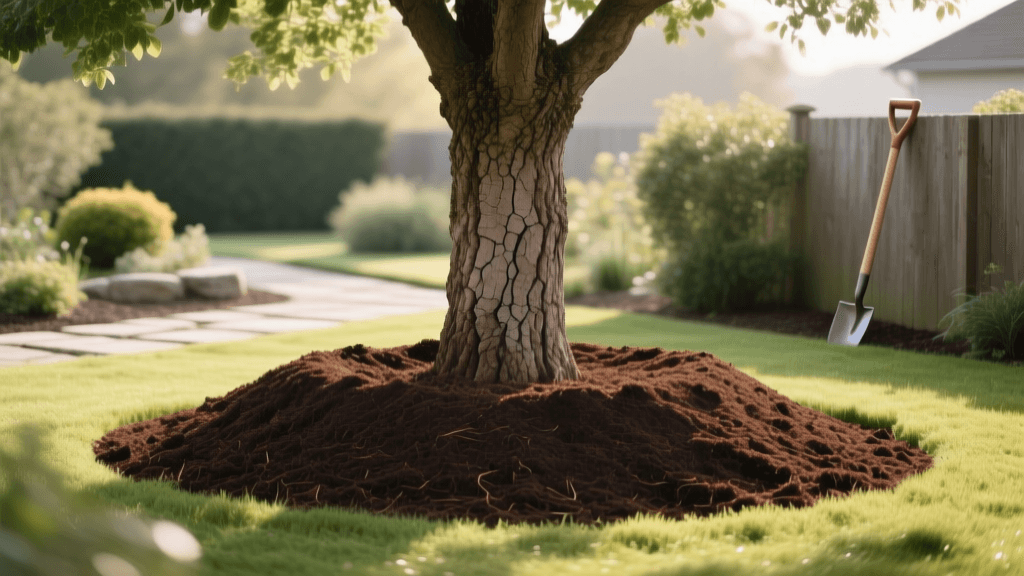
Mulch new trees with 2–4 inches of wood chips in a ring that reaches to the drip line—but keep the mulch 3–4 inches clear of the trunk. Research from the International Society of Arboriculture (2019) found that trees mulched this way establish 30–50% faster than bare-rooted ones in similar conditions.
Pruning for Structure and Longevity
Fast-growing trees need more regular pruning than slower ones, and how you prune affects how long they last. ANSI A300 Part 1 lays out standard practices for pruning landscape trees—what certified arborists follow when working on hedges and screens.
For evergreen screens, aim for a taper: wider at the base than at the top. If the top is wider, it shades out the lower branches, leaving bare spots at eye level. Try to keep the base at least 20% wider than the top. This is especially important for arborvitae and cypress.
Timing depends on the tree. Conifers like arborvitae and cypress do best when pruned in late spring—after new growth has hardened—or in late summer. Skip late fall pruning, which can trigger tender new shoots that won’t survive winter. Deciduous trees used for privacy should be pruned while dormant, in late winter, to reduce disease risk and let wounds heal before spring growth starts.
Avoiding Common Pruning Mistakes
Topping—cutting large limbs back to stubs just to shorten the tree—is one of the worst things you can do. It leaves big wounds that decay slowly, sparks clusters of weak, fast-growing sprouts, and shortens the tree’s life. If a tree has grown too tall for its spot, the better options are switching to a smaller species next time—or using reduction pruning, which means cutting back to a side branch that’s at least one-third the diameter of the limb you’re removing, following ANSI A300 guidelines.
Species Comparison at a Glance
When selecting a privacy tree, prioritize site compatibility over growth rate. A species that grows 2 feet per year in the right conditions will outperform a species that grows 4 feet per year in the wrong ones. Soil drainage, sun exposure, and proximity to infrastructure should drive the final decision. — Adapted from ISA Best Management Practices: Tree Planting (2014)
| Species | Annual Growth | Mature Height | Root Spread | Evergreen | Disease Risk |
|---|---|---|---|---|---|
| Green Giant Arborvitae | 3–5 ft | 40–60 ft | 15–25 ft | Yes | Low |
| Leyland Cypress | 3–4 ft | 60–70 ft | 20–30 ft | Yes | High (canker) |
| Eastern White Pine | 2–3 ft | 80+ ft | 35–50 ft | Yes | Medium |
| Tulip Poplar | 2–3 ft | 70–90 ft | 20–30 ft | No | Low |
| Hybrid Poplar | 5–8 ft | 40–50 ft | 100+ ft | No | Medium |
Long-Term Health and Monitoring
A privacy screen is a long-term project. Trees planted today will need care for decades. Start a simple monitoring routine early—it’s easier to fix small problems than big ones. Walk the planting twice a year: once in spring, when fresh growth shows winter damage, and again in late summer, when fungal issues are easiest to spot.
Watch for early signs of canker on cypress and arborvitae: sticky resin spots on the bark, yellowing on single branches, or dieback starting at the tips and moving inward. Cut out and throw away infected branches—don’t compost them. For white pine, keep an eye out for white pine blister rust and pine wilt nematode, both of which can kill trees quickly once they take hold.
Soil health sets the stage for everything else. A soil test every 3–5 years catches pH imbalances and nutrient shortages before they stunt growth. Most privacy trees prefer a pH between 5.5 and 7.0. Compacted soil can be loosened with vertical mulching or core aeration—techniques a certified arborist can handle without harming surface roots.
- Test soil pH and drainage before selecting species
- Plant at the correct depth with the root flare at grade
- Mulch to the drip line, keeping mulch away from the trunk
- Water deeply and infrequently during the first two growing seasons
- Prune for taper and structure, never for topping
- Inspect twice yearly and address disease or structural issues promptly
With the right tree for your site, careful planting, and steady upkeep, a fast-growing privacy screen can start working in 3–5 years—and stay healthy for generations. Getting the basics right upfront saves time and money every year after.