Lawn Care
Best Grass Seed For Shady Areas
Growing Grass in Low-Light Conditions
Shade is tough on lawns. Less sunlight means less photosynthesis, weaker roots, and damper conditions that can encourage disease. Still, lots of homeowners have lawns under mature trees, fences, or buildings. You don’t need to give up on grass altogether — just pick types that handle shade better. Knowing which grasses work, how to get them started, and how to care for them through the year helps turn a thin, uneven lawn into something thick and healthy.
How well a grass handles shade depends heavily on the species — and even on the specific cultivar. A grass that does fine under the open, dappled light of an oak tree might not survive under the thick, dry shade of a Norway spruce. Before buying seed, figure out what kind of shade you’ve got: light (3–4 hours of direct sun), moderate (1–3 hours), or dense (less than 1 hour). Most turfgrasses need at least 3 hours of direct sun or 4–6 hours of bright indirect light to stick around long term.
Cool-Season Grasses for Shaded Lawns
In the northern U.S. and Canada, cool-season grasses are the go-to for shady lawns. They grow best in spring and fall, when temperatures hover between 60°F and 75°F, and include some of the most shade-tolerant options available.
Fine Fescues: The Shade Specialists
Fine fescues — creeping red fescue (Festuca rubra), chewings fescue (Festuca rubra subsp. commutata), hard fescue (Festuca brevipila), and sheep fescue (Festuca ovina) — are the most shade-tolerant cool-season grasses around. According to the University of Minnesota Extension (2022), they can hold up with as little as 2–3 hours of direct sun per day, making them the top pick for heavily shaded spots.
Creeping red fescue spreads slowly with short rhizomes, so it gradually fills in bare patches. Chewings fescue grows in clumps and handles both shade and drought well. Hard fescue needs little mowing and barely any fertilizer. Seed companies often mix these together in shade-specific blends to balance growth habits and cover more ground.
For new lawns, use 4–6 lbs of pure live seed (PLS) per 1,000 square feet. To overseed an existing lawn, use 2–3 lbs per 1,000 square feet. Under good conditions — soil temps between 50°F and 65°F — seed sprouts in 7–14 days.
Tall Fescue in Partial Shade
Tall fescue (Festuca arundinacea) is coarser than fine fescues and tolerates moderate shade — think 3–4 hours of direct sun. It doesn’t do as well in deep shade, but its deep roots (2–3 feet down) help it handle dry conditions under big trees.
Newer turf-type tall fescue varieties like 'Rebel Supreme', 'Titan RX', and 'Crossfire 2' have finer blades and better shade tolerance than older types. The National Turfgrass Evaluation Program (NTEP) tests these cultivars across university research sites to rate their performance in shade. For seeding, use 6–8 lbs PLS per 1,000 square feet.
Rough Bluegrass for Wet Shade
Rough bluegrass (Poa trivialis) fills a narrow niche: cool, damp, shady areas where other grasses struggle. It handles more shade than Kentucky bluegrass and likes the soggy ground common under dense tree canopies. But it turns brown and goes dormant in summer heat, so it’s rarely used alone in most places. It shows up in shade mixes for northern lawns or as a temporary overseed in transition zones.
Warm-Season Grasses for Southern Shade
In the southern U.S., warm-season grasses rule — but they’re generally less shade-tolerant than cool-season types. Most need 6–8 hours of full sun. Still, a few hold up better than others in lower light.
St. Augustinegrass (Stenotaphrum secundatum) is the most shade-tolerant warm-season option. Cultivars like 'Seville' and 'Palmetto' keep decent density with 4–5 hours of direct sun. Texas A&M AgriLife Extension (2021) lists St. Augustinegrass as the top choice for shaded lawns along the Gulf Coast, saying it beats centipedegrass, zoysiagrass, and bermudagrass in low-light spots.
Zoysiagrass (Zoysia spp.) has moderate shade tolerance, especially Zoysia japonica and Zoysia matrella. The 'Zeon' cultivar held up well in university trials with just 3–4 hours of sun. Bermudagrass (Cynodon dactylon) is one of the least shade-tolerant warm-season grasses and isn’t a good fit for shady yards.
Recommended Shade Seed Mixes and Products
Most people with shady lawns get better results using a blend instead of a single grass. Blends combine strengths and hedge against uneven conditions. Several seed products are made just for shade.
- Jonathan Green Black Beauty Dense Shade — A mix of fine fescues (creeping red, chewings, and hard fescue) plus a small amount of rough bluegrass. Works in spots with 2–4 hours of sun. Seeding rate: 4 lbs per 1,000 sq ft.
- Pennington Smart Seed Dense Shade — A fine fescue blend with a water-saving coating. Marketed for areas with 2+ hours of sunlight. Contains creeping red and chewings fescue.
- Scotts Turf Builder Grass Seed Dense Shade Mix — Includes fine fescues and has Scotts’ WaterSmart PLUS coating. Recommended for 3+ hours of sunlight.
- Barenbrug Shade Mix — A professional-grade blend used by landscapers, with hard fescue, chewings fescue, and creeping red fescue. Sold in larger bags for commercial jobs.
- Lesco Shade Mix — Available through SiteOne Landscape Supply, this mix is popular with lawn care pros in the Northeast and Midwest for its high germination rates and strong cultivars.
Check the seed tag on the package. It lists each grass’s percentage, germination rate, and weed seed content. A solid shade mix should hit at least 85% germination for each grass and contain less than 0.5% weed seed by weight.
Establishment and Seeding Practices
Timing matters when seeding shade grass. In northern regions, late summer to early fall — usually late August through mid-October — gives cool-season grasses the best shot. Soil temps between 50°F and 65°F speed up germination and cut down on summer weeds. Spring seeding works, but the young grass may not be strong enough to handle summer heat.
"Fine fescues seeded in early September in the upper Midwest consistently outperform spring-seeded plots in both establishment speed and first-year density. Fall seeding aligns germination with the grass's natural growth cycle and reduces the window for crabgrass competition." — Turfgrass Science Program, University of Wisconsin–Madison, 2020 Annual Research Report
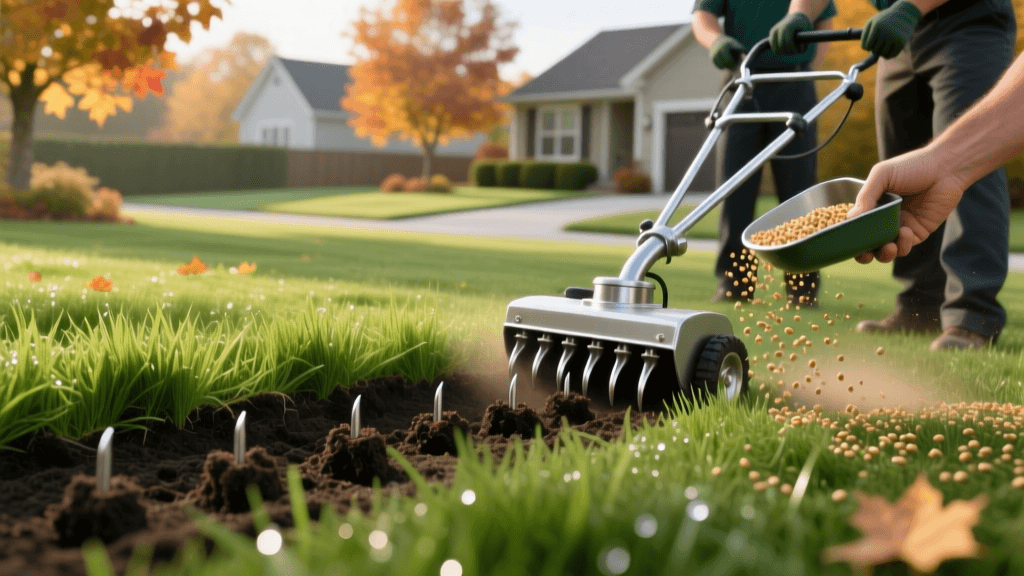
Getting soil ready under trees is tricky. Tree roots grab water and nutrients fast, and soil under heavy canopies tends to be compacted and low in organic matter. Core aerate the area to 3 inches deep, pulling out plugs to let air and water in. Then spread a 1/4-inch layer of compost and rake it into the holes. This improves the soil without raising the grade near the trunk — which can rot the crown.
After seeding, use a starter fertilizer high in phosphorus to help roots develop. A 18-24-12 (nitrogen-phosphorus-potassium) product applied at 3 lbs per 1,000 square feet gives good support for germination. Skip high-nitrogen fertilizers at this stage — they push leafy growth before roots are set.
Overseeding Existing Shaded Lawns
If your shaded lawn is thinning, overseeding with a shade-tolerant mix can fill it in without starting over. Mow the existing grass to 1.5 inches, dethatch if the thatch layer is thicker than 1/2 inch, and core aerate before spreading seed. A slit seeder works best for getting seed into contact with soil in areas with thick existing turf. Water lightly twice a day until seed sprouts, then switch to deeper, less frequent watering.
Ongoing Maintenance for Shade Grass
Shade grass needs different care than grass in full sun. With less sunlight, it makes less energy, so every decision should avoid adding extra stress.
Mowing height is key. Raise the blade 0.5–1 inch higher than usual. Fine fescues in shade do best at 3–4 inches; tall fescue at 3.5–4.5 inches. More leaf surface helps catch what light there is. Never cut off more than one-third of the blade at once.
Fertilize less. Same nitrogen rates used in sunny areas push too much leafy growth for what the plant can support. For fine fescues in shade, use no more than 1–2 lbs of nitrogen per 1,000 square feet per year — split between a fall feeding (September) and a light spring one (April). Skip nitrogen entirely in summer.
| Grass Species | Shade Tolerance | Mowing Height (shade) | Annual N Rate (lbs/1,000 sq ft) | Best Region |
|---|---|---|---|---|
| Creeping Red Fescue | High (2–3 hrs sun) | 3.0–4.0 in | 1–2 | North/Transition |
| Hard Fescue | High (2–3 hrs sun) | 3.0–4.0 in | 1–1.5 | North/Transition |
| Tall Fescue | Moderate (3–4 hrs sun) | 3.5–4.5 in | 2–3 | North/Transition |
| Rough Bluegrass | High (2–3 hrs sun) | 2.5–3.5 in | 1–2 | North only |
| St. Augustinegrass | Moderate (4–5 hrs sun) | 3.5–4.0 in | 3–4 | South/Gulf Coast |
| Zoysia ('Zeon') | Moderate (3–4 hrs sun) | 1.5–2.5 in | 2–3 | South/Transition |
Water shaded areas differently than sunny ones. Shade cuts down on evaporation, so the grass needs less water overall. Too much water in shade keeps things damp, which invites fungi like powdery mildew, brown patch (Rhizoctonia solani), and dollar spot (Clarireedia jacksonii). If your irrigation system lets you, water shaded zones separately — about 30–40% less than sunny areas. Water early in the morning so leaves dry quickly.
Managing Tree Competition
Trees compete with grass for light, water, and nutrients all at once. Maples (Acer spp.), beeches (Fagus spp.), and Norway spruces (Picea abies) have shallow roots and take a lot from the soil. Even shade-tolerant grasses can struggle under them. Raising the canopy by pruning lower limbs brings in more light and improves airflow. Cutting limbs up to 8–10 feet off the ground can boost light levels by 20–30%, according to Penn State Extension Turfgrass Program research.
A slow-release fall fertilizer helps grass compete with tree roots. Milorganite (6-4-0) or polymer-coated urea like Polyon 43-0-0 give steady nutrition without sudden growth spurts that stress shade-adapted grass. Keep fertilizer at least 12 inches away from tree trunks.
Disease Prevention in Shaded Turf
Shaded lawns get less airflow, stay damp longer, and have weaker grass — all of which make fungal diseases more likely than in sunny lawns. Powdery mildew shows up often on Kentucky bluegrass and some fine fescues in deep shade, looking like white dust on the leaves. It’s not usually fatal, but it’s a sign the grass isn’t getting enough light to stay healthy long term.
Preventive fungicides rarely pay off for home lawns in shade. Focus instead on simple fixes: prune trees for better airflow, skip evening watering, keep mowing height right, and don’t overdo nitrogen. If disease keeps coming back, consider switching to a shade-tolerant groundcover like pachysandra, vinca, or native ferns instead of fighting to keep grass alive.
When Grass Is Not the Right Answer
Even the best shade-tolerant grasses have limits. In spots with less than 2 hours of direct sun, no turfgrass will form a thick, lasting lawn. Trying to force grass there usually leads to thin patches, weeds, bare soil, and erosion. Accepting that and picking something else is practical — not a sign you’ve failed.
Groundcovers like pachysandra (Pachysandra terminalis), creeping Jenny (Lysimachia nummularia), and wild ginger (Asarum canadense) thrive in deep shade and need little care once settled in. Mulched beds with shade-tolerant shrubs and perennials are another low-hassle option. Rutgers Cooperative Extension suggests checking how much shade you really have before buying seed — homeowners who do this upfront save time and money by choosing plants that suit the spot.
For borderline areas — say, 2–3 hours of sun — try a mix: plant fine fescue where the light is strongest, and switch to groundcover or mulch in the darkest parts. It looks natural, cuts down on upkeep, and holds up better over time than a stressed-out lawn trying to do too much.