Lawn Care
Best Lawn Aeration Timing For Cool Season Grasses
Understanding Cool-Season Grass Physiology
Cool-season grasses grow best where summer highs usually stay under 85°F and winter lows rarely drop below −20°F. They put on the most growth in spring (April–June) and fall (September–November), when soil temperatures sit between 50°F and 65°F. Unlike warm-season grasses, they go dormant—without dying—during hot, dry summers or cold winters. That dormancy cycle matters for aeration: it works best when roots are actively growing and the grass can recover quickly from the stress.
Common types include Kentucky bluegrass (Poa pratensis), perennial ryegrass (Lolium perenne), tall fescue (Festuca arundinacea), and fine fescues (Festuca rubra, F. ovina). They handle compaction and drought differently. Kentucky bluegrass builds thick sod but struggles with compacted soil because its rhizomes stay near the surface. Tall fescue has deeper, sturdier roots—it tolerates some compaction, but responds well to core aeration once soil bulk density climbs above 1.6 g/cm³.
Primary Aeration Window: Early Fall
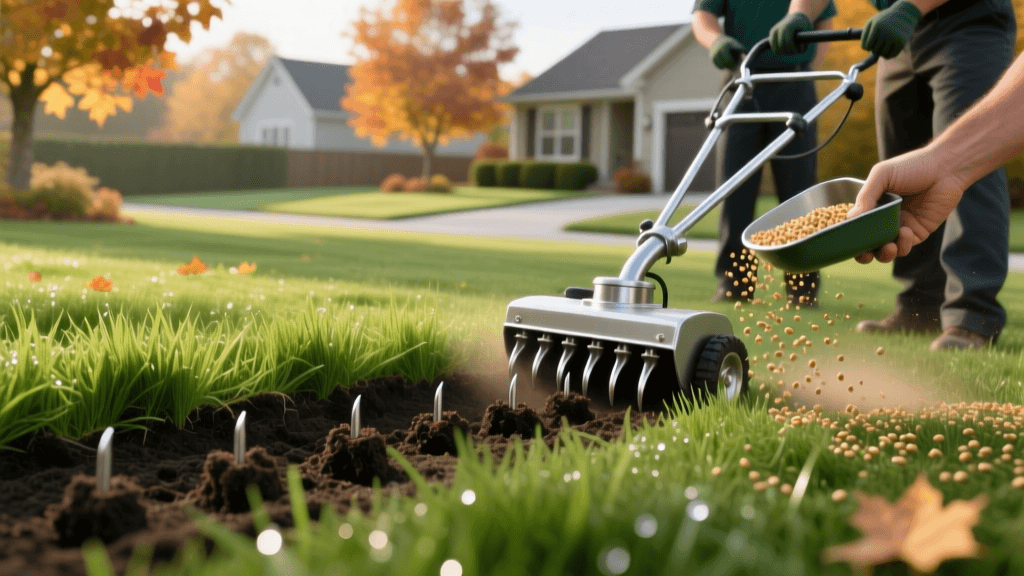
For most cool-season lawns, early fall is the best time to aerate—late August through mid-October, depending on your area. Soil temperatures hover around 55–65°F at 2 inches deep, air temps settle into the 60–75°F range, and rainfall helps seed germinate and roots spread. The grass is also coming out of summer dormancy and gearing up for strong growth.
The University of Minnesota Turfgrass Science Program found that aerating between September 1 and October 15 led to 32% more root mass by November than spring-only aeration (University of Minnesota Extension, 2021). This timing also lines up well with overseeding: after pulling 2–3 inch soil cores spaced 2–4 inches apart, spreading 4–6 lbs of Kentucky bluegrass seed per 1,000 sq ft gives new seedlings time to settle in before the first frost.
Soil Temperature Thresholds Matter
Soil temperature—not air temperature—drives root activity. Use a soil thermometer inserted 2 inches deep at 9 a.m. for three days running. Aeration doesn’t work well if soil is below 50°F (roots barely divide) or above 70°F (more chance of disease, especially Rhizoctonia solani). In Madison, Wisconsin, long-term data shows 2-inch soil temps hit 55°F around September 3 and stay above that until November 12.
Secondary Timing: Late Spring
Late spring—mid-May to early June—is another option, once soil temps hold steady between 55°F and 65°F and before summer heat sets in. It’s especially helpful for lawns with heavy clay or lots of spring foot traffic, like school grounds in Ann Arbor, Michigan. But spring aeration carries more risk: do it too early, when the soil is still soggy, and equipment smears instead of pulling clean cores; wait too long, past 68°F, and you may stir up fungal issues like Microdochium nivale (pink snow mold).
Penn State Extension advises using spring aeration only where compaction is confirmed—like penetrometer readings over 300 psi at 4 inches deep—and skipping it entirely on lawns seeded less than 12 weeks earlier. After spring aeration, use starter fertilizer with 0.5–1.0 lb of actual nitrogen per 1,000 sq ft. Skip urea-based products—they break down fast when temps rise above 60°F.
Equipment Selection and Core Specifications
Use core aerators, not spike aerators. Spikes just punch holes and squeeze the soil beside them. Core machines pull out plugs sized like this:
- 0.5–0.75 inches in diameter
- 2–3 inches deep
- spaced 2–4 inches apart on-center
- 20–30 cores per square foot
- removing enough thatch to cut the layer’s surface area by at least 10%
For home use, the Agri-Fab 45-0298 (80 lb, 12-inch width) gives consistent 2.5-inch-deep cores spaced 3 inches apart when pulled at 2–3 mph over moist—but not wet—soil. Commercial crews often run the John Deere 8000 Series, which covers 1.2 acres per hour and lets you adjust tine depth from 1.5 to 4 inches.
Post-Aeration Management Protocols
What you do right after aeration makes a real difference. Within 24 hours, apply a slow-release nitrogen source like Milorganite (6-2-0) at 3.5 lbs per 1,000 sq ft—or enough to deliver 1.2 lbs of actual nitrogen. Skip quick-release synthetics like ammonium nitrate, which can burn stressed grass crowns. Water deeply but not too often: 0.75 inches per session, split into two rounds 2 hours apart on slopes to keep water from running off.
Raise your mowing height by 0.5 inch for the next 14 days. For tall fescue, go from 3.0 to 3.5 inches; for Kentucky bluegrass, from 2.5 to 3.0 inches. That helps shield new tillers and cuts down on moisture loss from bare soil. Leave clippings for the first three mowings—mulching helps fill in the core holes naturally.
Fertilizer Timing Relative to Aeration
Fertilizer timing affects how well nutrients get used—and avoids washing away or throwing off soil microbes. The table below reflects intervals tested by Cornell University’s Turfgrass Program:
| Fertilizer Type | Apply Before Aeration? | Apply After Aeration? | Minimum Interval |
|---|---|---|---|
| Starter (high-P) | No | Yes—within 24 hrs | 0 hours |
| Slow-release N (e.g., sulfur-coated urea) | Yes—7 days prior | Yes—14 days after | 7 days before / 14 days after |
| Potassium (K₂O) | No | Yes—7 days after | 7 days |
Regional Variations and Microclimate Adjustments
General guidelines help, but local conditions change things. In the Puget Sound region—including Seattle and Tacoma—cool, damp weather slows soil warming, so peak aeration falls between September 15 and October 10. In the Upper Midwest (e.g., Fargo, North Dakota), early frosts shorten the window: aim for August 25 to September 20 to give grass 21 days of growth before freeze-up. Soil moisture matters too: aerate only when soil crumbles in your hand—not sticks together. Soggy soil leads to smeared cores and more compaction.
Ohio State University Extension (2022) notes that lawns getting over 40 inches of rain each year usually need annual aeration, while those in drier spots like northern Colorado’s Front Range (~15 inches/year) may only need it every 2–3 years—unless they get heavy use. If thatch measures more than 0.5 inches thick (check with a utility knife and ruler), aerate no matter what the calendar says.
“Core aeration is not a ‘one-size-fits-all’ treatment. Its success hinges on synchronizing mechanical intervention with the grass plant’s natural phenology—and ignoring soil temperature thresholds guarantees diminished returns.” — Dr. Eric Watkins, Professor of Turfgrass Science, University of Minnesota
How often you aerate depends on how compacted your soil is. Use a soil penetrometer: readings over 250 psi at 3 inches deep mean moderate compaction—plan for yearly aeration. Over 400 psi at that depth signals severe compaction, so do fall aeration plus a light topdressing (¼ inch compost) right after. Never aerate frozen ground—tines shatter instead of pulling cores, leaving jagged cracks that dry out roots.
Overseeding right after aeration helps fill in thin spots, but seeds need good contact with soil. Use a slit-seeder like the Brinly-Hardy SLT-500 set to 0.25-inch depth, making two passes at right angles. Then roll lightly with a 150-lb water-filled roller to settle seed without burying it.
Watering changes after aeration: water daily for 14 days, 0.25 inches each time—only in the morning—to keep the surface moist for germination. Once seedlings pop up, switch to 0.5 inches every 3 days. When they reach 2 inches tall, move to deeper, less frequent watering: 1.0 inch every 5–7 days.
Aeration doesn’t excuse poor mowing habits. Keep blades sharp—dull ones tear grass, opening the door to disease. Mow at the right height: 2.5–3.5 inches for Kentucky bluegrass, 3.0–4.0 inches for tall fescue, and 1.5–2.5 inches for fine fescues. Never cut off more than one-third of the leaf blade at once.
Track results to see what’s working. Take photos of the same 10×10 ft patch before and after aeration. Measure how fast water soaks in using a simple ring infiltrometer: time how long it takes 100 mL of water to soak into a 6-inch metal ring driven 1 inch into the soil. If it takes over 120 seconds before aeration, water isn’t moving well. Aim for 45 seconds or less within 30 days after.
When paired with careful fertilization, smart watering, and proper mowing for your grass type, aeration fits into a bigger picture of lawn care—not something you tack on at the last minute. It works best when timed with how the grass grows and what your soil actually needs.