
Lawn Care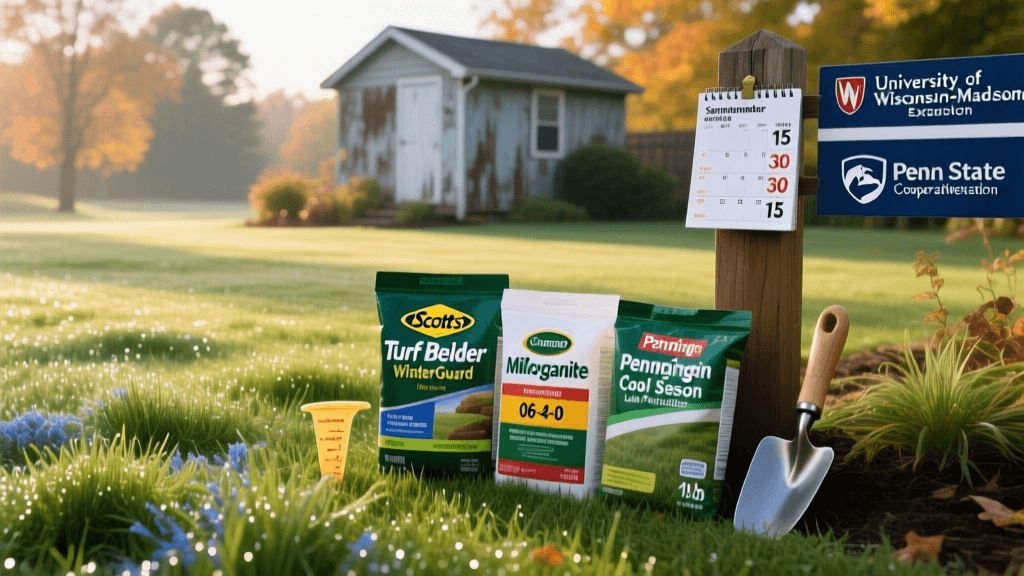
Best Lawn Fertilizer Schedule For Cool Season Grasses
Understanding Cool-Season Grass Biology
Cool-season grasses grow best where summer highs usually stay under 85°F and winter lows don’t often fall below –20°F. They put on the most growth in early spring (April–May) and early fall (September–October). That’s when roots and shoots are most active, and the grass takes up nutrients most efficiently. In midsummer heat or deep winter cold, they slow way down—so it’s best not to fertilize then, since the nutrients won’t be used and could run off or encourage disease.
Common types include Kentucky bluegrass (Poa pratensis), perennial ryegrass (Lolium perenne), tall fescue (Festuca arundinacea), and fine fescues (Festuca rubra, F. ovina). Their nutrient needs differ: Kentucky bluegrass responds well to more nitrogen for thickness and recovery, while tall fescue does fine with less frequent applications that go deeper—thanks to its drought-tolerant roots.
According to the University of Minnesota Turfgrass Science Program, “applying nitrogen outside the active growth windows increases thatch accumulation and reduces carbohydrate storage in roots” (University of Minnesota Extension, 2021). In other words, timing matters more than the calendar date.
Spring Fertilization: Timing and Tactics
Wait to apply the first fertilizer until the grass is steadily greening up and the soil temperature at 2 inches deep hits 50°F for three days in a row. In the Midwest, that’s usually between April 15 and May 10; in New England, it’s often May 10–25. And don’t fertilize before the third mowing—by then, the roots are better established, and you’re less likely to push out tender new growth just before a late frost.
Selecting the Right Spring Formula
Choose a slow-release fertilizer low in phosphorus unless your soil test shows a deficiency. Too much phosphorus can wash into nearby water and feed algae blooms—something seen in studies of Wisconsin’s Yahara River watershed.
- Recommended product: Scotts Turf Builder WinterGuard Fall Weed & Feed (0-0-7 formulation with 30% slow-release N)
- Application rate: 3.5 lbs per 1,000 sq ft for established lawns
- Nitrogen source: 60% polymer-coated urea + 40% methylene urea for 8–10 week release
Steer clear of quick-release urea in spring—it pushes leafy growth too fast, weakens root development, and means more mowing. Purdue University Turf Tips (2020) found it increases mowing frequency by up to 40% compared to controlled-release options.
Fall Fertilization: The Most Important Application
Apply fertilizer in early fall—mid-September to early October—for the biggest payoff. At this point, the grass shifts energy underground, building roots and storing carbs to get through winter and jumpstart growth next spring. Rutgers University’s Turfgrass Program found lawns that got a well-timed fall feeding needed 22% less water the following summer and held up 37% better against snow mold (Microdochium nivale).
Nutrient Ratios and Rates
Aim for 1.0–1.25 lbs of actual nitrogen per 1,000 sq ft. A blend higher in potassium (K) helps with cold tolerance and disease resistance—potassium strengthens cell walls and helps stomata function when temperatures drop.
- Soil test pH should be between 6.0–7.0; if it’s above 7.2, add elemental sulfur (Penn State Extension, 2022)
- Apply when air temps are 60–75°F and no rain is expected for 48 hours
- If it doesn’t rain, water lightly (0.1 inch) within 24 hours
In central Pennsylvania, Rutgers recommends a 22-0-14 granular blend at 4.5 lbs/1,000 sq ft for tall fescue lawns—giving exactly 1.0 lb N and 0.63 lb K₂O.
Summer and Winter Considerations
Don’t fertilize in midsummer (July–early August), even for tall fescue. University of Wisconsin-Madison trials showed that adding nitrogen when soil temps top 75°F raised dollar spot cases by 58% and cut root mass by 31%. If the lawn dries out, water deeply and infrequently—1 inch per week, all at once—instead of feeding.
Winter feeding only makes sense in a few cases: overseeded perennial ryegrass in transitional zones (like northern Virginia), or newly seeded Kentucky bluegrass planted after September 1. Use a starter fertilizer with 0.5 lb N/1,000 sq ft and no phosphorus—unless your soil test shows less than 15 ppm.
“Late-fall nitrogen (applied in November) is not recommended for mature cool-season lawns. It does not increase spring green-up and significantly elevates nitrate leaching risk in sandy soils.” — Cornell Cooperative Extension, 2023
Calibrating Your Spreader and Tracking Results
Even perfect timing won’t help if you’re applying the wrong amount. Calibrate your broadcast or drop spreader every year using the catch-can method: mark off a 10 ft × 10 ft area (100 sq ft), fill the spreader, and collect fertilizer in straight-sided cans spaced 2 ft apart across the spread pattern. Adjust the setting until the average catch equals your target rate divided by 10.
Keep track of what’s working: measure clipping volume weekly (aim for 1–2 cups per 1,000 sq ft per mow), note how often you mow (healthy tall fescue usually needs cutting every 6–7 days in peak season), and take monthly photos of the same 1-ft² patch to watch for changes in density and color.
Ohio State University’s turf lab found uncalibrated rotary spreaders often deliver 35% more or less than the labeled rate—leading to uneven growth or burn.
| Grass Species | Annual N Requirement (lbs/1,000 sq ft) | Max Single Application (lbs N) | Soil pH Preference | Optimal Mowing Height (in) |
|---|---|---|---|---|
| Kentucky bluegrass | 2.5–3.5 | 1.25 | 6.0–7.0 | 2.0–3.0 |
| Tall fescue | 2.0–3.0 | 1.0 | 5.8–7.0 | 3.0–4.0 |
| Perennial ryegrass | 3.0–4.0 | 1.25 | 5.5–7.0 | 1.5–2.5 |
Tracking things over time shows patterns you’d miss otherwise. For instance, if clipping volume jumps 20% after a July application, it’s a sign the grass is putting too much energy into leaves—and probably skimping on roots. Next time, hold off or scale back.
Local conditions matter more than regional averages. A Kentucky bluegrass lawn in Portland, Maine deals with different moisture and temperature swings than one in Spokane, Washington—even though both are cool-season grasses. Check with your county’s cooperative extension office for advice tailored to your area; Michigan State University Extension’s “Lawn Calendar” tool pulls real-time soil temperature data from 127 weather stations across the state.
Watering and fertilizing go hand in hand. After feeding, apply no more than 0.5 inch of water to move nutrients into the root zone without washing them away. Then go back to normal: 1 inch total per week, split into two deep soaks spaced 3–4 days apart. Light, daily watering encourages shallow roots and fungal problems—especially for fine fescues in shady, damp yards in the Pacific Northwest.
Mowing height also affects how well fertilizer works. Raising the blade by 0.5 inch during summer stress—say, from 2.5 to 3.0 inches for Kentucky bluegrass—adds about 18% more leaf surface, helping the plant make better use of nitrogen and handle dry spells.
Soil testing isn’t optional. Test every 2–3 years through a certified lab like the University of Massachusetts Soil and Plant Tissue Testing Lab. Their standard test uses Mehlich-3 extraction for phosphorus and potassium, and includes organic matter percentage—key for deciding whether you need extra potassium or iron along with nitrogen.
Write down every application: date, product name, lot number, rate, weather, and a quick note on how the lawn looked. After five years, that log tells you more than any general guide—how your lawn reacts to specific products under real local weather and soil conditions.