Lawn Care
Best Lawn Grass Seed For Sandy Soil Conditions
Understanding Sandy Soil’s Unique Challenges for Lawn Establishment
Sandy soils make lawn establishment trickier than most people expect. The particles are large and gritty—usually between 0.05 and 2.0 mm—and that means water and nutrients wash through fast. According to the University of Florida IFAS Extension, sandy soils hold just 0.25–0.75 inches of usable water per foot of depth, while loam holds 1.5–2.5 inches (UF/IFAS, 2021). That’s why you’ll likely need to water more often, especially when seed is sprouting and roots are just getting started. Nitrogen and potassium also leach out easily, so it’s better to feed in small amounts several times a year instead of all at once. Without the right grass and care, lawns on sand often thin out by midsummer, open up bare spots, and let weeds move in.
Top Cool-Season Grasses for Sandy Soils
In colder parts of the country—where winter regularly brings freezing temps—cool-season grasses are your best bet on sand. But not all types handle low fertility or dry spells well. Kentucky bluegrass (Poa pratensis) is common, but standard varieties need steady moisture to stay healthy. Rutgers University’s Turfgrass Program found that ‘Midnight II’ and ‘Barnyard’ hold up better: they send roots deeper (up to 6 inches in well-aerated sand) and tolerate dry stretches more easily. You’ll want 2–3 lb of seed per 1,000 sq ft when planting, and the best window is late August through mid-September—giving new grass 6–8 weeks of cool, damp weather before frost hits.
Perennial Ryegrass: Fast Germination, Strategic Use
Perennial ryegrass (Lolium perenne) doesn’t last long on its own in sandy soil, but it works well as a temporary cover in seed mixes. It sprouts in 5–7 days and helps hold the surface together, especially on slopes where rain can wash away topsoil. Its roots rarely go deeper than 4 inches, though, so it tends to brown out in summer unless you water every day. For best results, keep it under 15% of the mix—like in Scotts Turf Builder Grass Seed Sun & Shade Mix, which uses 12% perennial ryegrass, 65% tall fescue, and 23% fine fescue.
Leading Warm-Season Options for Coastal and Southern Sands
Along the Atlantic and Gulf coasts—and across much of the Southeast—warm-season grasses are the go-to choice for sandy ground. They handle heat better and grow deeper roots. Seashore paspalum (Paspalum vaginatum) stands out for tolerating salt and thriving in lean, sandy soil. At the University of Georgia’s Coastal Plain Experiment Station in Tifton, GA, the ‘SeaDwarf’ variety kept over 90% green coverage with just 0.5 inch of water per week—less than half what most bermudagrasses need.
Bermudagrass Cultivars with Proven Sand Performance
Hybrid bermudagrasses like ‘Tifway 419’ and ‘TifTuf’ adapt well to sand if managed right. In field trials by Texas A&M AgriLife Extension in Corpus Christi, ‘TifTuf’ reached 85% turf density by 12 weeks after seeding at 1 lb per 1,000 sq ft—18% denser than ‘Tifway’ under the same low-nitrogen conditions (1 lb N/1,000 sq ft/year). Both need full sun and do best when planted between May 15 and July 15, once soil temps stay above 65°F at 4-inch depth.
Fertilization Protocols Tailored to Sandy Substrates
Sand holds onto nutrients poorly—it has a low cation exchange capacity (CEC), usually just 1–5 meq/100g, compared to 10–20 meq/100g in clay-loams. That means feeding little and often works better than big, infrequent doses. Purdue University Cooperative Extension suggests splitting nitrogen into four rounds each year: 0.75 lb N/1,000 sq ft in early spring (April), 0.5 lb in late spring (June), 0.5 lb in early fall (September), and 0.25 lb in late fall (November). Slow-release options—like sulfur-coated or polymer-coated urea—help nitrogen last 8–12 weeks instead of washing away quickly.
- Only add phosphorus if a soil test shows it’s actually low—many sandy soils in the Southeast already have enough from past fertilizer use
- Apply potassium at 1.0 lb K₂O/1,000 sq ft per year, split between spring and early fall
- Use foliar sprays with iron and zinc every 4–6 weeks during active growth to keep leaves from yellowing
Irrigation Scheduling and Water Management
Too much water hurts sandy lawns just as much as too little—it pushes roots toward the surface and encourages fungal problems. Cornell Cooperative Extension recommends the “cycle-and-soak” method: apply 0.15–0.20 inches, wait 30–45 minutes for it to soak in, then repeat until you’ve delivered about 0.5 inches total. This avoids runoff and gets water down to the 4–6 inch root zone. Soil moisture sensors at 3-inch and 6-inch depths help track what’s really happening underground; University of California, Riverside research found that using them cut water use by 27% without hurting turf quality.
Water early in the morning (5:00–9:00 a.m.) to cut evaporation and keep leaf surfaces dry longer. Avoid evening watering—LSU AgCenter field trials (2020) showed it raises gray leaf spot risk in St. Augustinegrass by up to 40%.
Mowing and Cultural Practices That Support Root Development
Mowing height matters more on sand than people realize—it directly affects how deep roots grow and how well grass handles dry spells. Raising the blade just 0.5 inch above normal makes a real difference. Tall fescue, for example, does better at 3.5–4.0 inches (instead of 2.5–3.0), letting roots reach 8–10 inches down. Bermudagrass on sand also benefits from a slightly taller cut—1.5 inches in peak summer, up from the usual 1.25 inches—to shade the soil and slow moisture loss.
“Sandy soils demand a shift from quantity to consistency: less fertilizer per application, more frequent mowing, shorter irrigation cycles, and cultivar-specific timing.” — Dr. Becky Hines, Turfgrass Specialist, University of Florida IFAS Extension (2021)
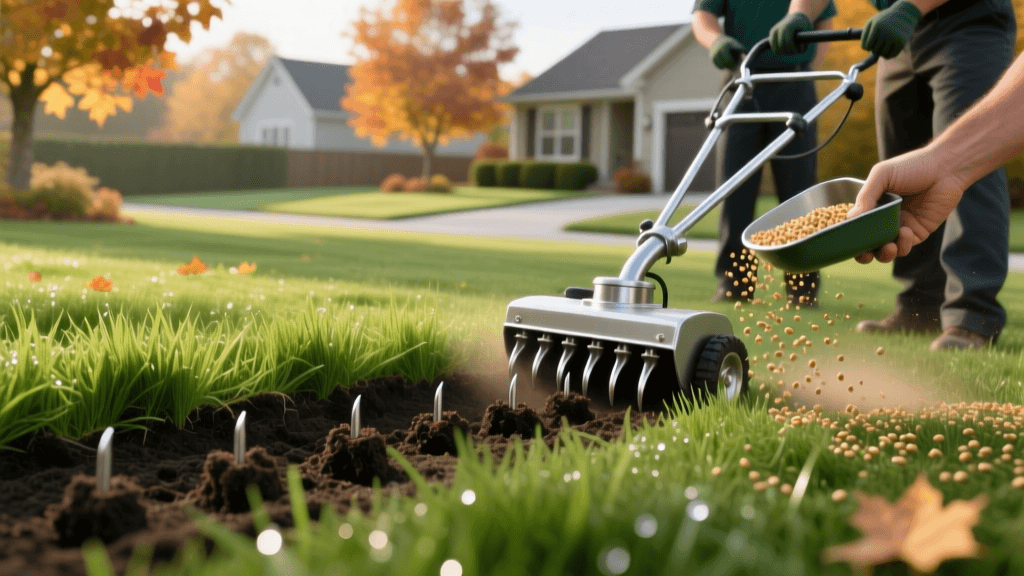
Aeration isn’t optional. Do core aeration every 12–18 months—early fall for cool-season grasses, late spring for warm-season ones—to punch holes through compacted layers below the surface. Space the cores 2–3 inches apart and aim for at least 3 inches deep. Afterward, spread a ¼-inch layer of compost-amended sand (say, 80% sand + 20% screened compost) to build organic matter without blocking drainage.
Pre-emergent herbicides need careful timing on sand. They don’t stick well to low-CEC soils, so you have to get the timing and placement right: apply pendimethalin at 2.0–2.5 lb ai/acre no later than March 15 in Zone 7, then water lightly (0.1 inch) right after to push the chemical into the top 0.5 inch—where weed seeds are waiting to sprout.
| Grass Species | Optimal Seeding Rate (lb/1,000 sq ft) | Soil Temp Min for Germination (°F) | Root Depth Potential (inches) | Recommended Mowing Height (inches) |
|---|---|---|---|---|
| Tall Fescue ‘Titan Rx’ | 7–9 | 60 | 12–18 | 3.5–4.0 |
| Seashore Paspalum ‘SeaDwarf’ | 1–2 | 70 | 10–14 | 0.75–1.25 |
| Kentucky Bluegrass ‘Midnight II’ | 2–3 | 55 | 6–8 | 2.5–3.0 |
After seed sprouts, give the grass time to settle in. Keep off it until it reaches 3 inches tall and has been mowed twice. When you do mow, take off no more than one-third of the blade. Hold off on nitrogen until after that second mowing—applying it earlier can burn young plants or invite Poa annua.
Test your soil every two years. Send samples to your state’s certified lab—like the University of Massachusetts Soil and Plant Nutrient Testing Lab—or a service like Logan Labs that checks for micronutrients. Sandy soils often run low on magnesium, boron, and manganese; fixing those based on actual test results prevents yellowing, stunted growth, or more disease problems down the line.
What works in one sandy area might not work in another. The quartz-rich sands of Cape Cod behave differently than the limestone-based sands of central Florida. Check local extension resources: North Carolina State University’s TurfFiles, Ohio State University’s Lawn Care Calendar, and Oklahoma State University’s fact sheet PSS-2304 all offer county-level advice backed by multi-year field trials.
Keeping an eye on things—not just stepping in seasonally—is what keeps sandy lawns healthy. Track soil moisture weekly, note mowing dates and heights, log fertilizer applications, and snap photos of trouble spots each month. Over time, those records show patterns you’d miss otherwise and help you adjust faster when something shifts.