Lawn Care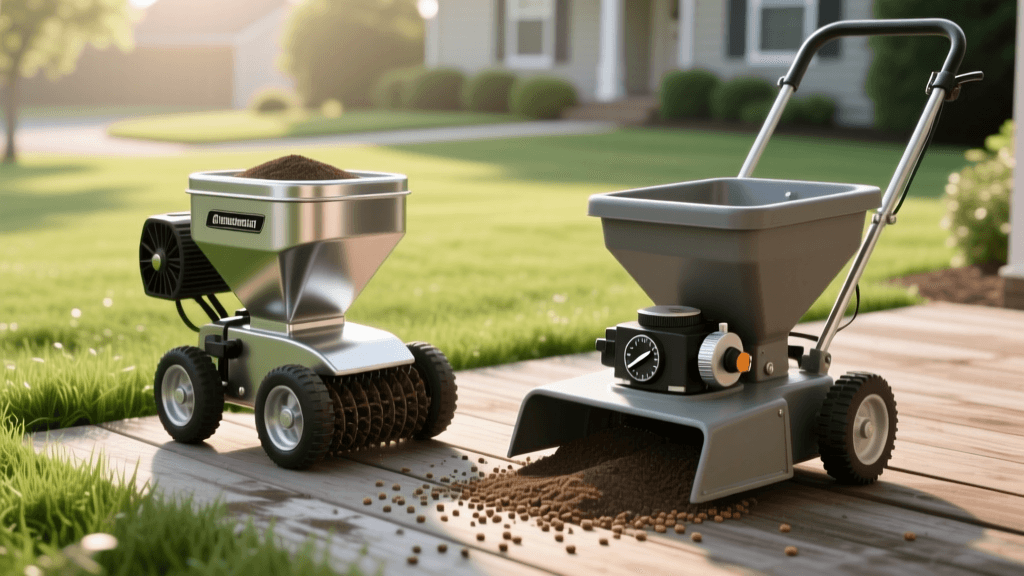
Best Lawn Spreader Reviews: Broadcast Versus Drop
The Importance of Choosing the Right Lawn Spreader
Applying fertilizer, grass seed, or weed control to your lawn is a significant investment in both time and money. However, the effectiveness of these treatments relies almost entirely on uniform application. Using the wrong equipment can lead to overlapping stripes of burnt grass, missed patches vulnerable to weeds, and costly fertilizer runoff into local waterways. For homeowners and landscaping professionals alike, selecting the right tool is the first step toward a lush, healthy turf. In this comprehensive guide, we break down the mechanics of broadcast versus drop spreaders, review the top-performing models on the market, and provide expert calibration techniques to ensure your lawn receives exactly what it needs.
Broadcast vs. Drop Spreaders: Understanding the Mechanics
Before diving into specific product reviews, it is crucial to understand the fundamental differences between the two primary types of lawn spreaders. Your choice will largely depend on your lawn size, shape, and the specific materials you intend to apply.
How Broadcast Spreaders Work
Broadcast spreaders, also known as rotary spreaders, utilize a spinning horizontal disk at the base of the hopper to fling granular products outward in a wide, circular pattern. This design allows for rapid coverage of large, open areas. Because the spread pattern is wide and somewhat forgiving, broadcast spreaders are generally faster to use and less prone to leaving visible striping lines if your walking speed varies slightly.
How Drop Spreaders Work
Drop spreaders release the product directly straight down through a series of holes spanning the width of the axle. The application width is strictly limited to the physical width of the hopper (usually between 18 and 36 inches). Drop spreaders offer pinpoint accuracy, making them the superior choice for small lawns, narrow strips of grass, or areas bordering sensitive flower beds, ponds, and driveways where overspray could cause damage or staining.
Top Broadcast Spreader Reviews
1. Scotts Turf Builder EdgeGuard Mini Broadcast Spreader
The Scotts EdgeGuard Mini is arguably the most popular residential broadcast spreader on the market, and for good reason. It is lightweight, easy to assemble, and features a proprietary EdgeGuard technology that blocks off the right side of the spread pattern to prevent product from landing on landscaping or hardscapes.
- Hopper Capacity: Holds up to 5,000 sq. ft. of Scotts product.
- Spread Width: Up to 5 feet.
- Best For: Small to medium-sized urban and suburban lawns.
- Price Range: $40 - $55.
Pros: Exceptional value, lightweight plastic construction prevents rust, EdgeGuard is highly effective near driveways.
Cons: Plastic gears may wear out over years of heavy use; not ideal for large properties over 10,000 sq. ft.
2. Lesco 50 lb. Professional Broadcast Spreader
For those who demand commercial-grade durability, the Lesco Professional Broadcast Spreader is the gold standard. Often seen on the back of landscaping trucks, this spreader is built with a heavy-duty steel frame, stainless steel components, and pneumatic tires that glide smoothly over rough terrain.
- Hopper Capacity: 50 lbs (covers roughly 10,000 to 15,000 sq. ft. depending on the product).
- Spread Width: Up to 12 feet.
- Best For: Large estates, commercial properties, and serious lawn care enthusiasts.
- Price Range: $150 - $190.
Pros: Incredible durability, wide spread pattern saves time, high ground clearance, enclosed gearbox prevents corrosion.
Cons: Heavy and requires significant storage space; higher upfront cost.
Top Drop Spreader Reviews
1. Scotts Classic Drop Spreader
The Scotts Classic Drop Spreader remains a staple for homeowners who need precision around delicate garden beds and water features. Its fully assembled, ready-to-use design features a 22-inch drop width, providing a balance between precision and reasonable coverage speed.
- Hopper Capacity: Holds enough product to cover up to 10,000 sq. ft.
- Spread Width: 22 inches.
- Best For: Complex lawns with many obstacles, tight property lines, and perimeter applications.
- Price Range: $90 - $110.
Pros: Zero overspray, rugged metal frame, highly accurate application rates.
Cons: Requires strict overlapping discipline (usually 2 inches) to avoid visible striping; slower than broadcast models.
2. Chapin International 8620B Push Drop Spreader
Chapin is well-known for its sprayers, but their 8620B drop spreader is a formidable competitor in the granular application space. It features a unique adjustable deflector gate and a robust steel construction that rivals much more expensive commercial models.
- Hopper Capacity: 50 lbs.
- Spread Width: 24 inches.
- Best For: Medium to large lawns requiring strict boundary control.
- Price Range: $110 - $130.
Pros: Wide drop width for a drop spreader, heavy-duty steel build, smooth-rolling pneumatic tires.
Cons: Heavy to push when fully loaded; requires thorough cleaning to prevent rust in the hopper.
Head-to-Head Comparison Chart
To help you visualize the differences between our top-reviewed models, refer to the comparison chart below:
| Spreader Model | Type | Capacity | Spread Width | Ideal Lawn Size | Approx. Cost |
|---|---|---|---|---|---|
| Scotts EdgeGuard Mini | Broadcast | 5,000 sq ft | 5 feet | Small / Medium | $45 |
| Lesco 50 lb Pro | Broadcast | 50 lbs | 12 feet | Large / Commercial | $170 |
| Scotts Classic Drop | Drop | 10,000 sq ft | 22 inches | Complex / Borders | $100 |
| Chapin 8620B | Drop | 50 lbs | 24 inches | Medium / Large | $120 |
Expert Calibration and Application Guidelines
Even the most expensive, top-rated spreader will fail to deliver a healthy lawn if it is not properly calibrated. Applying too much nitrogen can cause severe fertilizer burn, while applying too little will result in weak, weed-prone turf. Furthermore, excess fertilizer runoff is a leading cause of algae blooms in local waterways.
According to the University of Minnesota Extension, 'Proper calibration of your spreader is the single most critical factor in preventing nutrient runoff and turf burn. Homeowners should never rely solely on the settings printed on the side of the fertilizer bag, as these are based on generalized walking speeds and may not account for your specific equipment or stride.'
The 100-Square-Foot Calibration Method
To ensure accurate application, follow these steps recommended by turfgrass scientists:
- Measure a Test Area: Mark off a 10x10 foot area (100 square feet) on your driveway or a tarp. Never test on your actual lawn.
- Weigh the Product: Calculate the amount of product needed for 100 sq. ft. based on the bag's recommended rate. For example, if the bag covers 5,000 sq. ft. and weighs 20 lbs, you need 0.4 lbs for your test area.
- Perform a Test Run: Fill the spreader, set the dial to the manufacturer's suggested setting, and walk at your normal, comfortable pace over the test area.
- Weigh the Output: Collect and weigh the product that was dispensed. If you dispersed more than 0.4 lbs, lower the dial setting. If you dispersed less, increase it. Repeat until the output matches the target weight.
Spreader Maintenance for Longevity
Granular fertilizers and herbicides are highly corrosive. Failing to clean your spreader after every use is the fastest way to ruin its moving parts. To protect your investment, always follow these maintenance steps:
- Empty the Hopper: Never leave unused product in the hopper, as moisture will cause it to cake and seize the agitator.
- Wash Thoroughly: Use a garden hose to wash out the hopper, the agitator, and the underside of the spreader. Ensure all chemical residue is removed.
- Dry Completely: Allow the spreader to dry in the sun to prevent rust on metal components.
- Lubricate Moving Parts: Apply a silicone-based lubricant (avoid petroleum-based greases which attract dirt) to the axle, wheels, and spinner mechanism at the start and end of every lawn care season.
Final Verdict: Which Spreader Should You Buy?
The decision between a broadcast and a drop spreader ultimately comes down to your property layout. If you have a large, open, rectangular lawn with few obstacles, a broadcast spreader like the Lesco Professional or the Scotts EdgeGuard Mini is the undisputed winner for speed and ease of use. The wide swath and forgiving overlap make it the most efficient choice for the average homeowner and professional alike.
However, if your property features narrow strips of grass, intricate garden beds, or borders a sensitive ecological zone like a pond or storm drain, a drop spreader like the Scotts Classic or Chapin 8620B is an absolute necessity. The precision it offers will save you from staining your driveway and protect the local environment from chemical runoff. Whichever model you choose, remember that consistent walking speed and rigorous calibration are the true secrets to a flawless, golf-course-quality lawn.