Tree Care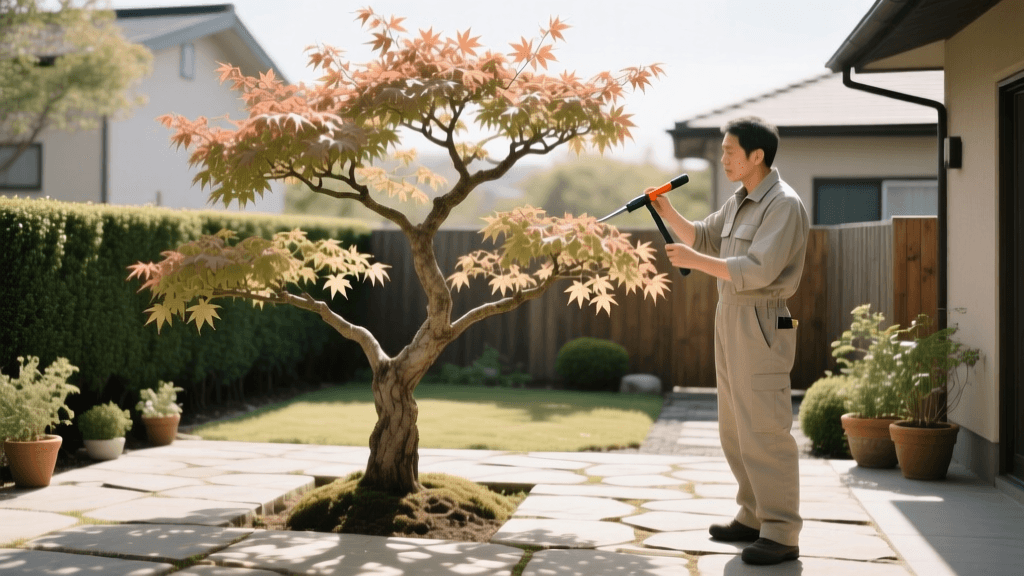
Best Shade Trees For Small Backyards
A small backyard doesn’t mean you have to skip the shade, wildlife habitat, or visual structure that trees bring. It just means picking carefully. A tree that’s too big for the space can lift a patio slab, press against a fence, or outgrow its spot in ten years. The right one gives steady shade, seasonal changes, and lower cooling bills — all without crowding the yard. Here’s a look at shade trees that fit compact residential lots, with real numbers to help you choose.
How Much Space Do You Actually Have?
The most common mistake? Picking a tree based on how it looks in the nursery pot instead of how big it gets. A tree that’s 6 feet tall in a 15-gallon container might hit 40 feet tall and 30 feet wide in 20 years. In a 30-by-40-foot yard, that doesn’t leave much room.
Before you head to the nursery, measure your planting area. Watch for overhead power lines (most require at least 15 feet of clearance), the edge of your house or deck, and any underground pipes or cables. In the U.S., call 811 before digging deeper than 12 inches — it’s free, fast, and required by law.
Roots matter just as much. Most trees send roots outward 1.5 to 3 times the width of their canopy. So a tree with a 20-foot-wide canopy may have roots stretching 30 to 60 feet from the trunk. That affects patios, foundations, and sewer lines. Choosing trees with gentler root habits helps avoid trouble down the line.
Shade Trees That Fit Small Yards
We picked these species based on how tall and wide they get, how fast they grow, how their roots behave, and how well they handle different climates. Each gives solid shade without taking over like silver maple or weeping willow.
Japanese Zelkova (Zelkova serrata)
Urban foresters at the University of Florida IFAS Extension and the Morton Arboretum often recommend Japanese Zelkova. It grows about 1.5 to 2.5 feet per year and reaches 50 to 80 feet tall — but its vase-shaped canopy stays narrower, at 40 to 50 feet wide. Its roots are less likely to cause problems near hardscape, so it can go 10 to 15 feet from a patio or walkway.
Zelkova also resists Dutch elm disease, which is why many people plant it where American elms used to grow. It handles city air well, grows in USDA zones 5 through 8, and turns yellow to russet-red in fall. For small yards in the Mid-Atlantic or Midwest, it’s a strong all-around pick.
Serviceberry (Amelanchier × grandiflora)
If your backyard is under 1,000 square feet, Apple Serviceberry is hard to top. It grows 1 to 2 feet per year and tops out at 20 to 25 feet tall, with a canopy 15 to 20 feet wide. Its roots spread about 22 to 45 feet — manageable for most small lots. It thrives in zones 4 through 9, so it works across a wide stretch of the country.
It offers something in every season: white flowers in early spring, sweet berries in early summer that birds love, and orange-red leaves in fall. It also tolerates partial shade, which helps if your yard already has some cover from buildings or nearby trees.
Trident Maple (Acer buergerianum)
Trident Maple grows slowly to moderately — around 1 to 1.5 feet per year — and settles in at 20 to 35 feet tall and 20 to 25 feet wide. Its roots stay fairly contained, which is why cities across the Southeast use it along sidewalks without cracking the pavement. It does best in zones 5 through 9 and handles dry spells well once it’s settled in — usually after two or three growing seasons.
Growth Rates and Size at a Glance
When you’re narrowing down options for a small yard, seeing growth rates and mature sizes side by side helps. Below are the key numbers for the trees above, plus two more worth knowing.
| Species | Growth Rate (ft/yr) | Mature Height (ft) | Canopy Spread (ft) | Root Spread Ratio | USDA Zones |
|---|---|---|---|---|---|
| Japanese Zelkova | 1.5–2.5 | 50–80 | 40–50 | 1.5–2× canopy | 5–8 |
| Apple Serviceberry | 1–2 | 20–25 | 15–20 | 1.5–2.5× canopy | 4–9 |
| Trident Maple | 1–1.5 | 20–35 | 20–25 | 1.5–2× canopy | 5–9 |
| Redbud (Eastern) | 1–1.5 | 20–30 | 25–35 | 1.5–3× canopy | 4–9 |
| Crape Myrtle (tree form) | 2–3 | 15–30 | 10–20 | 1–2× canopy | 6–10 |
USDA Forest Service research from 2022 found that shade trees placed thoughtfully can cut home cooling costs by 15 to 35 percent each year. Trees on the west or southwest side of a house do the most work in summer, blocking the low afternoon sun that heats things up fastest. Even one well-placed tree in a small backyard can make a real difference in comfort and energy use.
When to Prune, By Zone
Pruning timing depends on the tree, what you’re trying to do (shape it, control size, or clean up dead branches), and where you live. Pruning at the wrong time can stress the tree, open it up to disease, or push new growth that won’t toughen up before winter.
The ISA’s pruning guidelines, updated in 2019, give arborists a baseline. Most structural pruning happens during dormancy — but “dormant” shifts a few weeks depending on your zone.
- Zones 4–5 (Upper Midwest, New England): Prune deciduous shade trees between late February and early April — after the worst cold passes but before buds swell. Skip late summer or early fall pruning; new growth may not harden before frost, which usually hits between September 15 and October 15 here.
- Zones 6–7 (Mid-Atlantic, Pacific Northwest, Transition Zone): Dormant pruning runs from late January through mid-March. For spring-flowering trees like Serviceberry and Redbud, prune right after they bloom — otherwise you’ll cut off next year’s flowers.
- Zones 8–9 (Southeast, Southwest, Gulf Coast): Dormancy is shorter. Prune deciduous trees between December and February. Crape Myrtles, common in these areas, need only light pruning in late winter — just enough to remove crossing or dead branches. Avoid “crape murder” (chopping them back hard); it weakens the tree over time.
- Zone 10 (South Florida, Southern California): Many trees here hold leaves year-round or drop them gradually. Prune in late winter or early spring, just before new growth starts. Tropical and subtropical species vary, so check with an ISA Certified Arborist for advice specific to your tree.
One rule holds everywhere: don’t take off more than 25 percent of a tree’s live branches in a single growing season. Going beyond that stresses the tree and can weaken its structure and disease resistance over time. Texas A&M researchers found that trees pruned too heavily had higher rates of pests and disease within three to five years.
Managing Roots in Tight Spaces
How roots behave often decides whether a small-yard tree thrives or causes trouble later. Even trees with mild root habits can run into problems if planted too close to patios, foundations, or utility lines. The idea isn’t to stop roots — it’s to place the tree where its natural growth fits the space.
Root Barriers — What They Can (and Can’t) Do
Linear root barriers — usually sheets of high-density polyethylene buried vertically in the soil — can steer roots away from patios or walkways. They work best when installed at planting time, before roots settle into a pattern. Adding one later is harder and risks damaging existing roots.
For best results, bury the barrier at least 24 inches deep and let at least 6 inches stick up above ground to block roots from going over the top. Think of it as a guide, not a wall. It redirects roots — but if there’s nowhere healthy for them to go, the tree suffers.
Structural Soil and Pavement Systems
When you must plant near paved surfaces — like a patio cover or concrete path — structural soil offers a better fix. Developed for city streets, it’s usually 4 parts crushed stone to 1 part loam by volume. This mix lets roots grow under pavement without lifting it. The Morton Arboretum has detailed guidance on using structural soil at home.
"The most important factor in long-term tree health in constrained urban environments is not species selection alone — it is the total volume of quality soil available to the root system. A tree planted in 300 cubic feet of structural soil will consistently outperform the same species planted in 100 cubic feet of native soil, regardless of how well-suited the species is to the site."
— ISA Best Management Practices: Trees and Turf, 2021 Edition
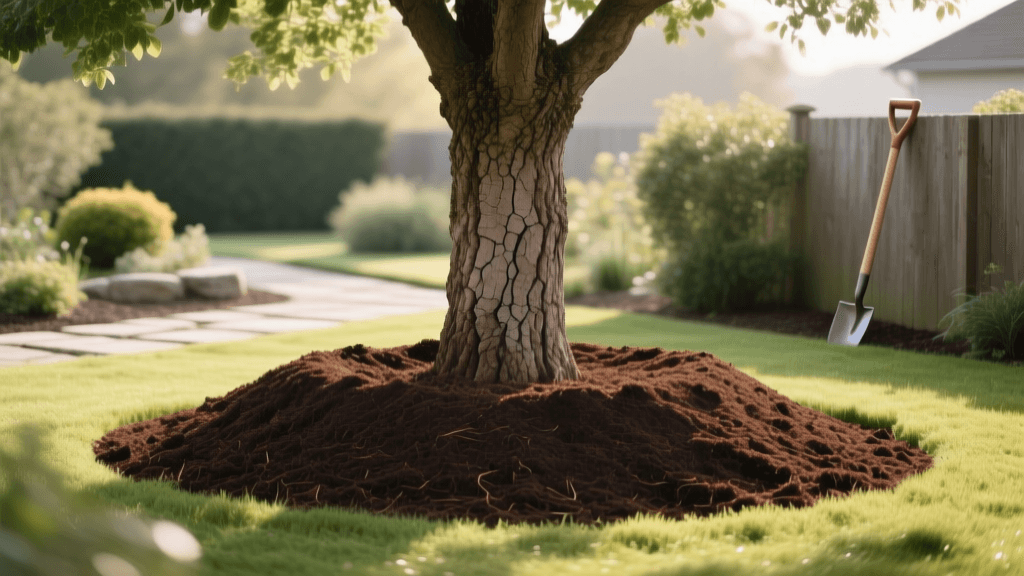
For most small yards, the takeaway is simple: give the tree as much loose, well-drained soil as you can. Don’t plant where foot traffic or vehicles will pack the soil down over the roots. A 3- to 4-inch ring of organic mulch, spread to the drip line but kept 3 to 4 inches clear of the trunk, helps hold moisture and eases the impact of rain.
What to Look For When Buying a Tree
The tree’s condition at planting affects how fast it settles in and how strong it becomes. In the U.S., nursery stock follows the American Standard for Nursery Stock (ANSI Z60.1), last updated in 2014. Arborists use this standard to choose trees for landscape jobs.
At the nursery, check for:
- Single dominant leader: Most shade trees should have one clear main trunk. Two trunks of similar thickness create a weak point that can split in wind or ice — risky in tight yards where falling limbs could hit your house or someone nearby.
- Caliper-to-height ratio: A healthy tree’s trunk diameter (measured 6 inches above soil) should match its height. A very tall, thin-trunked tree was likely crowded in the nursery and may never develop a sturdy base.
- Root flare visibility: You should see the spot where the trunk widens at the base — the root flare — right at or just below the soil surface. If it’s buried, the tree may develop girdling roots that choke it off over 10 to 20 years.
- No circling roots: With container-grown trees, ask staff to tip the pot so you can peek at the bottom. Roots that loop around the inside edge need cutting or straightening before planting — otherwise they’ll tighten like ropes as the trunk thickens.
- Branch spacing and angles: Main branches should be spaced 6 to 8 inches apart up the trunk and attach at angles wider than 45 degrees. Narrow angles break more easily.
A 2020 study in Urban Forestry & Urban Greening found that trees with root issues corrected at planting had a 40 percent higher survival rate after 10 years. Taking those few minutes to inspect and fix the roots before planting pays off.
If you’re unsure about picking, planting, or caring for a tree, an ISA Certified Arborist is a good call. You can find one through the ISA website — just enter your zip code. Certification means passing a thorough exam and keeping up with training. It’s not just a title — it’s proof of real knowledge. For a tree that could shape your yard for 30 to 50 years, it’s worth the fee.