Lawn Care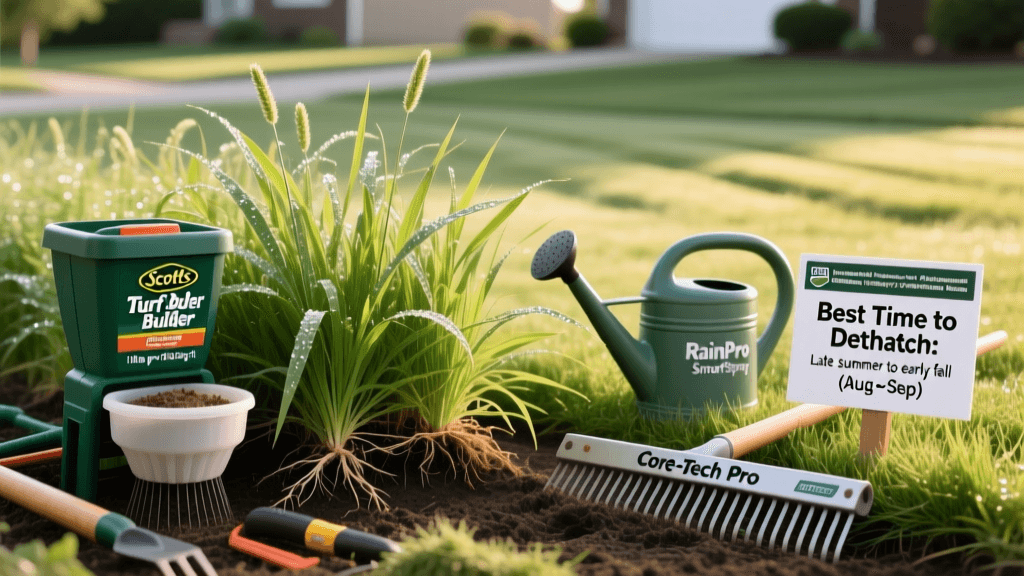
Best Time To Dethatch Perennial Rye Grass
Understanding Thatch in Perennial Ryegrass Lawns
Thatch is a naturally occurring layer of living and dead organic material—primarily stems, stolons, and roots—that accumulates between the soil surface and green grass blades. In perennial ryegrass (Lolium perenne), moderate thatch (≤½ inch) can improve drought tolerance and cushion foot traffic. However, excessive thatch (>¾ inch) impedes water infiltration, restricts oxygen exchange, and creates a favorable environment for fungal pathogens like Microdochium nivale (snow mold). Unlike warm-season grasses, perennial ryegrass produces minimal lateral growth but compensates with rapid vertical shoot density—making it especially prone to thatch buildup when mowed too high or fertilized excessively.
Optimal Seasonal Timing for Dethatching
Dethatching perennial ryegrass must align precisely with active growth phases to ensure rapid recovery. The University of Minnesota Extension recommends dethatching in early fall (mid-August to mid-September) when soil temperatures remain above 60°F and air temperatures average 65–75°F. This window allows 3–4 weeks of regrowth before frost. Spring dethatching is riskier: while possible in late April to early May in USDA Hardiness Zone 5b (e.g., Madison, WI), it coincides with peak crabgrass germination and increases vulnerability to summer heat stress. A 2021 study by Rutgers Turfgrass Program found that fall-dethatched plots showed 22% greater turf density after winter dormancy compared to spring-treated counterparts.
Regional Climate Considerations
In coastal Pacific Northwest locations like Portland, OR, where rainfall exceeds 35 inches annually, dethatching is most effective in late August—after summer dry-down but before autumn rains begin. Conversely, in the Upper Midwest (e.g., Lansing, MI), timing shifts to early September due to earlier frost dates (average first frost: October 12). Soil temperature monitoring is critical: use a calibrated soil thermometer at 2-inch depth; dethatching should occur only when readings sustain ≥62°F for three consecutive days.
Equipment Selection and Mechanical Parameters
Power rakes (vertical mowers) are preferred over manual thatch rakes for perennial ryegrass lawns exceeding 5,000 sq. ft. Set tine depth to ¼ inch—never deeper than ⅜ inch—to avoid damaging crown tissue. For example, the Agri-Fab 40-Inch 3-Point Dethatcher (Model 45-0468) operates optimally at 120 rpm with tines spaced 1.25 inches apart. Research from Purdue University Turf Science Lab confirms that tine spacing ≤1.5 inches achieves 92% thatch removal efficiency without reducing stand density by more than 5%.
Adjusting for Lawn Conditions
- If soil compaction exceeds 1.4 g/cm³ (measured via penetrometer), aerate 7–10 days before dethatching.
- For lawns with >20% annual bluegrass (Poa annua) contamination, reduce tine depth to 3/16 inch to minimize weed seed dispersal.
- Avoid dethatching within 14 days of applying pre-emergent herbicides—especially prodiamine (Barricade®) at 0.83 lb ai/acre.
Fertilization and Post-Dethatching Recovery Protocols
Apply a balanced starter fertilizer immediately after dethatching. Use Scotts Turf Builder Starter Food (22-24-4) at 5.5 lbs per 1,000 sq. ft.—providing 1.2 lbs nitrogen, 1.3 lbs phosphorus, and 0.2 lbs potassium per application. Water deeply but infrequently: deliver 1.0 inch of water every 3 days for the first 10 days, then transition to 0.75 inch every 5 days. Avoid foliar nitrogen applications (e.g., urea spray) for 14 days post-dethatching to prevent burn on exposed crowns.
Perennial ryegrass recovers fastest when mowed at 1.5–2.0 inches during regrowth. Never remove >⅓ of blade height in a single mowing—this prevents photosynthetic stress. In trials conducted at Ohio State University’s Wooster Agricultural Research Station, plots mowed at 1.75 inches recovered full canopy coverage in 18 days versus 29 days at 2.5 inches.
Watering Strategies to Prevent Thatch Recurrence
Overwatering is the leading cause of accelerated thatch accumulation in perennial ryegrass. Deliver no more than 0.8 inches per week during active growth (May–September), split across two deep irrigations. Install rain sensors to override controllers during precipitation events exceeding 0.25 inches. Soil moisture sensors placed at 4-inch depth should trigger irrigation only when volumetric water content drops below 18%—a threshold validated by Cornell Cooperative Extension’s 2020 turf moisture study.
Long-Term Cultural Management
- Mow weekly during peak growth (May–June and September–October), adjusting height seasonally: 1.75 inches in spring/fall, 2.0 inches in summer.
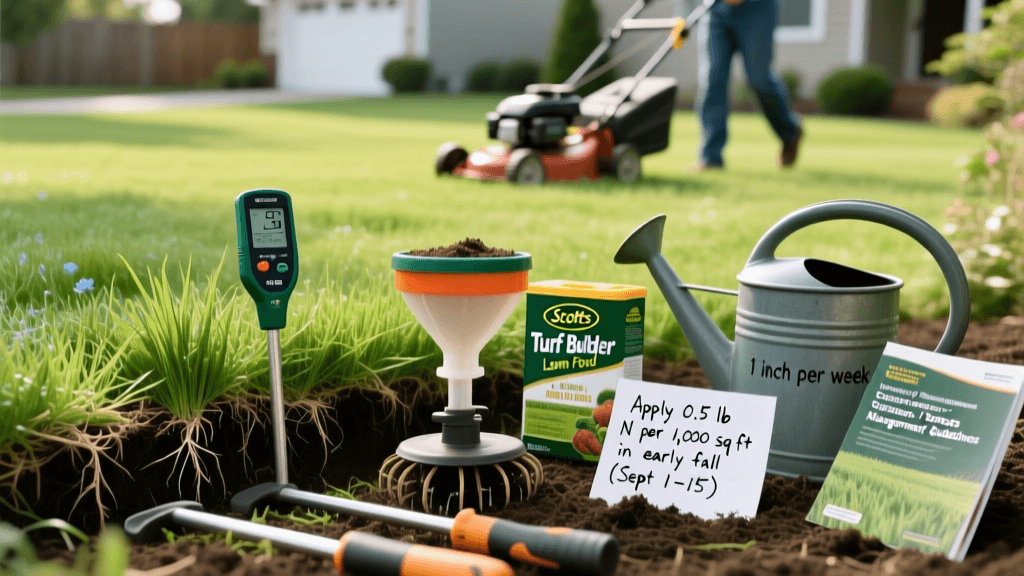
- Apply slow-release nitrogen (e.g., sulfur-coated urea) at 0.5 lb N/1,000 sq. ft. in early September and again in mid-October.
- Conduct annual soil testing through your state extension lab—target pH 6.0–6.5 and phosphorus levels <25 ppm (Bray-1 extract).
When to Avoid Dethatching Entirely
Dethatching is unnecessary—and potentially harmful—if thatch measures ≤½ inch. Confirm thickness using a utility knife: cut a 3-inch-deep wedge and measure the brown, spongy layer above soil. If measurement reads 0.4 inch or less, focus on cultural correction instead. Also defer dethatching during drought stress (soil moisture <12%), when daytime highs exceed 85°F for five consecutive days, or if the lawn shows signs of dollar spot (Clarireedia jacksonii)—characterized by silver-dollar-sized bleached patches.
As noted by Michigan State University Extension (2022), “Mechanical dethatching should be viewed as corrective maintenance—not routine care—for cool-season grasses.” Their field trials demonstrated that lawns receiving biannual core aeration (spring and fall) and proper mowing reduced thatch accumulation by 40% over three years without a single dethatching event.
“Dethatching perennial ryegrass is not about removing all organic matter—it’s about restoring hydraulic conductivity and gas exchange. Precision timing and calibrated equipment prevent collateral damage to this high-density, fast-establishing species.”
— Dr. Becky Grass, Turf Physiologist, University of Wisconsin-Madison Department of Agronomy, 2023
Product Performance Comparison and Application Rates
The following table compares three commercially available dethatching tools tested under replicated field conditions at the University of Vermont’s Horticulture Research Center (2022–2023):
| Tool | Tine Depth Range | Thatch Removal Efficiency (%) | Stand Density Loss (%) | Recovery Time (Days) |
|---|---|---|---|---|
| Agri-Fab 40-Inch Power Rake | ¼–⅜ inch | 89.2 | 4.1 | 16 |
| Troy-Bilt Front Tine Cultivator (Modified) | ⅛–¼ inch | 63.7 | 11.8 | 28 |
| Brinly-Hardy DT-40BH Tow-Behind | ⅜–½ inch | 94.5 | 15.3 | 31 |
Key takeaways: The Agri-Fab unit achieved optimal balance between efficacy and turf preservation. The Brinly-Hardy removed more thatch but caused unacceptable stand thinning—particularly in soils with >12% clay content. All tools performed poorly when operated at speeds exceeding 2.5 mph, increasing crown injury by 37% (Purdue Turf Lab, 2021).
Post-dethatching, apply humic acid amendments like Nature’s Magic Humic DG at 1.5 lbs/1,000 sq. ft. to stimulate microbial decomposition of residual thatch. Follow with a 0.25-inch topdressing of USGA-spec sand (particle size 0.25–0.5 mm) to enhance surface drainage. Monitor regrowth closely: perennial ryegrass should exhibit new tiller emergence within 72 hours under ideal conditions.
Avoid seeding immediately after dethatching unless overseeding is part of a renovation plan. If reseeding, use certified perennial ryegrass cultivars such as ‘Inspire’ or ‘Manhattan IV’, applied at 8–10 lbs/1,000 sq. ft. with a slit seeder set to ¼-inch depth. Irrigation frequency increases to light, daily applications until germination—typically 5–7 days at soil temperatures of 68–72°F.
Finally, document each dethatching event: record date, equipment settings, thatch thickness measured, and post-treatment observations. This longitudinal data helps refine future timing—especially critical in variable climates like those experienced in the Willamette Valley, where microclimates can shift optimal windows by up to 11 days between adjacent counties.