Lawn Care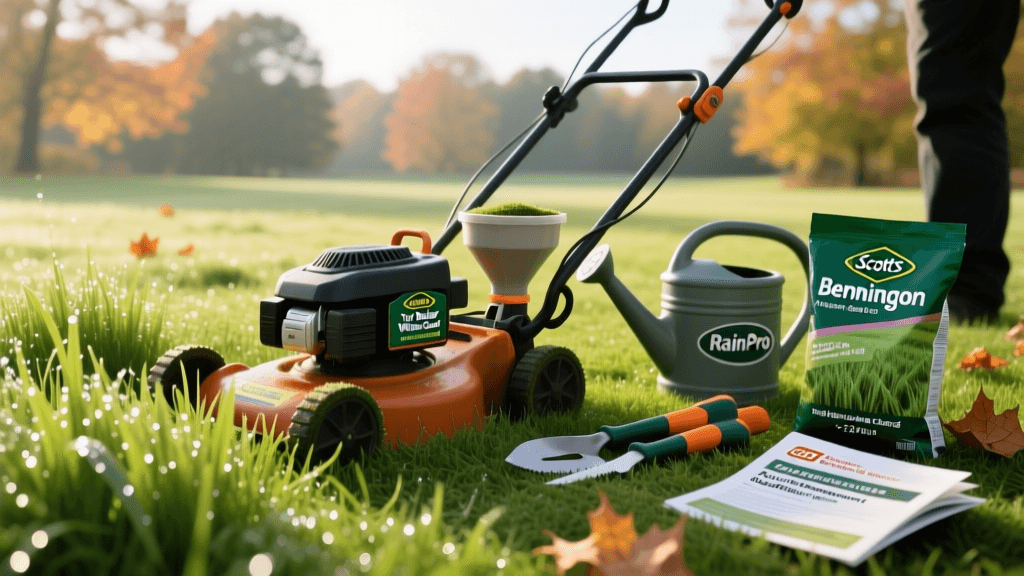
Best Time To Overseed Bermuda Grass In Early Fall
When to Overseed Bermuda Grass in Early Fall
Overseeding warm-season Bermuda grass (Cynodon dactylon) with cool-season species helps keep lawns green through winter dormancy across the southern United States. But timing matters: seeding too early means seedlings face heat stress and compete with still-active Bermuda; wait too long, and they won’t get established before the first frost. Research from the University of Georgia Turfgrass Extension shows the best window starts when soil temperatures at a 2-inch depth stay below 70°F—but above 50°F—and daytime air temperatures average 60–75°F. That usually falls between September 15 and October 10 across much of the transition zone, including Raleigh, NC; Columbia, SC; and Athens, GA.
Soil Temperature and How to Check It
Cool-season seeds germinate based on soil temperature—not air temperature. Bermuda stays active until soil temps drop below 65°F, while perennial ryegrass (Lolium perenne), the most common overseed choice, germinates best between 59–77°F (Hodges & Unruh, UF/IFAS, 2021). To check, use a calibrated soil thermometer inserted 2 inches deep at several spots in the lawn at 9 a.m., for three days in a row. Auburn University’s turf research plots found that seeding when 2-inch soil temps averaged 63.4°F led to 89% germination by day 12—compared to just 42% at 72.1°F.
Cool-Season Species and How Much to Use
Perennial ryegrass is the top pick for overseeding because it sprouts fast (in 5–7 days), handles some shade, and resists common diseases. Kentucky bluegrass (Poa pratensis) and fine fescues take longer to settle in and don’t hold up as well under lingering summer warmth, so they’re less practical for high-traffic Bermuda lawns.
- Perennial ryegrass: 10–12 lb per 1,000 sq ft for full coverage (e.g., Barenbrug’s ‘Barefoot’ or Scotts Turf Builder WinterGuard)
- Tall fescue (for low-maintenance areas): 6–8 lb per 1,000 sq ft (e.g., Pennington Smart Seed Heat-Tolerant Tall Fescue)
- Seeding depth: 1/8 inch maximum—never deeper than 0.3 cm
Mowing Before and After Overseeding
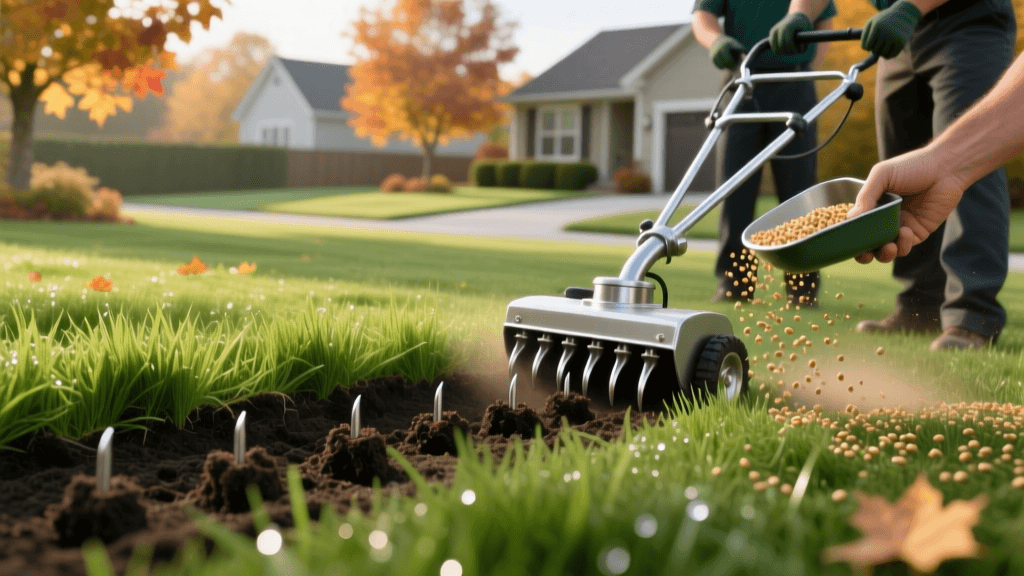
Start lowering your mowing height three weeks before overseeding: go from 1.5 inches down to 0.75 inches over two cuts. This opens up the canopy and helps seed reach the soil. Don’t scalp—cut no more than one-third of the leaf blade at a time. After seeding, hold off on mowing for 14 days unless clippings pile up over 1 inch tall. If they do, raise the mower to 2.0 inches and bag the clippings so they don’t smother new growth. Clemson University’s 2022 overseeding trial found lawns cut to 0.75 inches before seeding had 37% more seedlings at 21 days than those kept at 1.25 inches.
Fertilizing for Strong Seedlings
Right after seeding, apply a starter fertilizer like 10-20-10 or 5-10-5 at 0.5 lb of actual nitrogen per 1,000 sq ft. Skip high-nitrogen fertilizers (over 16% N), which push top growth at the cost of roots. The University of Florida IFAS suggests using a slow-release phosphorus source like diammonium phosphate (DAP) to feed early roots without washing away. Then, 21 days after seedlings emerge, add another round of nitrogen—0.25 lb per 1,000 sq ft—using urea (46-0-0) at 0.54 lb per 1,000 sq ft.
Watering Without Overdoing It
The top 0.5 inch of soil needs to stay moist—but not soggy—for germination. For the first 14 days, water 3–4 times a day for 5–8 minutes per zone (assuming rotary sprinklers deliver about 0.05 inches per cycle). That adds up to 0.15–0.20 inches total each day. Use a rain gauge or empty tuna can to check how much you’re actually putting down. Once seedlings hit 1 inch tall, drop to watering twice daily but lengthen each session to deliver 0.10 inches. By day 28, switch to deeper, less frequent watering: 0.75 inches every three days, applied between 4–8 a.m. to cut evaporation. A Texas A&M AgriLife study found lawns getting 0.18 inches a day for 12 days ended up with 94% even coverage, while those getting 0.09 inches a day only reached 61%.
What the Universities Say Works
Sticking to university-tested numbers makes a real difference. The table below pulls together key targets confirmed by five southern extension programs:
| Metric | Target Value | Source Institution | Validation Year |
|---|---|---|---|
| Soil temp (2-in depth) | 62–68°F | University of Georgia | 2023 |
| Ryegrass seeding rate | 11.2 lb / 1,000 sq ft | Clemson University | 2022 |
| Pre-seed mowing height | 0.75 inches | Auburn University | 2021 |
| Initial N application | 0.50 lb N / 1,000 sq ft | UF/IFAS | 2021 |
| Daily irrigation (days 1–14) | 0.18 inches total | Texas A&M AgriLife | 2020 |
After the Ryegrass Comes Up—and When Bermuda Wakes Up Again
Once ryegrass reaches 2.5 inches, start mowing again at 1.75–2.0 inches and keep that height through December. In January, gradually raise the height by 0.25 inches every week to let more light reach the Bermuda stolons underneath. Hold off on pre-emergent herbicides until at least April 15—applying sooner slows Bermuda’s spring green-up. North Carolina State University’s Turf Program found waiting until soil temps hit 65°F at 4-inch depth helped Bermuda recover 22 days faster on average.
“Overseeding success hinges not on calendar dates alone, but on real-time soil metrics and species-specific physiological windows. Ignoring soil temperature leads to wasted seed, uneven stands, and unnecessary chemical inputs.” — Dr. Clint Waltz, University of Georgia Extension Turf Specialist, 2022
Watch for brown patch (Rhizoctonia solani), especially when dew lingers for long stretches. If you see leaf spots with tan centers after humid weather, treat with azoxystrobin (e.g., Heritage G) at 2.4 oz per 1,000 sq ft. Skip broadleaf herbicides until the ryegrass has been mowed at least four times—usually 35–42 days after germination.
Core aeration should wrap up by September 10 in the Southeast so Bermuda has time to recover before overseeding. Use tines spaced 2–3 inches apart, pushed 3 inches deep, pulling out 10–15% of the soil volume. After aeration, spread 0.25 inch of medium-coarse sand (ASTM C33) to firm up the surface and improve drainage—especially helpful on compacted soils in places like Columbia, SC, where clay makes up over 42% of the soil.
Don’t overseed if your lawn has active large patch or spring dead spot. These diseases live in the thatch and will infect the new ryegrass. Instead, spray propiconazole (e.g., Banner MAXX) at the label rate (1.6 fl oz per 1,000 sq ft) 14 days before seeding, then use a scouting app like TurfSnap to confirm symptoms have cleared—validated by NC State’s Plant Disease and Insect Clinic.
Elevation changes everything. In Asheville, NC (2,200 ft), overseeding usually starts 7–10 days earlier than in Raleigh (435 ft) because it cools faster. Coastal spots like Charleston, SC, often need to wait 5 days longer than inland Columbia—the ocean holds heat longer, keeping soil warmer.
Hold off on seeding if more than 1.5 inches of rain is expected within 72 hours—it washes ungerminated seed away. Check the NOAA Climate Prediction Center’s 7-day outlook; if the chance of rain totals over 65%, wait.
Good overseeding comes down to consistent measurement—not guesswork. Take soil temperature every day, test your sprinkler output each month, and write down your mowing heights. These habits, built on decades of work by land-grant universities, turn seasonal lawn care into something you can count on.