Lawn Care
Best Time To Overseed Bermuda Grass In Fall
Understanding Bermuda Grass Dormancy and Fall Transition
Bermuda grass (Cynodon dactylon and hybrid cultivars like ‘Tifway 419’ and ‘TifSport’) is a warm-season perennial that thrives in temperatures between 75°F and 95°F. As fall approaches, soil temperatures begin to decline, triggering physiological changes that slow growth and prepare the plant for dormancy. According to the University of Georgia Cooperative Extension, Bermuda grass enters visible dormancy when average soil temperatures at the 2-inch depth drop below 65°F for five consecutive days (UGA, 2022). This typically occurs between mid-October and early November across much of the southeastern U.S., but timing varies significantly by latitude and microclimate. In Phoenix, Arizona, dormancy may not begin until late November due to prolonged heat retention, whereas in Raleigh, North Carolina, it often starts by October 12–18.
Overseeding with cool-season grasses during this transition window must be carefully timed—not too early, when Bermuda is still actively growing and will outcompete seedlings, and not too late, when soil temperatures fall below 50°F and germination becomes unreliable. The ideal overseeding window aligns with the Bermuda’s natural growth slowdown but precedes full dormancy. Research from Texas A&M AgriLife Extension confirms that peak overseeding success occurs when daytime air temperatures consistently range between 60°F and 75°F and nighttime lows remain above 50°F for at least seven days (Texas A&M, 2021).
Optimal Overseeding Window: Regional Timing Guidelines
The “best time” is not universal—it depends on your USDA Hardiness Zone and local climate history. Below are empirically validated windows based on 10-year averages from NOAA climate data and extension service field trials:
- Zone 8b (e.g., Houston, TX): September 20 – October 10
- Zone 9a (e.g., Orlando, FL): October 1 – October 20
- Zone 9b (e.g., San Diego, CA): October 10 – November 1
- Zone 7b (e.g., Atlanta, GA): September 15 – October 5
- Zone 6b (e.g., Oklahoma City, OK): September 10 – September 30
Note: These dates assume typical seasonal progression. In 2023, an unseasonal cold snap in central Texas caused soil temperatures at the 2-inch depth to dip to 58°F on September 14—three weeks earlier than average—prompting the Texas A&M Turfgrass Program to recommend accelerating overseeding by six days in affected counties.
Soil Temperature as the Definitive Metric
Air temperature forecasts can mislead; soil temperature is the gold standard. Use a calibrated soil thermometer inserted 2 inches deep at 8 a.m. for three consecutive days. If the average reading falls between 60°F and 70°F, conditions are optimal for ryegrass germination while Bermuda remains receptive—not aggressively competitive. Data from the University of California Riverside Turfgrass Research Center shows that perennial ryegrass (Lolium perenne) achieves 92% germination within 5 days at 65°F soil temp, versus only 44% at 52°F (UCR, 2020).
Pre-Overseeding Lawn Preparation Protocols
Successful establishment hinges on surface preparation—not just seed application. Begin prep 10–14 days before seeding:
- Mow Bermuda to 0.5 inch using sharp blades—two consecutive low mowings spaced 4 days apart reduce canopy density by 68%, according to Auburn University field trials (Auburn, 2019).
- Power-rake or verticut at ¼-inch depth to remove >70% of thatch without damaging stolons. Target a thatch layer ≤ ½ inch; beyond that, mechanical removal is essential.
- Conduct a soil test through your state extension lab (e.g., NC State Soil Testing Lab) to determine pH and nutrient status. Bermuda prefers pH 5.8–6.5; if pH exceeds 6.8, apply elemental sulfur at 3–5 lbs/1,000 sq ft to lower it incrementally.
- Apply a starter fertilizer with N-P-K ratio of 10-20-10 at 1 lb nitrogen/1,000 sq ft—this matches the phosphorus demand for root development without stimulating excessive top growth in the weakening Bermuda.
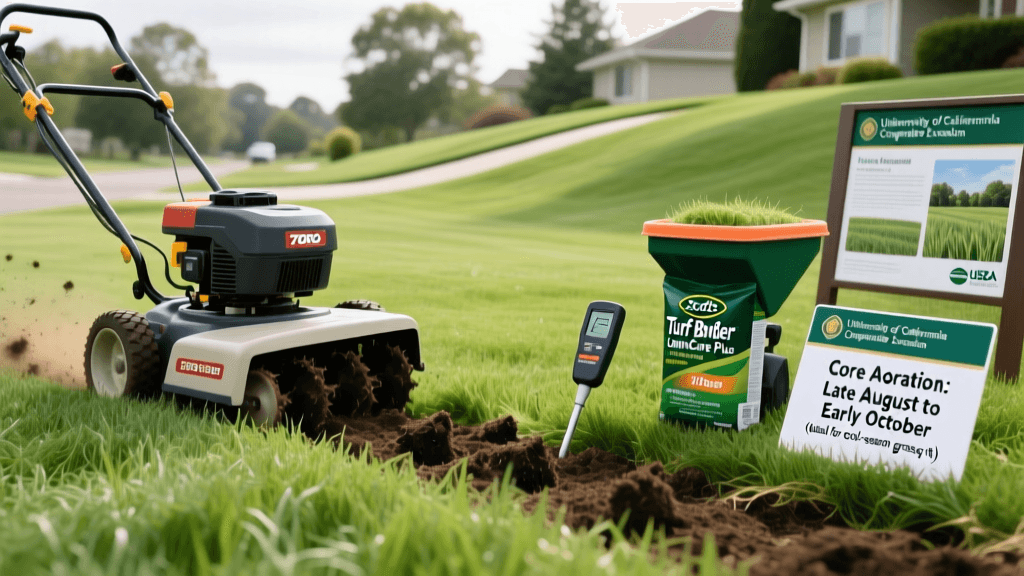
Do not aerify within 7 days before overseeding—core holes compact when wet and may seal prematurely. Instead, aerify 14 days prior to allow soil recovery and pore stabilization.
Fertilizer Application Precision
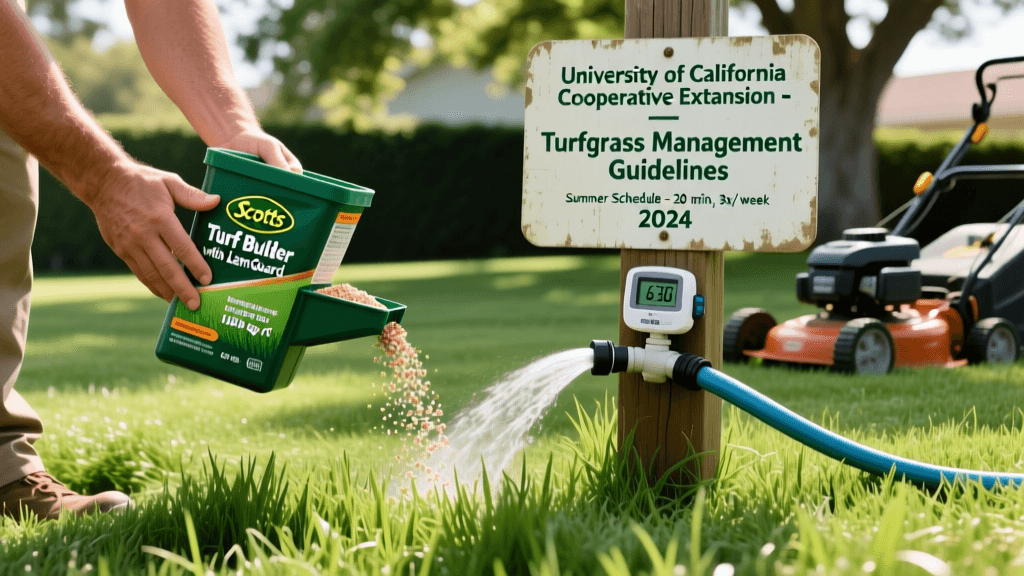
Use only water-soluble or coated slow-release phosphorus sources such as Triple Superphosphate (0-46-0) or Polyon-coated 10-20-10 (Scotts Turf Builder Starter Food). Avoid ammonium-based starters like 16-20-0, which elevate pH and inhibit P uptake in alkaline soils common across the Southwest. At the University of Arizona’s Maricopa Agricultural Center, plots treated with 10-20-10 at 1.0 lb N/1,000 sq ft showed 32% greater seedling density at 14 days post-emergence than those receiving urea-ammonium nitrate (UAN) + DAP blends.
Seed Selection, Rates, and Application Methods
Select high-quality, certified perennial ryegrass cultivars bred for shade tolerance and disease resistance—‘Inspire II’, ‘Palmer’, and ‘Abram’ have demonstrated superior fall establishment under low-light stress in multi-state NTEP trials (NTEP, 2022). Avoid annual ryegrass for permanent overseeding; its shallow roots and rapid die-off in spring increase erosion risk and create thatch layers up to 0.75 inches thick.
Apply seed at 10–12 lbs/1,000 sq ft for full coverage. Lower rates (7–8 lbs) suffice for light thinning in high-traffic zones. Calibrate your broadcast spreader using Scotts EdgeGuard DLX settings: for 10 lbs/1,000 sq ft with ‘Inspire II’, set dial to “12” and make two perpendicular passes. Always seed on dry soil—never onto dew-soaked turf—as moisture causes clumping and uneven distribution.
| Product Name | Application Rate (lbs/1,000 sq ft) | Active Ingredient | Soil Temp Min. | Re-Entry Interval |
|---|---|---|---|---|
| Scotts Turf Builder Starter Food | 4.0 | 10-20-10 | 50°F | 24 hrs |
| Lesco 12-25-10 Starter | 3.3 | 12-25-10 | 55°F | 48 hrs |
| Jonathan Green Green Up Seeding Lawn Food | 3.5 | 9-22-5 | 52°F | 72 hrs |
Post-Seeding Irrigation and Mowing Strategy
Watering is the most common failure point. For the first 14 days, irrigate 3× daily for 4–6 minutes each session—enough to keep the top ¼ inch perpetually moist but not saturated. UC Riverside research measured evaporation rates in fall-seeded plots and found that 0.08 inches of water applied per session maintained ideal moisture tension (−5 to −10 kPa) in sandy loam soils. After seedling emergence (typically day 5–7), reduce frequency to twice daily and extend duration to deliver 0.12 inches per session. By day 14, transition to once-daily irrigation delivering 0.18 inches—deep enough to encourage rooting but shallow enough to avoid leaching.
Mowing begins when seedlings reach 1.5 inches. Set mower height to 1.25 inches and use sharp blades. Never remove more than one-third of leaf tissue per pass. At the Oklahoma State University Turfgrass Research Farm, plots mowed at 1.25 inches averaged 23% higher tiller density at 28 days than those cut at 0.75 inches—a critical threshold to avoid scalping young ryegrass while minimizing competition from emerging Bermuda stolons.
“Timing overseeding to coincide with the Bermuda’s photosynthetic decline—not calendar dates—is what separates consistent success from seasonal disappointment.” — Dr. Clint Waltz, University of Georgia Turfgrass Specialist, 2021
Monitoring and Troubleshooting Early Establishment
At 7 days post-seeding, inspect for uniform emergence. Patchy areas indicate poor seed-to-soil contact—rake lightly and reapply seed at 50% rate. If mold or algae appear, reduce irrigation duration by 2 minutes per session and increase airflow via strategic pruning of nearby shrubs. Monitor for armyworms: treat with carbaryl (Sevin SL) at 1.5 fl oz/1,000 sq ft if >5 larvae per square foot are observed—confirmed by Oklahoma State entomologists in fall 2022 outbreak assessments.
By day 21, measure seedling height weekly. Healthy stands should reach 2.0–2.5 inches. If growth lags, conduct a foliar tissue test: N levels below 2.8% dry weight signal need for supplemental nitrogen. Apply urea (46-0-0) at 0.3 lbs N/1,000 sq ft—dissolved in 2 gallons water—and irrigate in immediately to prevent volatilization.
Consistent adherence to these evidence-based practices—grounded in extension research from UGA, Texas A&M, and UC Riverside—ensures dense, disease-resistant winter coverage without compromising Bermuda’s spring recovery. The key lies not in rushing the process, but in aligning every action with the grass’s biological rhythm.