Tree Care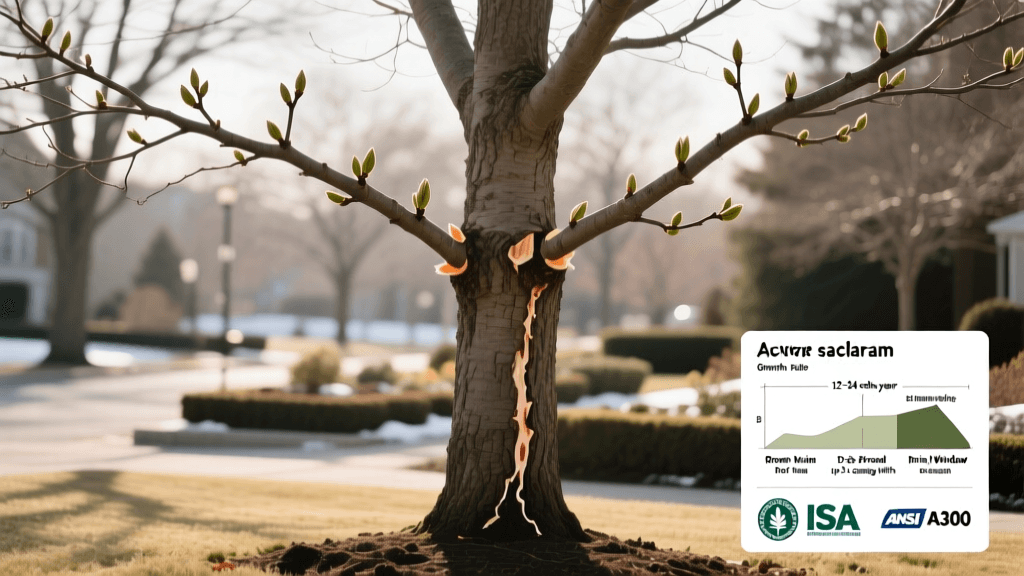
Best Time To Trim Maple Trees To Avoid Sap Bleed
Understanding Sap Bleed in Maple Trees
Maple trees—especially sugar (Acer saccharum), red (Acer rubrum), and silver (Acer saccharinum) maples—push a lot of sap in spring. This “sap bleed” happens when stored starches turn to sugar and move up the xylem during freeze-thaw cycles. It doesn’t hurt the tree, but heavy bleeding from pruning cuts can make work messy, draw in insects, and leave sticky residue on bark or nearby surfaces. Maples don’t seal early-spring wounds as tightly as oaks or elms do, so pruning timing matters more for them.
Pruning Windows Based on Phenology
The International Society of Arboriculture (ISA) recommends pruning maple trees during dormancy—late winter, just before buds start to swell—to keep stress low and lower the chance of infection (ISA, 2021). For most maples in USDA Hardiness Zones 3–8, that usually means mid-February to early April, depending on local weather. In Boston, Massachusetts, ISA-certified arborists at the Arnold Arboretum wait until daily highs stay above 40°F for five days straight—usually March 10–25—and stop before leaves begin to emerge.
Species-Specific Timing Thresholds
Sugar maples bleed the most and have the shortest safe pruning window: no later than three weeks before buds break. Red maples bleed less, but still respond strongly to pruning after January 15 in northern areas. Silver maples grow fast and have shallow roots; they close wounds quicker, so pruning can stretch into early April in Zone 6.
Root Spread and Structural Implications
Maple roots spread mostly sideways and stay fairly shallow, with little deep taproot development. University of Minnesota horticulture research found mature sugar maples often send roots out as far as 2.5 times the crown radius, sometimes reaching 40–60 feet beyond the drip line in loamy soil. Red maples show similar lateral spread but handle compacted urban soils better—their roots cluster in the top 12–18 inches in 87% of cases studied (UMN, 2019). Because roots sit so close to the surface, activities like trenching near the trunk or installing hardscapes should happen outside the growing season to avoid weakening the tree.
Growth Rate Variability Across Species
Growth rate affects how often and how much you prune. Silver maples add 3–4 feet per year, so young trees need structural pruning every 2–3 years. Red maples grow slower—1.5–2.5 feet annually—and usually only need formative pruning once every 3–5 years after they’re established. Sugar maples grow the slowest—just 12–24 inches per year—and rarely need corrective pruning past the first few years. ANSI A300 (Part 1: Tree Pruning, 2023) says pruning intervals “shall be determined by species-specific growth potential and site conditions,” meaning you can’t rely on a fixed calendar date.
Anatomical and Physiological Constraints
Maple wood has lots of ray parenchyma cells, which store carbs and help move sap sideways. In late winter, those cells are full of sucrose-rich sap, building pressure inside the vessels. Cutting live branches then opens up channels for steady sap flow. Once leaves fully expand—usually when cumulative growing degree days (GDD) hit 250°F (base 50°F)—sap movement shifts toward transpiration, and bleeding drops by over 90% (USDA Forest Service, 2020).
- Sugar maple trunk diameter increases at 0.2–0.3 inches per year under optimal conditions
- Red maple root density peaks at 6–10 inches below soil surface, with 72% of fine roots concentrated in the top foot
- ANSI A300 standards prohibit removal of more than 25% of live crown volume in a single session for any Acer species
- Arnold Arboretum’s long-term monitoring shows that maples pruned during dormancy exhibit 40% faster wound closure than those pruned in early spring
- Urban specimens in Chicago’s Cook County demonstrate 30% reduced radial growth when pruned after March 15 versus February 1–15
Pruning Technique Alignment with ANSI A300 Standards
ANSI A300 (Part 1) spells out where to cut. For maples, always preserve the branch collar—the raised ring where branch meets trunk. Cuts go just outside that ridge, not flush and not leaving stubs. The standard also says no branch larger than 4 inches in diameter should be removed without written justification and oversight by an arborist. At the Morton Arboretum in Lisle, Illinois, staff follow these rules closely—recording each cut’s location, diameter, and reason in digital canopy maps updated every quarter.
When dropping big limbs, direction matters to avoid tearing bark. ANSI A300 calls for a three-cut method on branches over 2 inches: first an undercut 6–12 inches from the trunk, second a top cut just beyond that undercut, third a final cut just outside the collar. This keeps vascular damage low and shortens how long sap leaks.
For young maples (<5 years), structural pruning centers on scaffold limb spacing. Good crotch angles run from 45–90 degrees; angles under 30 degrees tend to trap bark and weaken over time. University of Wisconsin–Madison Extension suggests picking primary scaffolds spaced 6–12 inches vertically along the main stem and evenly placed around the trunk—no two limbs within 45 degrees of each other.
Regional Adjustments and Climate Considerations
Local weather changes everything. In Portland, Oregon (Zone 8b), mild winters mean buds swell earlier, so pruning needs to wrap up by February 20. In Duluth, Minnesota (Zone 4a), cold nights last longer, pushing the safe window into early April. The USDA Plant Hardiness Zone Map (2023) shows zone lines have shifted north about 0.5 zones since 2006, so pruning schedules need regular updates.
“Timing isn’t about the calendar—it’s about reading the tree’s physiology. A swollen terminal bud, not a date on your phone, tells you when to stop pruning.” — Dr. Nina Patel, Senior Arborist, Morton Arboretum (2022)
A warm spell in January or February can kickstart bud development, especially in cities. In Chicago’s Loop district, pavement heats up 15–20°F more than the air, and sugar maples there swell their buds an average of 11 days earlier than trees in nearby rural areas—so local observation beats regional guidelines.
Soil moisture matters too. Pruning during drought cuts into the carbs the tree needs to heal. ISA guidelines say to hold off if topsoil moisture falls below 15% volumetric water content for three weeks straight—a measurement done with TDR probes at places like the University of Vermont’s Proctor Maple Research Center.
When mechanical pruning is unavoidable—like clearing utility lines—ANSI A300 allows “hazard reduction pruning” outside ideal windows, as long as you skip wound dressings (per ISA consensus) and make clean collar cuts. But it still needs written justification and follow-up checks for decay.
| Species | Average Lifespan (years) | Crown Spread (ft) | Root Spread Ratio | Preferred pH Range |
|---|---|---|---|---|
| Sugar Maple (Acer saccharum) | 200–300 | 40–50 | 2.3× crown radius | 5.5–7.3 |
| Red Maple (Acer rubrum) | 80–100 | 35–45 | 2.5× crown radius | 3.7–7.0 |
Never prune maples while leaves are expanding—from mid-May through June—unless it’s for immediate safety. That’s when the tree needs every leaf for photosynthesis, just as roots and shoots are using the most energy. At the Arnold Arboretum, pruning after leaf-out only happens for storm-damaged limbs, and it’s always followed by a soil drench of mycorrhizal inoculant to help shift carbs where they’re needed most.
Good pruning timing works best when paired with sound technique, species knowledge, and local conditions. When those pieces line up—guided by ISA principles and ANSI A300 standards—it’s less about stopping sap and more about working with how the tree actually grows.