Lawn Care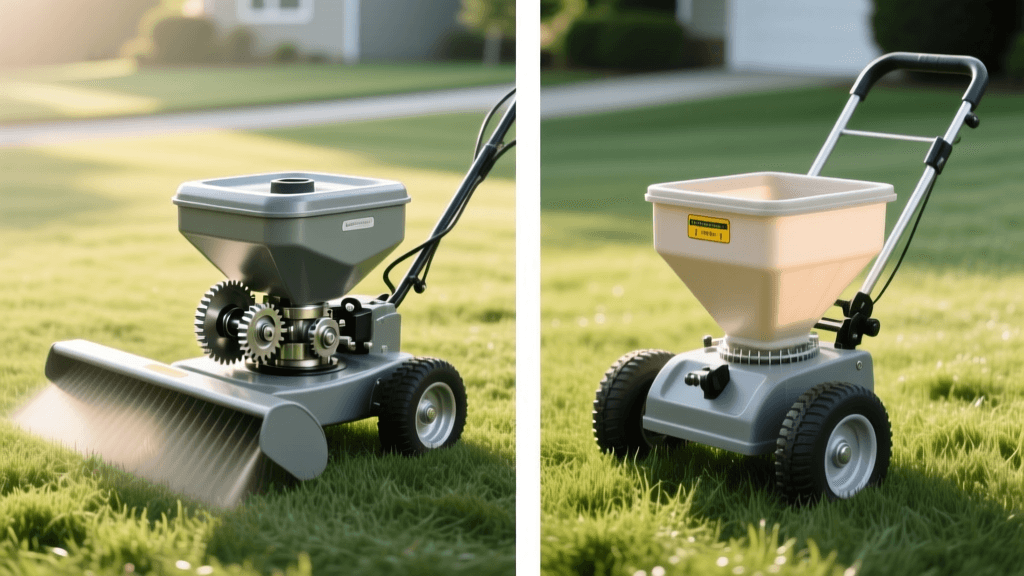
Broadcast vs Drop Spreaders: Which Fertilizer Spreader is Best?
The Great Spreader Debate: Broadcast vs. Drop
Applying fertilizer, grass seed, or weed control to your lawn is a fundamental aspect of seasonal lawn maintenance. However, the tool you use to distribute these materials is just as important as the materials themselves. Uneven application can lead to severe consequences, including fertilizer burn, striped lawns, and wasted money. When shopping for lawn care equipment, homeowners and professionals alike are faced with a primary decision: should you buy a broadcast spreader or a drop spreader?
In this comprehensive product review and comparison guide, we will break down the mechanics, pros, and cons of both spreader types. We will also review specific top-rated models on the market, compare their costs and features, and provide an expert-backed calibration guide to ensure your lawn receives the exact nutrients it needs.
Broadcast Spreaders: Speed and Wide Coverage
Broadcast spreaders, also known as rotary spreaders, utilize a spinning horizontal disc at the base of the hopper. As the granular product falls through the hopper opening, the spinning disc throws the material outward in a wide, fan-like pattern. This design allows you to cover large areas quickly and is highly forgiving if your walking path overlaps slightly.
Top Pick for Small to Medium Lawns: Scotts EdgeGuard Mini Broadcast Spreader
Estimated Cost: $35 - $45
Capacity: Up to 5,000 square feet of product
Best For: Suburban lawns under 5,000 sq. ft.
The Scotts EdgeGuard Mini is a staple in suburban garages. Its standout feature is the EdgeGuard technology, a physical shield that blocks the right side of the spreading pattern to prevent fertilizer from landing on driveways, sidewalks, and garden beds. While its plastic construction is lightweight and easy to maneuver, it lacks the durability required for heavy commercial use. The small hopper means you will be refilling frequently if your lawn exceeds 5,000 square feet.
Top Pick for Large and Professional Lawns: Lesco High Wheel Fertilizer Spreader
Estimated Cost: $150 - $180
Capacity: 50 lbs (covers up to 15,000+ sq. ft. depending on product)
Best For: Large estates, commercial properties, and rough terrain.
If you have a massive lawn or uneven terrain, the Lesco High Wheel is the gold standard. Featuring a stainless steel frame and a 50-pound capacity hopper, it is built to withstand corrosive fertilizers and heavy use. The 14-inch pneumatic tires glide over bumpy lawns without disrupting the application rate. The primary drawback is the price point and the heavy weight, which can make it difficult to transport in smaller vehicles.
Drop Spreaders: Precision and Control
Drop spreaders operate using gravity. The product falls directly through a series of holes at the bottom of the hopper, dropping in a precise band directly beneath the machine. The application width is strictly limited to the wheelbase of the spreader. This makes drop spreaders ideal for small, intricately shaped lawns where you need to avoid flower beds, water features, and property lines.
Top Pick for Precision: Scotts Classic Drop Spreader
Estimated Cost: $45 - $55
Capacity: Up to 10,000 square feet of product
Best For: Small, rectangular lawns with tight boundaries.
The Scotts Classic Drop Spreader offers a 22-inch drop width, providing excellent control. Because the product drops straight down, wind has virtually no impact on your application, making it perfect for applying pre-emergent herbicides near sensitive garden beds. However, because the spread width is narrow, it takes significantly longer to cover a large yard, and you must be incredibly precise with your wheel tracks to avoid visible striping.
Top Pick for Durability: EarthWay 2150 Commercial Drop Spreader
Estimated Cost: $120 - $140
Capacity: 50 lbs
Best For: Professionals and meticulous homeowners with medium-sized lawns.
The EarthWay 2150 features a rust-proof aluminum frame and a unique EV-N-SPRED system that ensures an even drop pattern across the entire 24-inch width. The pneumatic tires provide a smooth ride, and the enclosed gearbox prevents fertilizer dust from seizing the gears. It is a premium tool for those who demand drop-spreader precision but want commercial-grade longevity.
Head-to-Head Comparison Chart
| Feature | Scotts EdgeGuard Mini (Broadcast) | Lesco High Wheel (Broadcast) | Scotts Classic (Drop) | EarthWay 2150 (Drop) |
|---|---|---|---|---|
| Application Style | Rotary / Fan Pattern | Rotary / Fan Pattern | Gravity / Direct Drop | Gravity / Direct Drop |
| Effective Width | 5 to 8 feet | 8 to 12 feet | 22 inches | 24 inches |
| Speed of Use | Fast | Very Fast | Slow | Slow |
| Precision | Moderate | Low (requires edge guarding) | High | Very High |
| Wind Interference | High | High | None | None |
| Approximate Cost | $40 | $165 | $50 | $130 |
The Importance of Spreader Calibration
Regardless of whether you choose a broadcast or drop spreader, failing to calibrate your equipment will result in poor lawn health. Applying too much fertilizer causes chemical burn and promotes thatch buildup, while applying too little leaves your lawn vulnerable to weeds and drought stress.
'Spreader calibration is not a one-time event. You must recalibrate every time you switch to a different granular product, as particle size, shape, and density drastically alter the application rate. Furthermore, walking speed is the most common variable that causes application errors among homeowners.' — Purdue University Extension, Turfgrass Science Program
How to Calibrate Your Spreader in 5 Actionable Steps
To ensure you are applying the exact amount of product recommended on the bag, follow this calibration method endorsed by university extension offices:
- Step 1: Determine the effective spread width. For a drop spreader, measure the distance between the outer edges of the wheels. For a broadcast spreader, fill the hopper with a test product (like kitty litter), walk a straight line on your driveway, and measure the width of the visible pattern. Divide that width by two to find your effective overlap width.
- Step 2: Calculate the test distance. You need to know how far to walk to cover exactly 1,000 square feet. Divide 1,000 by your effective spread width. For example, if your drop spreader is 2 feet wide, you must walk 500 feet. If your broadcast effective width is 10 feet, you must walk 100 feet.
- Step 3: Weigh your test product. Weigh out slightly more product than you think you will need for 1,000 square feet and pour it into the hopper. Weigh the empty collection bucket or tray you will use to catch the product.
- Step 4: Execute the test run. Attach a catch tray to the bottom of your spreader (or use a drop spreader over a tarp). Walk the exact calculated distance at your normal, comfortable mowing pace. Do not walk artificially slow or fast.
- Step 5: Weigh the results. Weigh the bucket with the caught product. Subtract the empty bucket weight. If the product bag recommends 3.5 lbs per 1,000 square feet, and you caught 3.5 lbs, your spreader dial is perfectly calibrated. If you caught 5 lbs, close the dial setting and test again. If you caught 2 lbs, open the dial and repeat.
Maintenance and Cleaning Best Practices
Fertilizers and herbicides are highly corrosive. Leaving residue in your spreader hopper or on the spinning disc will lead to rusted gears and seized axles, effectively ruining a $150 investment in a single season. After every single use, you must rinse the hopper, the agitation bar, and the wheels with a garden hose. For broadcast spreaders, pay special attention to the spinning disc and the gear housing. Once the spreader is completely dry, apply a light coat of silicone lubricant or WD-40 to the axle and moving metal parts. Always store your spreader in a dry, covered garage or shed, preferably hanging on a wall hook to keep the tires from developing flat spots over the winter.
Final Verdict: Which Spreader Should You Buy?
The choice between a broadcast and a drop spreader ultimately comes down to the size and layout of your property. If you have a large, open lawn with few obstacles, a broadcast spreader like the Lesco High Wheel will save you hours of labor and provide excellent coverage, provided you use edge guards near sensitive areas. Conversely, if you manage a smaller, geometric lawn bordered by vegetable gardens, koi ponds, or property lines, the precision of a drop spreader like the EarthWay 2150 is worth the extra time it takes to walk the yard. Whichever you choose, commit to the Purdue-recommended calibration process to ensure your lawn receives the precise care it deserves.