
Landscaping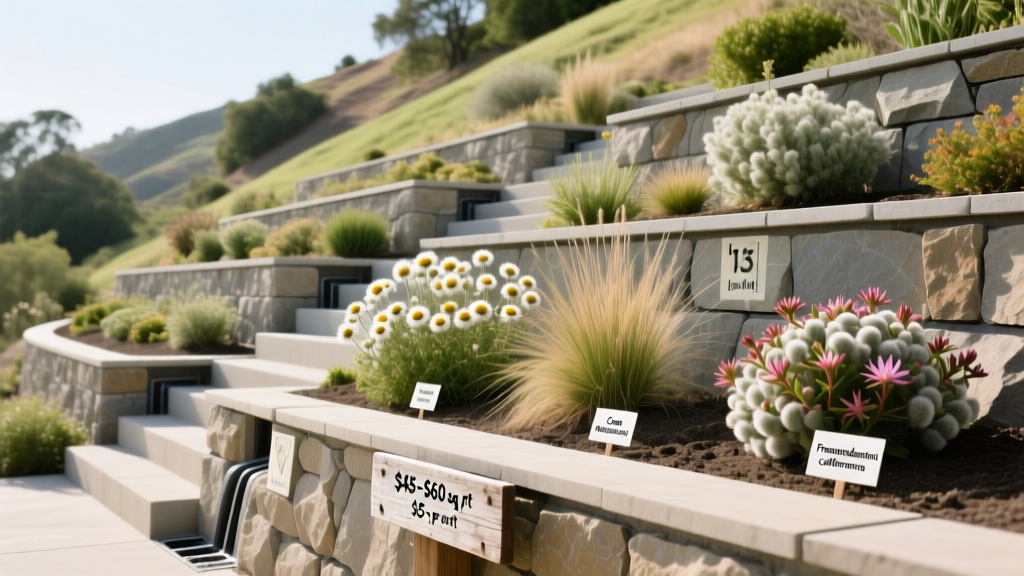
Build Tiered Retaining Wall For Steep Slopes
Structural Integrity and Site Assessment
Before breaking ground on a tiered retaining wall system for steep slopes—defined by the American Society of Landscape Architects (ASLA) as gradients exceeding 3:1 (horizontal:vertical)—a rigorous site assessment is non-negotiable. Slope stability analysis must precede design, incorporating soil testing to determine bearing capacity, drainage characteristics, and potential for lateral earth pressure. At the University of California, Davis Arboretum, engineers conducted borings at 5-foot intervals across a 40-foot-wide hillside with a 45° incline to confirm cohesion values above 1,200 psf before approving a three-tier gravity wall system. Soil type directly influences wall height limits: granular soils permit taller tiers (up to 6 feet per segment), while clay-rich substrates require stepped setbacks no greater than 4 feet per tier and mandatory weep hole spacing at 48-inch centers.
Design Principles and Tiered Geometry
Tiered walls mitigate cumulative lateral forces by dividing vertical grade change into manageable horizontal segments. Per ASLA’s *Landscape Architecture Technical Standards* (2021), each tier must be set back from the one below it by a minimum of 1.5 times its height to ensure passive resistance and prevent surcharge loading. For example, a 36-inch-tall lower tier requires a minimum 54-inch horizontal offset before the next tier begins. This geometry creates intermediate planting shelves—typically 30–48 inches deep—that serve both functional and aesthetic roles. The High Line in New York City employs precisely this principle: its 12-foot elevation gain over 1,300 linear feet is resolved through seven staggered tiers averaging 22 inches in height and 36 inches in shelf depth, enabling layered planting without compromising structural integrity.
Material Selection and Load Calculations
Segmental concrete units (SCUs) remain the most widely specified material for residential and institutional tiered walls due to their interlocking geometry, modular flexibility, and compressive strength exceeding 4,000 psi. For slopes exceeding 25°, reinforced systems using geogrids embedded at 16-inch vertical intervals are required. A typical installation for a 100-square-foot tier (measuring 25 ft × 4 ft shelf area) uses approximately 120 SCUs weighing 42 lbs each, plus 30 lineal feet of #8 galvanized steel rebar for toe anchoring. Labor and materials for such a tier average $2,800–$3,400, excluding grading and drainage work.
Drainage Integration and Hydrologic Management
Inadequate drainage causes 70% of retaining wall failures, according to the National Association of Home Builders (NAHB, 2022). Tiered systems demand redundant drainage: perforated 4-inch PVC pipe laid on a 1% slope behind each tier’s stem, wrapped in ASTM D4354-compliant filter fabric, and backfilled with ASTM C33 coarse aggregate to a minimum depth of 12 inches. Weep holes—minimum 2-inch diameter, spaced no more than 6 feet apart—must penetrate the facing units at the lowest course. At the Chicago Botanic Garden’s Lakeside Bluff restoration, designers installed dual-drainage layers: a primary gravel trench behind Tier 2 and a secondary French drain running laterally beneath Tier 1’s shelf to intercept upslope runoff before it reaches the structure.
Planting Shelf Specifications
Each shelf must support root development, moisture retention, and erosion control while avoiding excessive weight on the wall’s cantilevered lip. Minimum soil depth is 18 inches for shrubs and 24 inches for small trees. Shelf widths under 30 inches limit plant selection to low-maintenance, shallow-rooted species. Recommended species include:
- Salvia nemorosa ‘Caradonna’ — drought-tolerant perennial; mature height 18–24 in; spacing 12–15 in
- Potentilla fruticosa ‘Red Ace’ — deciduous shrub; mature height 36 in; root spread ≤24 in
- Heuchera americana — evergreen groundcover; mature height 12 in; tolerates partial shade and clay
- Bouteloua gracilis — native warm-season grass; mature height 18–24 in; requires full sun and 12-in soil depth
- Arctostaphylos uva-ursi — creeping evergreen; mature height 6 in; spreads 3–6 ft; ideal for uppermost tier erosion control
Construction Sequence and Quality Control
Installation follows strict sequencing: (1) rough grade entire slope to final sub-base elevation; (2) compact native soil to 95% Standard Proctor density per ASTM D698; (3) place 6-inch crushed stone base course; (4) lay first tier’s leveling pad and units with 1/8-inch mortar joint tolerance; (5) install geogrid and backfill in 8-inch lifts, compacting each to ≥90% density; (6) repeat for subsequent tiers with verified setback dimensions. On-site verification includes laser-level checks every 10 linear feet and documented compaction test reports. The U.S. Botanic Garden’s Capitol Hill terrace renovation mandated third-party geotechnical oversight for all tiers exceeding 48 inches in height.
Cost Breakdown and Square Footage Guidance
Total project cost scales nonlinearly with height and complexity. For a standard residential application with three tiers totaling 12 feet of vertical rise across a 40-linear-foot frontage:
- Site prep and excavation: $1,200–$2,500
- Drainage infrastructure (pipe, fabric, aggregate): $850–$1,400
- Materials (SCUs, geogrid, rebar, soil): $4,100–$6,300
- Labor (12–16 days at $85–$110/hr): $6,200–$9,800
- Planting and irrigation: $1,400–$2,700
Thus, total installed cost ranges from $13,750 to $22,700 for approximately 280 square feet of wall face area and 320 square feet of planting shelf surface. Projects exceeding 200 linear feet or incorporating custom capstones or lighting increase costs by 18–25%.
Plant Selection for Long-Term Stability and Aesthetics
Strategic plant placement reinforces structural performance. Deep-rooted species like Ceanothus thyrsiflorus ‘Skylark’ (root depth up to 6 ft) stabilize upper-tier backfill, while fibrous-rooted Festuca ovina glauca reduces surface erosion on exposed shelves. Avoid species with aggressive lateral roots (Acer platanoides) within 5 feet of any tier face. At the Missouri Botanical Garden’s Climatron Hillside, designers layered Andropogon gerardii (big bluestem) on upper shelves for wind buffering, interspersed with Echinacea pallida to attract pollinators without excessive biomass accumulation.
“Tiered retaining walls are not merely vertical interventions—they are landscape-scale hydrologic regulators, microclimate modifiers, and habitat scaffolds. Their success hinges on synchronizing engineering precision with ecological intentionality.” — ASLA Sustainable Sites Initiative™ (SITES v2, 2020), Principle 3.2
| Tier Position | Max Height (in) | Min Shelf Depth (in) | Soil Depth Requirement (in) | Recommended Plant Height Range (in) |
|---|---|---|---|---|
| Uppermost | 30 | 36 | 18 | 6–24 |
| Middle | 42 | 48 | 24 | 18–48 |
| Lowermost | 48 | 60 | 30 | 24–72 |
Long-term maintenance includes biannual inspection of weep hole functionality, removal of sediment buildup in drainage trenches, and pruning of overhanging vegetation that impedes airflow behind wall faces. At Stanford University’s Oval Terrace, quarterly root-pruning of Photinia fraseri prevents lateral root intrusion into geogrid layers. Soil pH testing every 24 months ensures continued viability for acid-loving species like Pieris japonica, which thrives between pH 4.5 and 6.0 but declines rapidly above pH 6.5.
Properly engineered tiered walls reduce stormwater runoff velocity by up to 60% compared to unvegetated slopes, per data collected during the 2019–2022 USGS monitoring program at the North Carolina State University Plant Sciences Research Farm. This attenuation supports downstream water quality goals outlined in EPA’s National Pollutant Discharge Elimination System (NPDES) Phase II regulations.
When integrating hardscape with living systems, prioritize native species adapted to local precipitation regimes. In the Pacific Northwest, Mahonia aquifolium provides year-round structure and wildlife value with minimal irrigation after establishment. In the Southeast, Ilex vomitoria ‘Nana’ offers dense evergreen coverage suitable for lower-tier windbreaks.
Shelf edging must be robust enough to retain soil yet permeable enough to allow root penetration. Galvanized steel L-brackets anchored into the wall’s facing units at 36-inch intervals provide secure attachment points for 2×6 pressure-treated hardwood or recycled composite edging boards.
Lighting integration should follow IESNA RP-6-18 guidelines for exterior landscape illumination: fixtures mounted no higher than 30 inches above shelf surface, with beam angles no wider than 40° to minimize light trespass and skyglow. Low-voltage LED path lights recessed into capstones at 8-foot intervals enhance nighttime safety without disrupting nocturnal ecology.
Final grading around the base of the lowest tier must direct sheet flow away from the structure at a minimum 2% slope. A 12-inch-wide gravel swale lined with filter fabric channels diverted water toward a dry well or bioswale, preventing undermining of the foundation course.
Per ASLA’s *Ethical Standards and Professional Practice Guidelines* (2023), landscape architects must disclose all assumptions underlying load calculations—including projected plant mass at maturity—to clients prior to construction documentation. This transparency ensures alignment between design intent and long-term performance expectations.
At the Brooklyn Botanic Garden’s Native Flora Garden expansion, designers used photogrammetric surveying to model root-zone interactions between Amelanchier canadensis and tiered wall footings, confirming safe planting distances of 4.5 feet from any vertical face—well beyond the 3-foot minimum cited in the International Building Code Appendix J.
For slopes where bedrock is encountered within 3 feet of the surface, specialized anchors—such as epoxy-set stainless steel dowels drilled 18 inches into sound rock—replace conventional buried footings. This technique was employed at the Huntington Library’s Japanese Garden hillside, where granite outcrops dictated custom anchoring for two tiers totaling 8 feet in height.
Annual mulching with 2-inch-deep aged hardwood chips suppresses weeds, moderates soil temperature fluctuations, and contributes organic matter without generating excessive weight or impeding drainage. Avoid bark nuggets, which float during heavy rain and clog weep holes.
When specifying irrigation for planting shelves, use drip emitters rated at 0.5 gph placed at 12-inch intervals along the shelf’s inner edge—never directly against the wall face—to prevent moisture wicking into masonry joints.
The integration of tiered retaining walls into broader landscape architecture practice reflects a maturing understanding of systems thinking: each tier functions as a node in a network connecting soil health, hydrology, biodiversity, and human experience. Success is measured not only in structural longevity but in the richness of life it sustains across seasons.

