
Landscaping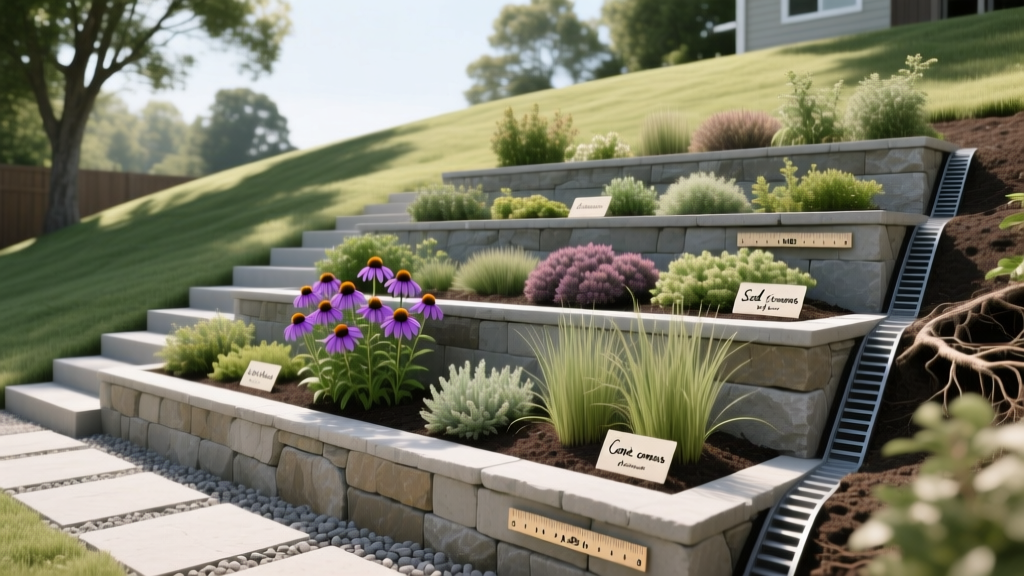
Building Tiered Garden Beds On Sloped Yard
Designing Functional and Aesthetic Terraces for Sloped Terrain
Grading a steep yard isn’t just about erosion control—it’s an opportunity to layer spatial experience, enhance biodiversity, and extend usable outdoor living area. Tiered garden beds transform problematic slopes into dynamic, multi-level landscapes that align with core principles of landscape architecture: hierarchy, rhythm, scale, and material continuity. According to the American Society of Landscape Architects (ASLA), terraced systems on residential sites exceeding 15% grade should integrate structural support, drainage redundancy, and plant-root reinforcement to meet safety and longevity standards (ASLA, 2022).
In practice, this means moving beyond simple stacked timbers. A well-executed tiered system considers sightlines from primary living areas, sun exposure across elevations, and vertical microclimates created by differential soil depth and aspect. For example, at the UC Davis Arboretum in California, terraced demonstration gardens use 24-inch-high retaining walls spaced 6 feet apart horizontally to manage a 28% slope while supporting native understory species.
Structural Planning and Dimensional Guidelines
Effective tiering begins with precise measurement and grading. Use a line level or digital inclinometer to determine slope percentage: a 30-foot horizontal run with a 9-foot vertical rise equals a 30% grade. ASLA recommends limiting individual terrace depth to no more than 10 feet for residential applications to maintain visual coherence and reduce hydrostatic pressure on retaining elements (ASLA, 2022). Each tier should be at least 24 inches deep to accommodate root zones for shrubs and perennials, with a minimum 18-inch-wide planting ledge.
Retaining structures must withstand lateral earth pressure. For tiers under 36 inches tall, dry-stacked stone or segmental concrete blocks rated for 4,000 psi compressive strength are appropriate. Tiers over 36 inches require engineered footings and geogrid reinforcement—consultation with a licensed landscape architect is mandatory per California Building Code Section 1003.2.
Material Selection and Cost Benchmarks
Material choice directly impacts long-term performance and budget. Here’s a comparative overview for a 120-square-foot installation (three 4’ × 10’ tiers):
- Pressure-treated pine (2×12) with galvanized steel spikes: $420–$580 total
- Segmental concrete blocks (e.g., Belgard Rivenstone): $890–$1,240 total
- Dry-stack fieldstone (locally sourced, 6–12” depth): $1,450–$2,100 total, including labor
Soil fill costs vary by region but average $45–$65 per cubic yard for screened topsoil blended with 30% compost. A single 4’ × 10’ × 18” tier requires 2.2 cubic yards—approximately $110–$145 in soil alone.
Planting Strategy for Vertical Microclimates
Slope orientation creates distinct ecological niches. South-facing tiers receive 6–8 hours of direct sun and benefit from drought-tolerant species; north-facing tiers retain moisture and support shade-adapted flora. Layering plant heights within each tier reinforces visual rhythm: groundcovers anchor edges, mid-height perennials provide seasonal color, and small shrubs define vertical structure.
For south-facing exposures, consider Echinacea purpurea (purple coneflower), which tolerates shallow soils and attracts pollinators, and Lavandula angustifolia ‘Hidcote’, requiring only 12 inches of well-drained soil. North-facing tiers thrive with Heuchera americana (alumroot), whose evergreen foliage persists in partial shade, and Polygonatum biflorum (Solomon’s seal), a native woodland perennial reaching 24–36 inches tall.
At the Brooklyn Botanic Garden’s Native Flora Garden, tiered installations use Ilex verticillata (winterberry holly) on lower, moister tiers—its 6- to 10-foot mature height provides vertical screening without blocking views from upper levels.
Drainage Integration and Soil Engineering
Every tier requires subsurface drainage to prevent saturation and wall failure. Install 4-inch perforated PVC pipe wrapped in landscape fabric behind the retaining face, sloping 1/8 inch per foot toward daylight outlets or a French drain system. Backfill the first 12 inches behind the wall with ¾-inch crushed gravel before adding soil.
Soil composition must balance porosity and nutrient retention. A recommended blend: 60% sandy loam, 25% mature compost, and 15% expanded shale (¼–½ inch particle size). This mix achieves a saturated hydraulic conductivity of 0.5–1.2 inches per hour—within ASLA-recommended ranges for planted retaining systems (ASLA, 2022).
Construction Sequence and Safety Protocols
Begin excavation at the lowest tier and work upward to avoid destabilizing higher grades. Excavate a 6-inch-deep, 12-inch-wide leveling trench for each wall base. Compact subsoil to 95% Proctor density using a plate compactor before placing base material. Verify level and plumb every 3 feet of wall length with a laser level and mason’s line.
Install root barriers between tiers when planting aggressive species like Buddleja davidii (butterfly bush)—its rhizomes can penetrate joints in masonry walls. At the Missouri Botanical Garden’s Climatron expansion, engineers embedded HDPE root barriers angled downward 15 degrees behind all retaining faces to redirect growth away from structural elements.
Maintenance Framework and Long-Term Viability
Tiered beds demand proactive maintenance: inspect weep holes quarterly, prune overhanging branches annually to prevent leaf accumulation in drainage lines, and replenish mulch to a 2-inch depth each spring. Monitor for bulging or leaning walls—any movement exceeding ¼ inch per linear foot warrants professional evaluation.
Perennial plantings should be divided every 3–5 years to sustain vigor. Species like Rudbeckia fulgida var. sullivantii ‘Goldsturm’ benefit from division in early spring before new growth exceeds 6 inches. Replace aged mulch with shredded hardwood or locally sourced arborist chips—avoid dyed mulches near edible plantings.
A properly engineered tiered system lasts 25–40 years. Segmental block systems installed per NCMA (National Concrete Masonry Association) guidelines show 92% structural integrity after 30 years in monitored Mid-Atlantic trials (NCMA, 2020). Dry-stack stone, when built with proper batter and interlocking, often exceeds 50 years—as seen in centuries-old terraces at the Royal Botanic Gardens, Kew.
“The success of any terraced garden lies not in its height or number of levels, but in how thoughtfully each tier responds to site-specific forces: gravity, water, light, and root pressure. Design begins where the slope meets the soil—not the blueprint.” — Dr. Elena Torres, Senior Landscape Architect, Harvard University Office for Sustainability, 2023
Performance Metrics and Verification Standards
Validate your design against measurable benchmarks:
- Maximum terrace width: 10 feet (ASLA Residential Design Guideline 4.7)
- Minimum setback between tiers: 3 feet for accessibility compliance (ADAAG §206.2.2)
- Soil depth above wall cap: minimum 18 inches for herbaceous plants, 30 inches for small trees
- Drainage outflow rate: ≥0.25 inches/hour during 10-year storm event (based on NOAA Atlas 14 data)
- Wall height-to-base ratio: ≤2:1 for gravity walls under 36 inches tall
Document all structural decisions in writing. The City of Portland’s Bureau of Development Services requires stamped engineering plans for any retaining wall over 48 inches tall—even on private residential property.
When executed with attention to soil science, structural integrity, and ecological appropriateness, tiered garden beds do more than hold back earth—they create legible, resilient, and deeply human-scaled landscapes. They turn constraint into choreography: one step, one root, one stone at a time.

