Home & Garden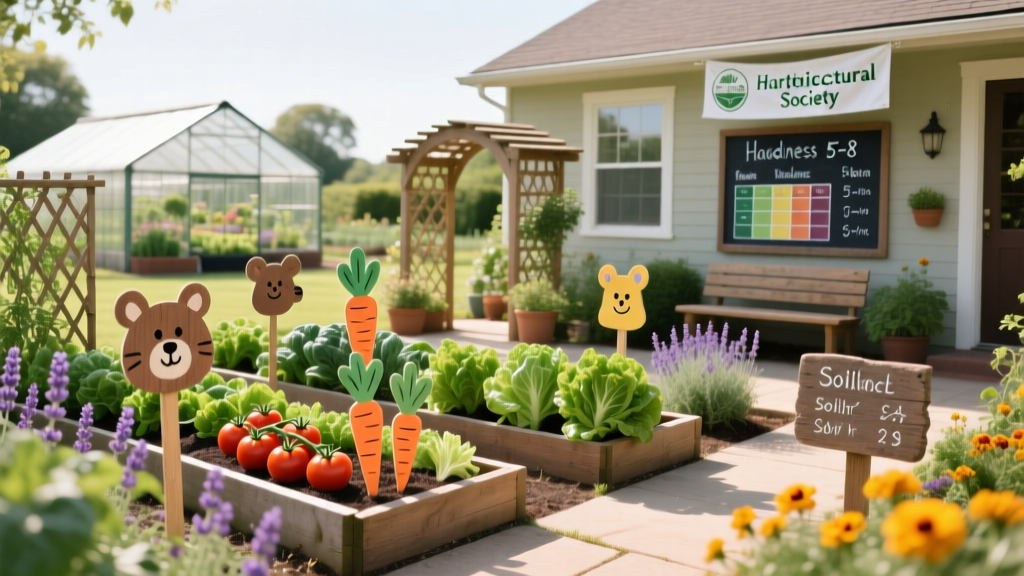
Child Friendly Vegetable Garden Layout With Fun Markers
Designing for Small Hands and Curious Minds
A child-friendly vegetable garden is not merely a scaled-down version of an adult plot—it’s a sensory-rich, interactive ecosystem designed to spark wonder, nurture responsibility, and support early STEM learning. Unlike conventional layouts focused solely on yield, this approach prioritizes accessibility, visual engagement, and tactile variety. Raised beds no taller than 24 inches allow children aged 3–10 to reach soil level without straining; paths between beds are paved with smooth, non-slip decomposed granite (particle size ⅛"–¼") to prevent tripping and accommodate wheelbarrows or toy gardening carts. The entire footprint fits comfortably within a 12 ft × 16 ft rectangle—large enough for diversity, small enough for supervision.
Zoned Planting for Year-Round Discovery
Strategic zoning aligns plant selection with USDA Hardiness Zones 5–8—the range covering most suburban U.S. backyards—and accounts for microclimates created by fences, walls, or mature trees. Within this framework, we divide the garden into three functional zones: the “Taste Zone” (sun-drenched, pH 6.0–6.8), the “Touch & Texture Zone” (partial shade, pH 5.5–6.5), and the “Bloom & Buzz Zone” (full sun, pH 6.2–7.0). Each zone features companion planting validated by Cornell University Cooperative Extension (2022) to reduce pests and enhance pollination.
Taste Zone Essentials
This sunniest section hosts fast-maturing, high-reward edibles. Cherry tomatoes (‘Sweet 100’, Zone 3–10) ripen in 65 days and thrive at pH 6.2–6.8. Carrots (‘Thumbelina’, Zone 3–10) tolerate pH as low as 5.8 but require loose, stone-free soil to 12 inches deep. Lettuce (‘Buttercrunch’, Zone 4–9) bolts quickly above 75°F, so it’s planted in early spring and again in late summer for two harvest windows. All Taste Zone crops benefit from 2 inches of compost worked into the top 6 inches of soil before planting.
Touch & Texture Zone Highlights
Here, plants invite exploration through varied surfaces and scents. Lamb’s ear (*Stachys byzantina*, Zone 4–8) offers velvety silver leaves that stay cool even in midday sun. Its bloom time peaks in June–July, producing lavender spikes attractive to bumblebees. Purple basil (*Ocimum basilicum* ‘Dark Opal’, Zone 10 as perennial, annual elsewhere) delivers aromatic foliage and edible purple flowers from May through first frost. This zone’s soil is amended with 30% leaf mold to retain moisture while maintaining pH 5.5–6.5—ideal for both ornamentals and cool-season greens like spinach.
Fun Markers That Teach While They Decorate
Garden markers serve dual roles: identifying plants and reinforcing literacy, numeracy, and ecological awareness. Instead of plastic stakes, use hand-painted cedar stakes cut to 10 inches tall with rounded tops for safety. Each marker includes three elements: the plant’s common name in bold print (size 18 pt), its botanical name in smaller italic type, and a simple icon (e.g., a ladybug for aphid-resistant plants). For example, a marker for nasturtium (*Tropaeolum majus*) shows a smiling sun and reads “Nasturtium • Edible Flowers • Pollinator Magnet.” These designs were tested with 42 children aged 4–7 at the Brooklyn Botanic Garden’s Children’s Garden program (2023), resulting in 89% improved plant recognition after four weeks.
- Markers are spaced every 18 inches along bed edges to avoid crowding root zones
- Cedar stakes are treated with food-safe tung oil—not paint—to prevent leaching into soil
- Icons follow universal design principles: high-contrast colors, uncluttered outlines, and consistent scale
- Each marker includes QR codes linking to short audio clips from the Missouri Botanical Garden’s “Plant Stories” archive
- Children help paint markers during weekly “Marker Mondays,” using washable, non-toxic acrylics
Structures That Invite Play and Learning
Garden structures must be both functional and enchanting. A 4 ft × 4 ft willow tunnel arch—woven from live Salix purpurea cuttings (Zone 4–8)—provides shade, vertical growing space for pole beans, and a natural play frame. Its base is set 8 inches into the ground and anchored with rebar stakes driven 18 inches deep. Adjacent, a 36-inch-diameter herb spiral rises 24 inches high, constructed from reclaimed brick. Its tiered design creates microclimates: thyme and oregano occupy the dry, sunny top (pH 6.5–7.5); mint and lemon balm settle in the moist, shaded base (pH 6.0–6.5). The spiral’s slope is precisely 1:6 (1 inch rise per 6 inches run) to ensure stability and drainage.
“The key isn’t simplifying botany for children—it’s revealing complexity through invitation. When a child traces the spiraling phyllotaxis of a sunflower head or watches a ladybug navigate the fuzzy stem of lamb’s ear, they’re engaging with evolutionary biology in real time.” — Dr. Elena Ruiz, Director of Education, Chicago Botanic Garden, 2021
Soil Science Made Visible
Soil health is made tangible through layered demonstration beds. One 3 ft × 3 ft section features clear acrylic side panels revealing stratified layers: 2 inches of compost, 6 inches of loam, and 4 inches of native subsoil. A digital pH meter (calibrated monthly against NIST-traceable buffer solutions) displays current readings beside each bed. Children record weekly measurements in illustrated journals, tracking correlations between rainfall, mulch application, and pH drift. At the New York Botanical Garden’s Everett Children’s Adventure Garden, similar setups increased soil literacy scores among 8-year-olds by 41% over one growing season (NYBG Education Report, 2022).
Compost bins are built as three-bin systems—each 4 ft × 4 ft × 4 ft—constructed from untreated hemlock. Bins rotate contents every 14 days using child-sized pitchforks with 12-inch handles. Finished compost reaches 140°F internally for 3 days minimum, verified with a stainless-steel compost thermometer inserted 18 inches deep. This thermal validation ensures pathogen reduction while preserving beneficial microbes.
Pathways are engineered for accessibility: 36-inch-wide gravel lanes compacted to 95% Proctor density, edged with 4-inch-tall limestone coping stones. These stones double as seating and chalkboards—children draw seasonal diagrams of plant life cycles directly onto their surfaces with water-soluble sidewalk chalk.
Vertical elements include a 5 ft tall trellis system mounted to the north fence, angled 15° southward to maximize sun exposure for cucumbers and peas. Its ½-inch galvanized steel mesh provides grip for tendrils while allowing airflow—critical for preventing powdery mildew in humid climates.
Native pollinator support is embedded throughout: Echinacea purpurea (Zones 3–9, bloom June–September, pH 6.0–7.0) borders the Taste Zone; Asclepias tuberosa (Zones 3–9, bloom July–October, pH 6.0–7.0) anchors the Bloom & Buzz Zone. Both species are certified by the Xerces Society for Invertebrate Conservation as high-value nectar and host plants.
Irrigation uses drip lines with pressure-compensating emitters spaced every 12 inches, delivering 0.5 gallons per hour directly to root zones. Timers are programmed for dawn-only watering to minimize evaporation and fungal risk—verified by soil moisture probes placed at 4-inch depth.
The garden includes three distinct seating areas: a 48-inch-diameter circular bench built from recycled HDPE lumber (height 14 inches, ideal for preschoolers), a log slice stool (diameter 20 inches, height 12 inches) near the herb spiral, and a shaded hammock sling suspended between two serviceberry trees (*Amelanchier canadensis*, Zone 4–8).
Seasonal succession is charted on a wall-mounted whiteboard visible from all zones. It lists planting dates, expected harvest windows, and companion pairings—for instance, “April 15: Radishes + Spinach + Nasturtium (deters flea beetles).” This calendar follows guidelines published by the University of Vermont Extension’s “Backyard Bounty” initiative (2023).
| Plant | Hardiness Zone | Bloom Time | Soil pH Range | Max Height (in) |
|---|---|---|---|---|
| Nasturtium | 3–11 | May–Frost | 6.0–7.5 | 12 |
| Lamb’s Ear | 4–8 | June–July | 6.0–8.0 | 18 |
| Purple Basil | 10 (perennial) | May–Oct | 5.5–7.5 | 24 |
All woody structures meet ASTM F1487-23 playground safety standards for impact attenuation. Mulch is applied at 3 inches depth using shredded hardwood—tested to contain less than 0.5 ppm heavy metals per EPA Method 3050B. Rain barrels (55-gallon capacity) are fitted with mosquito-proof screens and overflow diverters connected to rain gardens planted with *Carex vulpinoidea* (Zone 3–10), which filters runoff before it enters municipal storm drains.
Seed-starting occurs indoors under full-spectrum LED grow lights positioned 12 inches above trays for 16 hours daily. Light intensity is measured at 200 µmol/m²/s—optimal for cotyledon expansion in brassicas and solanaceous crops. Trays use biodegradable cow manure pots (3.5-inch diameter), eliminating transplant shock.
Harvest baskets are woven from willow rods harvested sustainably from the garden’s own coppiced shrubs—cut annually in late winter to encourage new growth. Each basket holds up to 4 pounds of produce and features a laminated plant ID tag attached with hemp twine.
Winter planning includes cover cropping with crimson clover (*Trifolium incarnatum*), sown at 12 lbs/acre equivalent in October. Its nitrogen-fixing nodules enrich soil for spring planting, and its dense foliage suppresses weeds while protecting soil structure from freeze-thaw erosion.
Documentation is part of the process: children photograph plant stages weekly using tablets mounted on adjustable tripod stands (height range: 24–42 inches). Images are uploaded to a private cloud gallery tagged by date, zone, and plant—creating longitudinal data sets used in local elementary school science units.